
Seasonal
« Previous Entries Next Entries »Polypore Fungi finished
Thursday, November 1st, 2007
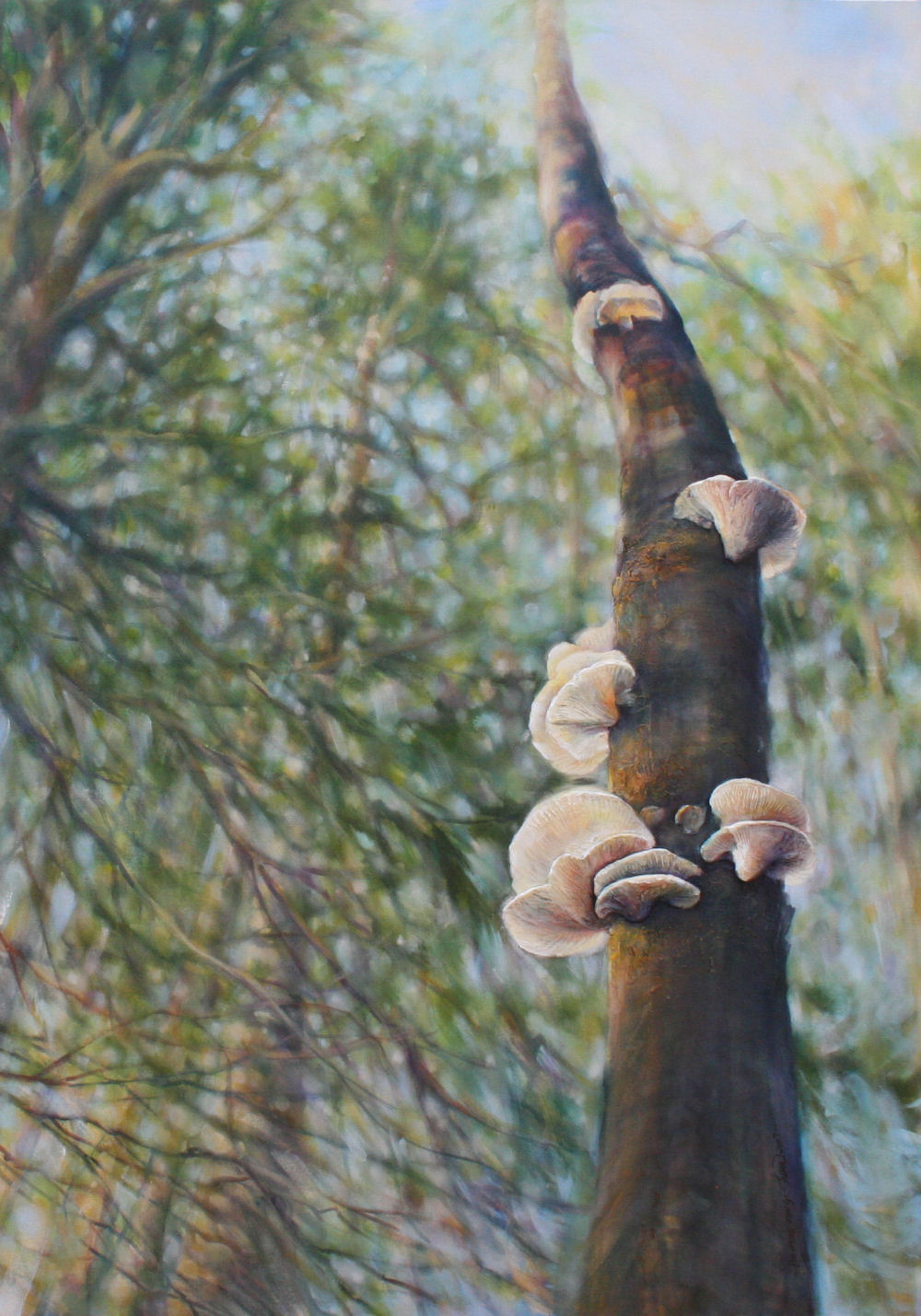
Polypore Fungi finished – 58H x 41W x 1.5D inches, acrylics, modeling paste, plaster on canvas, wrapped sides painted, narrow frame
One of the goals for this painting was to see if a composition could remain balanced with the main subject offset to the right. With Petra’s suggestion there is more contrast, also scrubbed some paint away for more background to show through.
Mushrooms, bacteria, molds, lichen and other non-flowering plants are lesser appreciated life forms that help maintain the healthy life cycles of forests by aiding the decay and conversion of plant and animal matter into nutrient-rich soil.
‘Tis the season
Tuesday, October 30th, 2007
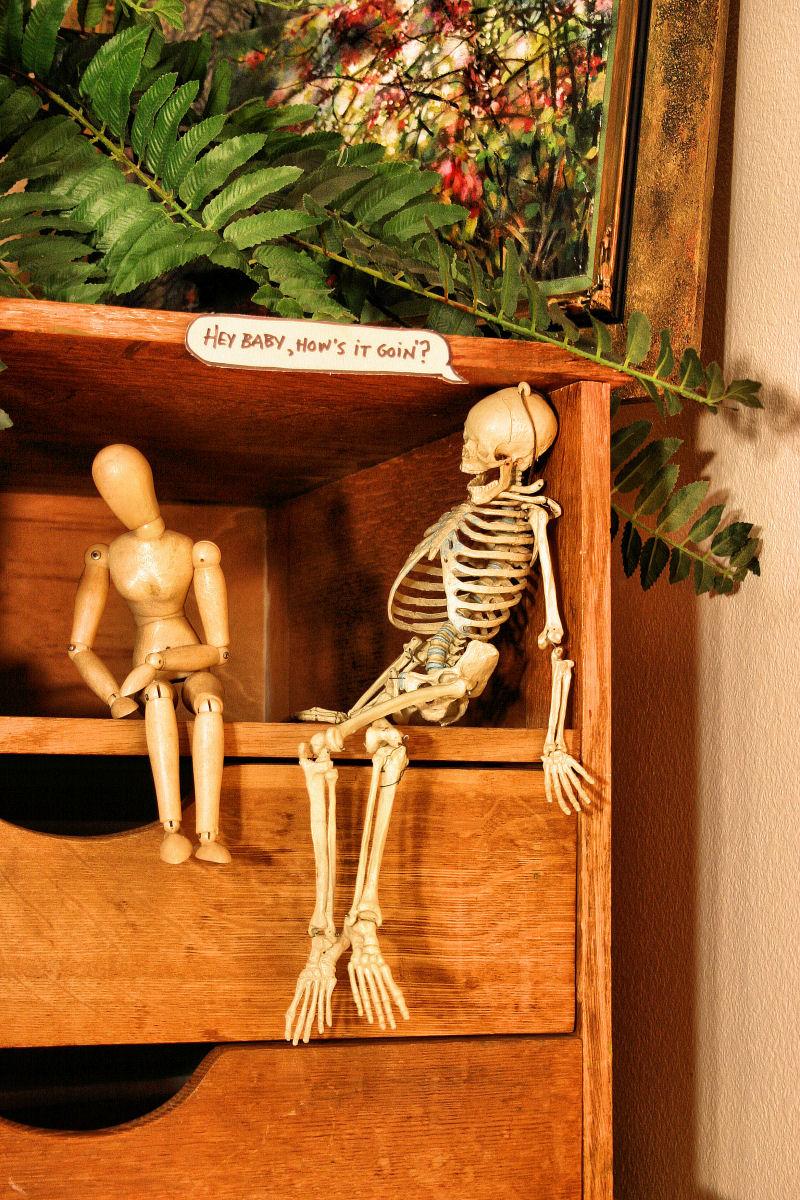
“Hey Baby, How’s it goin’?”
Changes to Polypore Fungi
Monday, October 29th, 2007
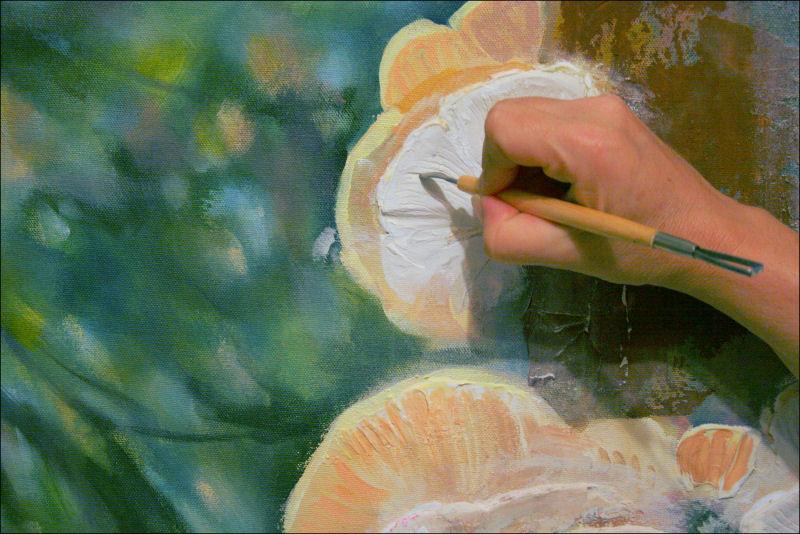
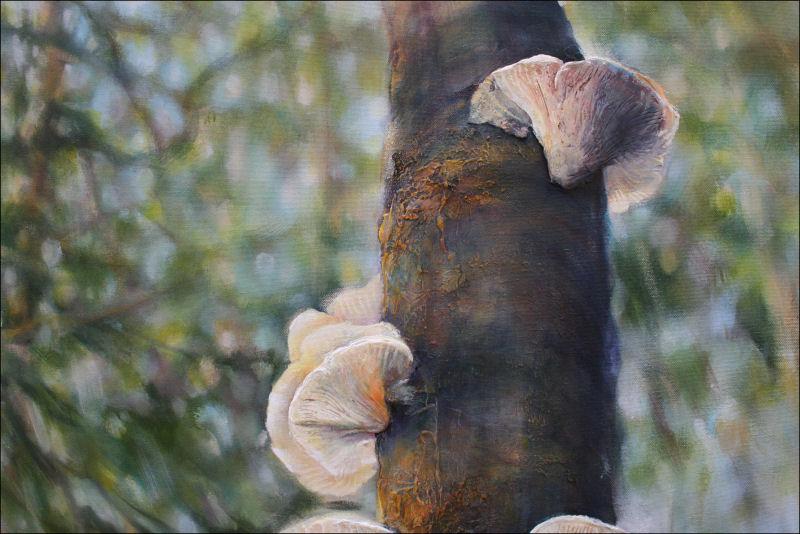
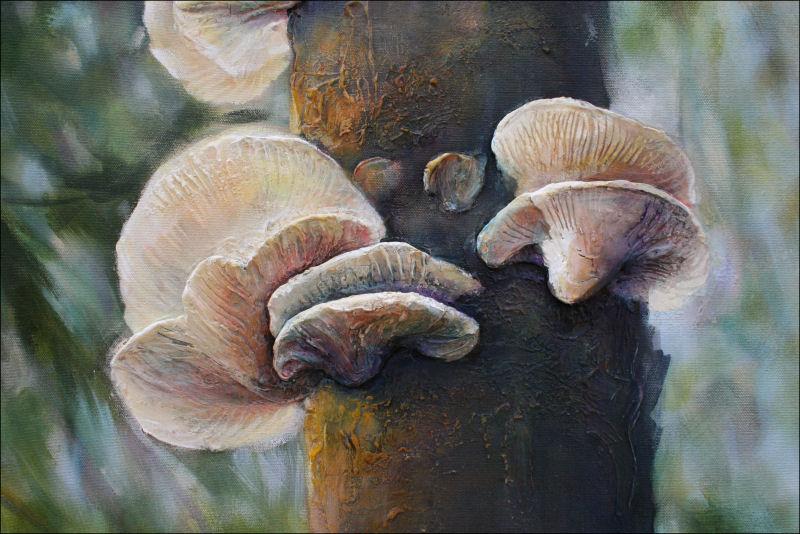
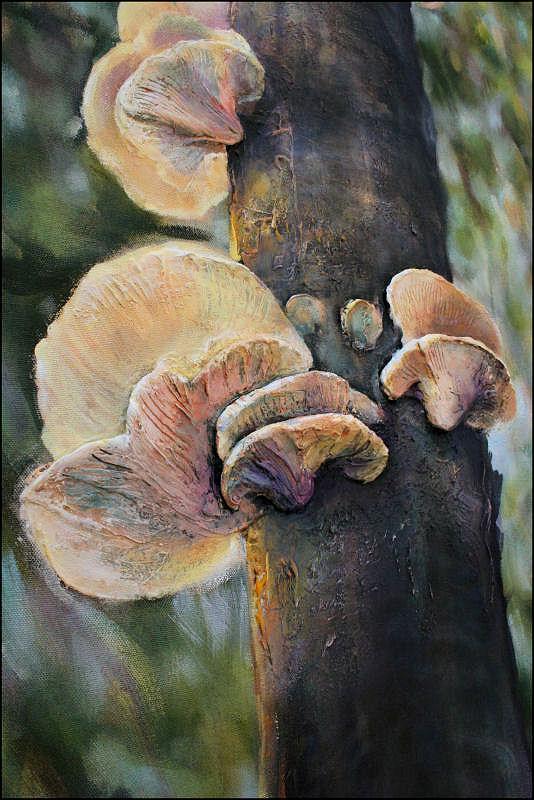 The 3D fungi idea was fun to try. The canvas absorbed moisture from the modeling paste, so the faux fungi are permanently incorporated and will not fall off. It was carved after drying, being too goopy to manage while wet. The paste was applied then built gradually, dried before applying more, sanded, scraped and carved to define areas. Commercial modeling paste does not sand well, so a tiny bit of plaster helped to tidy it.
Polypore Fungi, work in progress
Monday, October 22nd, 2007
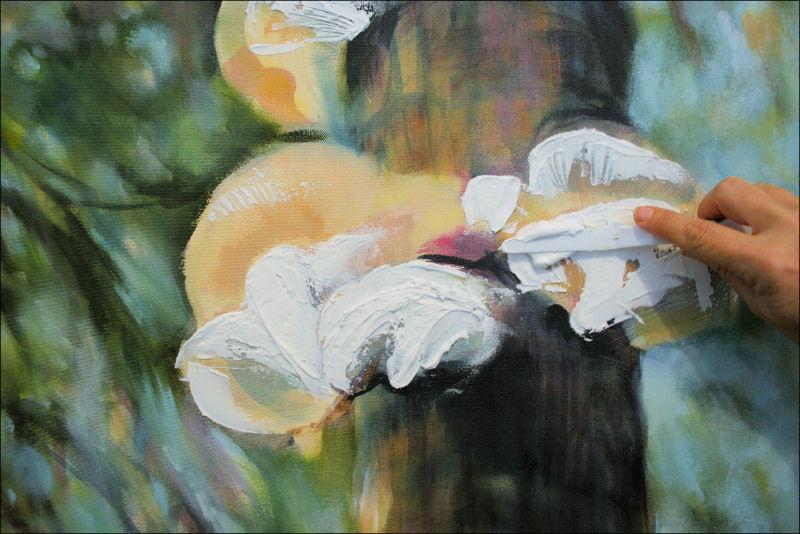
Polypore Fungi, 59H x 41W x 2D, acrylics on canvas, work in progress. Started in June, hung and studied in the loose-phase state; cautious about overworking it. Plans this week: most everything will stay out of focus, with details only on the fungi using a little modeling paste to sculpt. Modeling paste is applied in layers, drying in between, becoming permanent and adhered well to the canvas. Applying too thick at once creates cracks and unstable structures.
Water strider
Sunday, October 21st, 2007
Polypore Fungi, 59H x 41W x 2D, acrylics on canvas, work in progress. Acrylics painting started in June, hung and studied in the loose-phase state; cautious about overworking it. Plans this week: most everything will stay out of focus, with details only on the fungi (starting that next), using a little modeling paste to sculpt the fungi.

Watching the water-striders in the pond in our back yard pond. Interesting that it is so weightless, yet with enough mass to be able to walk on water.
Dandelions In the Tulips
Friday, October 19th, 2007

 Dandelions in the Tulips, 16 x 20 inches acrylics on canvas with maple wood frame stained dark with red trim design, total size 22H x 28W inches. Available with or without the frame.
Simply “Tulips” as a title would have been too obvious. Dandelions are persistent. Likewise, I’m pleased to have persevered through the course of painting this one; it went through many changes and I learned a lot. Gradual build-up of textures and colors, layers of piling on, scrubbing off and reapplying paint — those parts show through. Painting with pure color in Firewheels, plus grey scale drawing earlier this year really contributed to finding a way to finish this painting. Next two thumbnails show phases of work in progress:


Firewheels
Saturday, October 13th, 2007

Firewheels 18H x 24W x 2D inches acrylics on canvas, wrapped sides painted with scene extending onto the narrow frame.


Thumnails: masking medium, usually used for watercolor paintings, was applied with a toothpick, first image. After being painted it was rubbed off, revealing abstract scribbles and areas of pure color. A time limit was set for this one to be done by the end of today, something I don’t normally do, but the restrictions ensure that it doesn’t get overworked.Next, Firewheels finished and successful in that I was able to stay away from the desire to perfect everything.
This painting was showcased in The 23rd Texas & Neighbors Regional Art Exhibition, April 26 – May 24, 2008, Irving Arts Center, Irving, TX.
Firewheels work in progress
Friday, October 12th, 2007

Firewheels, 18H x 24W inches acrylics on canvas, started
I started a small painting last night that I’ve been wanting to do since Spring, of Firewheels (Gaillardia). Masses of them come back every Spring in a nearby field.
Male Cardinal
Saturday, October 6th, 2007

Male Cardinal at the Dallas Arboretum, Dallas TX, 24H x 24W inches acrylics and masking medium on canvas, trim frame. Sold.
Cardinals are one of my favorite subjects. On walks I see them in the open, but good photos of them are elusive, as they hide just beyond the branches so perfect shots are next to impossible. Branches here are partially in front, placed around the bird in the abstract shape of a nest. The cardinal in the painting really is that chubby. He is well fed at the Dallas Arboretum.
There were two separate applications of masking medium, used traditionally in watercolor paintings. Second phase: trying to highlight the bird’s interaction with its environment and hoping to find a way to do more than provide the expected sort of cardinal portrait. Adding Pthalos Blue wash changes the mood and the season, maybe even the time of day…interesting what one or two brushes of color can do.
 One male Cardinal returns regularly to our yard with his mate who chirps quick, sharp notes. I discovered this when thinking that our air conditioner needed servicing, and going out to see what the consistent squeaking was. The pair laid eggs in one of our back yard bushes during May this year. I half-hoped the eggs would be red! The nest was made to perfection with a tightly woven bowl of dry grass, leaves, twigs, and pieces of plastic garbage, so artfully crafted.
North Carolina
Monday, October 1st, 2007
 Alain and I flew to North Carolina for three days ( a little business trip and I tagged along—he threatened to take my camera with him and I was sure I could not manage without it!) We drove around the eastern countryside between Raleigh and Washington (NC) through old, old towns (it takes a looong time for wooden doors to shred, and a looong time for conditions to be just right for vines to sprout then twirl round and round, entwined and squished between panes of glass!) …old, old farms: tobacco, cotton, peanuts.. and an interesting gas station.
 There is a lot of history in NC – fossil, human/settlers and Civil War history. We stayed at Kitty Hawk (first flight – Wright bros.) and walked the shores at various places along the narrow coast of the Outer Banks. We watched the sun rise and dolphins feed – too far away for good photos, even with the telephoto. As soon as the sun rose they swam away.
Along Cape Hatteras, groups of Grackles ate ripe grass seeds, bouncing up and down on the stems, their bodies too heavy for the tall grasses.

On Pony Island a large sand crab tried to buff up and look tough, but it was quite vulnerable there out in the open; all the other crabs scurried into holes but this one stayed, trying to hide in footprints, which offered no protection if we had been birds looking for a hearty meal.
Great fun to watch the behavior for a while. It’s clearly outlined crab-shaped shadow following it everywhere, creating a few graphic photos that are perfect resource material for drawings and paintings but do not stand alone as good photography because it was moving so fast.

Just off the 2 1/2 hr. long ferry at Swan Quarter, and sunset with a short, wide rainbow after a storm that we managed to escape and watch from the better side.
NO OLF – we were curious about this sign in many people’s yards. The following website shows a video describing how the U.S. Navy has purchased over 30,000 acres of land near the eastern North Carolina coast, planning to move their pilot training program from Virginia.

Part of the huge controversy is that over 75 families would be forced to leave their homes, many of them farming that land for generations. The human issues are enough, but the cause and effect on the wildlife and ecology would be drastic and irreparable. Thousands of ducks and large flocks of snow geese that feed in the area annually would no longer have sanctuary. The large birds would also be a danger to the jets.
http://www.youtube.com/watch?v=3XDmC1LD1Kc
« Previous Entries Next Entries »