
history/multicultural theme
Next Entries »Magic Hour – work in progress
Thursday, July 24th, 2008
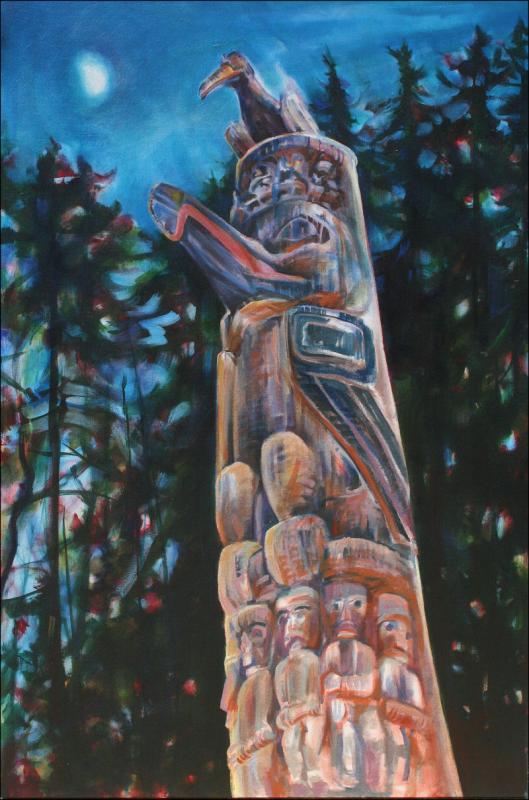
Magic Hour, 60H x 40W x 3D inches acrylics on canvas, work in progress.
Art history is human history. What we call Art is the expression of individuals finding connection with our humanity; who are we? How do we respond to our surroundings and who are we in relation the things we depend on for survival? Standing in front of the Totems I realized that the answers we sought long, long ago are the same, and the things we love now are the same things people have always loved. As Artists and Art Viewers we’ll never venture far from subjects that speak to the heart.
The originals of all the totem poles erected in Thunderbird Park on the grounds of the Royal BC Museum in Victoria, Canada are now protected from the effects of weather inside the museum. The totem portrayed in this painting is a replica of the Gitxsan Pole that was moved in 1958 from Kitwankool, BC. This version of the pole is named Skim-sim and Will-a-daugh, belonging to Chief Wiha (Wee-kha, Ernest Smith), the chief of the Wolf Clan: only the top 3/4 of the totem is portrayed. Due to deterioration caused by weather, the originals of all the totems in Thunderbird Park are now erected inside the museum and are replaced with replicas carved by Mungo Martin, chief carver, Henry, Tony and Richard Hunt (this one 1960).
Symbols/crests: The bird at the crown is a giant woodpecker (wee-get-welku). Legend reads that a female ancestor kept a pet woodpecker, feeding it so much it grew to be a giant monster that ate everything made of wood until it was killed. It sits atop 5 human figures who stand on the head of the Mountain Eagle (Skim-sim), who kidnapped and mated with a woman then devoured their offspring. The eleven small figures are humans fishing through holes in the ice. Under them and not pictured in the painting is Will-a-daugh, also known as “Person With a Large Nose”, holding her child who was conceived from a wood grub.
Magic Hour started
Thursday, July 17th, 2008
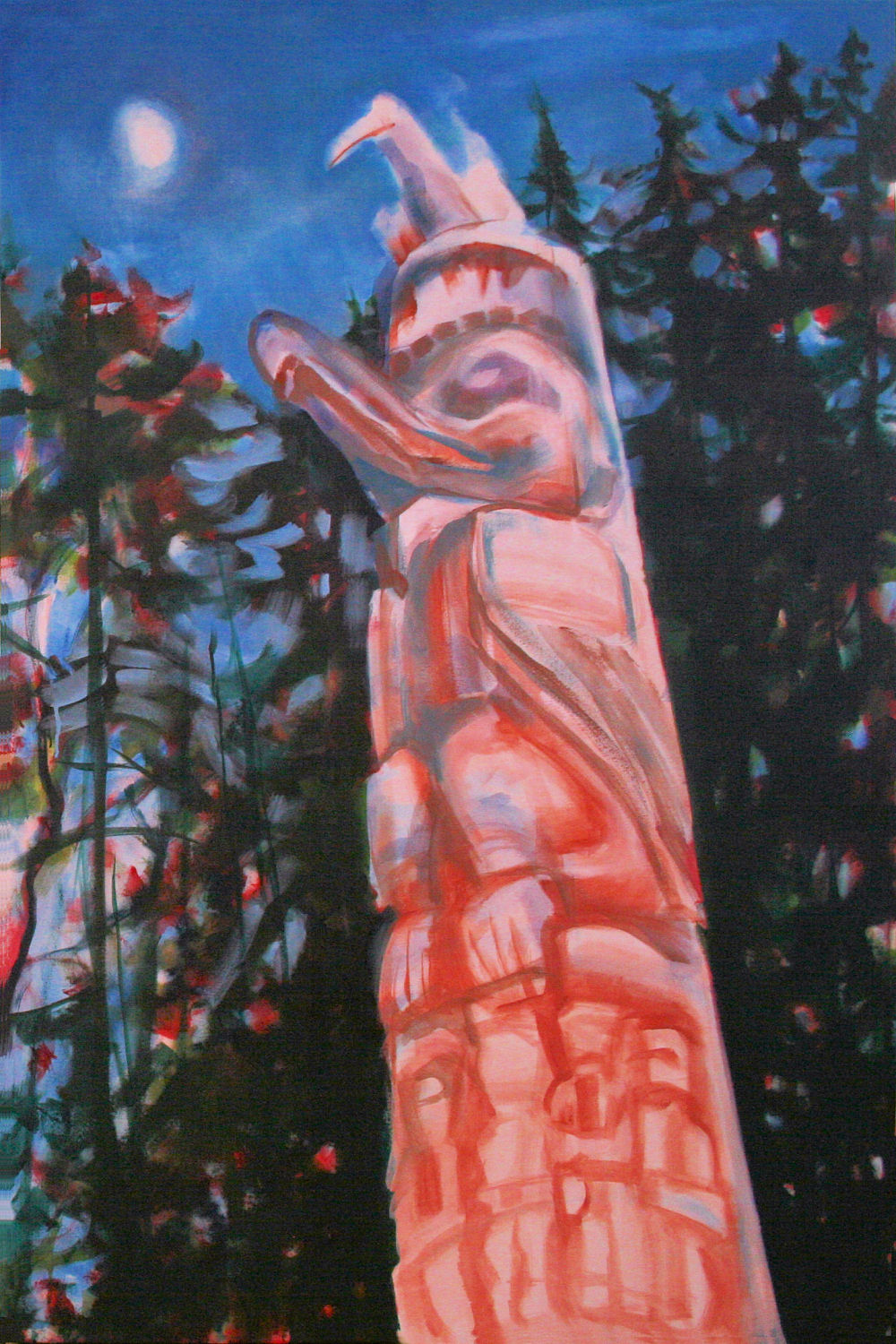
Magic Hour, 60H x 40W x 3D inches acrylics on canvas, wrapped sides painted, work just started. This is the top half of the magnificent Gitxsan Totem pole, one of the Haida totems in Thunderbird Park near the Inner Harbor downtown Victoria, B.C.
The drawing is sketched with Alizarine Crimson and Red Oxide base. We were there a week ago just as the sun set, shining light on the right side of the totems and rising moon light lit the left side. I changed the tree silhouette to a typical B.C. horizon of tall Red Cedar, whereas the trees in that park are Maples.
Pre-Columbian Jaguar Beads
Thursday, February 1st, 2007
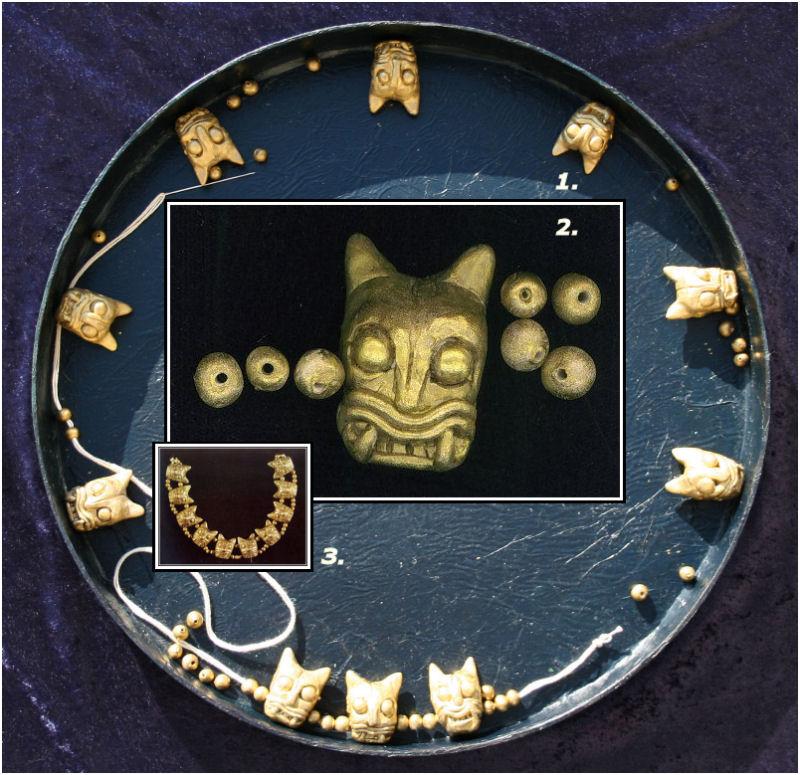
1. the tray 2. the beads 3. a picture of the original necklace.
The Pre-Columbian Jaguar Beads are made of Polymer clay, a permanent material once baked, acrylic paints, varnish, tray re-purposed and paper-mached, painted and varnished for durability.
I was drawn immediately to this Pre-Columbian Mayan necklacewith jaguar beads upon seeing a photo of it, and would love to own it. Well, making one is the next best thing! The original necklace of gold jaguar head-shaped beads was made over 500 years ago, discovered in a tomb in Guatemala.
Like much of the pre-historic and tribal art that looks crude or seems like it should be easy to recreate, there is a lot more here than meets the eye. One of the things that’s so enjoyable about a project like this is experiencing the same design dilemmas that the original artist might have encountered.
There is a lot of good design in that simple-looking necklace! I think the goldsmith who created the original might have used a mold because each individual jaguar head-shaped bead needs to be identical, and so do the small round ones in order to string the beads together and obtain the exact uniform semi-circle shape. Mine were individually shaped, less than perfect, and did not fit together well unfortunately. I’ll need to make a mold from one of the more perfect beads in order to replicate this with consistancy.
The jaguar beads are glued onto a useful tray, a recycled film case that was paper mached then painted with acrylic, and it’s as if a moment in time is recaptured, a moment when the original artist had beads on a surface, ready to be strung together. The refurbished tray is varnished, durable and useful. Hand wash gently with damp soapy cloth, and the crevices with a wet paintbrush, dabbing the area softly to absorb excess moisture.
Ancient Mayan Bowl Chair
Thursday, March 30th, 2006
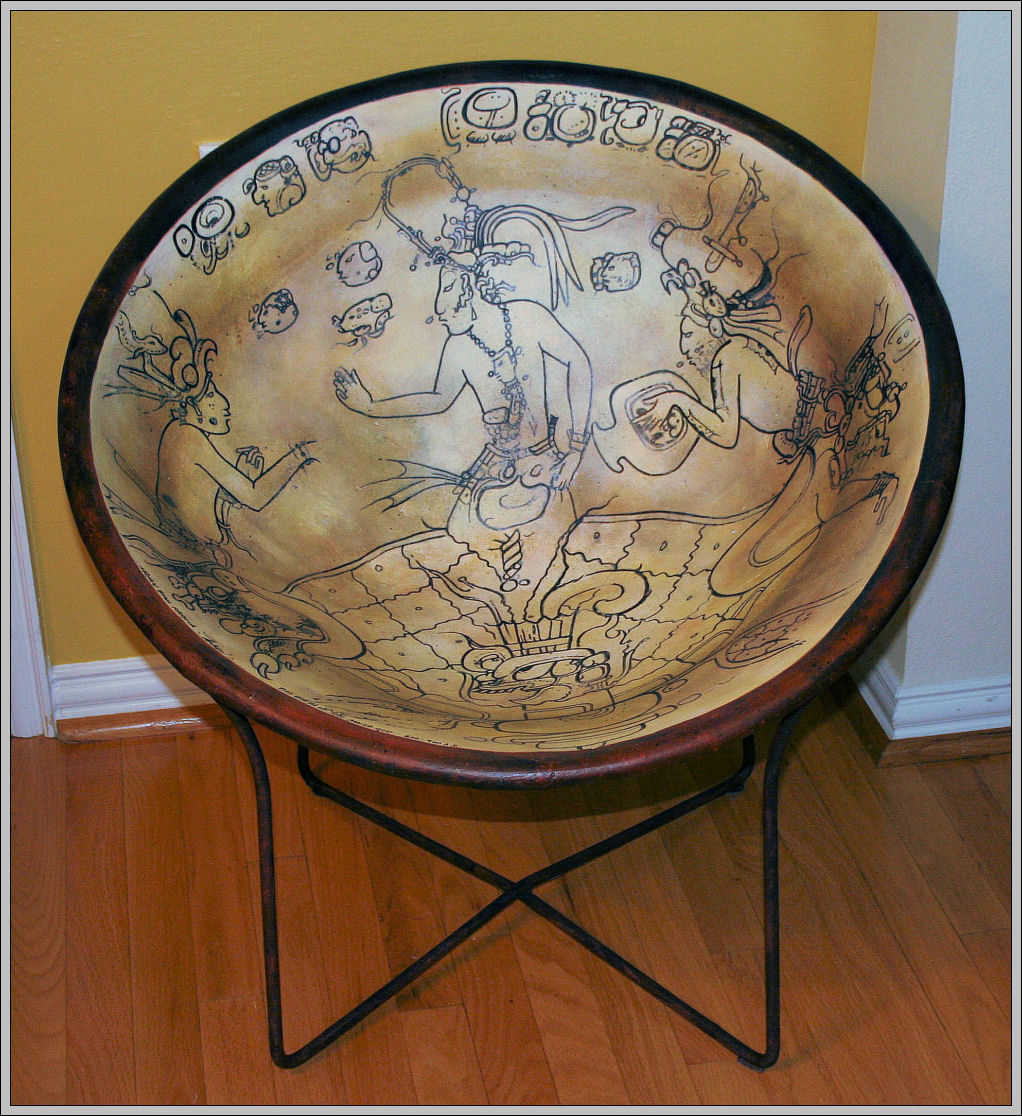
Mayan Bowl Replica Chair, 29H x 29W x 29D inches durable, functional, comfortable refurbished vintage 1960’s plastic lawn chair, mixed media: woven canvas strips, plaster cured and painted, varnish and wax.
This replica of an ancient Mayan artifact re-utilizes a vintage plastic lawn chair that was considered Art in its own day. The refurbished chair was created by a process of weaving canvas strips and white glue paper-mache style over the entire plastic top and bottom, layering wall plaster sanded in between coats, acrylics paint, varnish, graphite, marker, more varnish, then waxed for durability. Three more chairs are yet to be created with historic Art themes from other cultures.
The original bowl design is from the Late Classic Period of Mayan history, 600 – 900 A.D. Common Era, portraying two water Gods witnessing the birth of the all-important Maize God who emerges from a turtle, symbol of the earth and origins thereof. Customarily, hieroglyphs written along the top rim show the bowl-owner’s name and what the bowl was used for.
Inspirational resource: Maya, Divine Kings of the Rainforest edited by Nikolai Grube ISBN 3-8290-4150-0
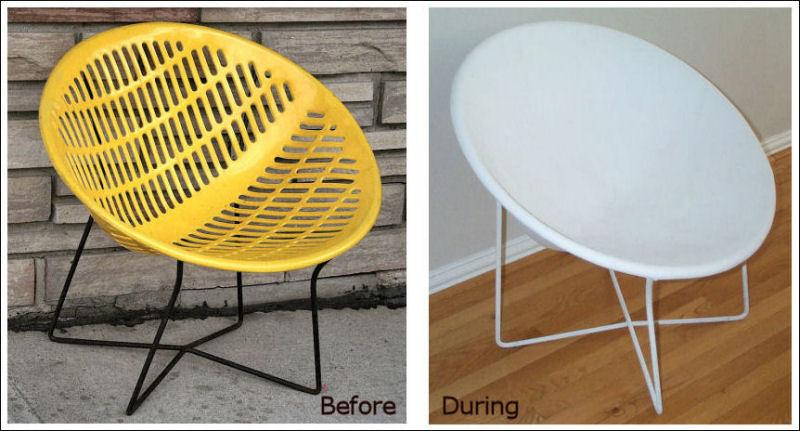
Post-dated notes: Accepted into Grand Prairie Arts Council Juried Exhibition and Sale Sept./Oct. 2007, and won Second Place cash award, 3D Category. Also accepted into Artjury.com’s 2007 Fall/Winter Juried Online Exhibition.
Next Entries »