
animals
« Previous Entries Next Entries »Perpetual painting
Monday, October 5th, 2009
Like music
where silence between the notes sets the rhythm,
not painting is half the work.
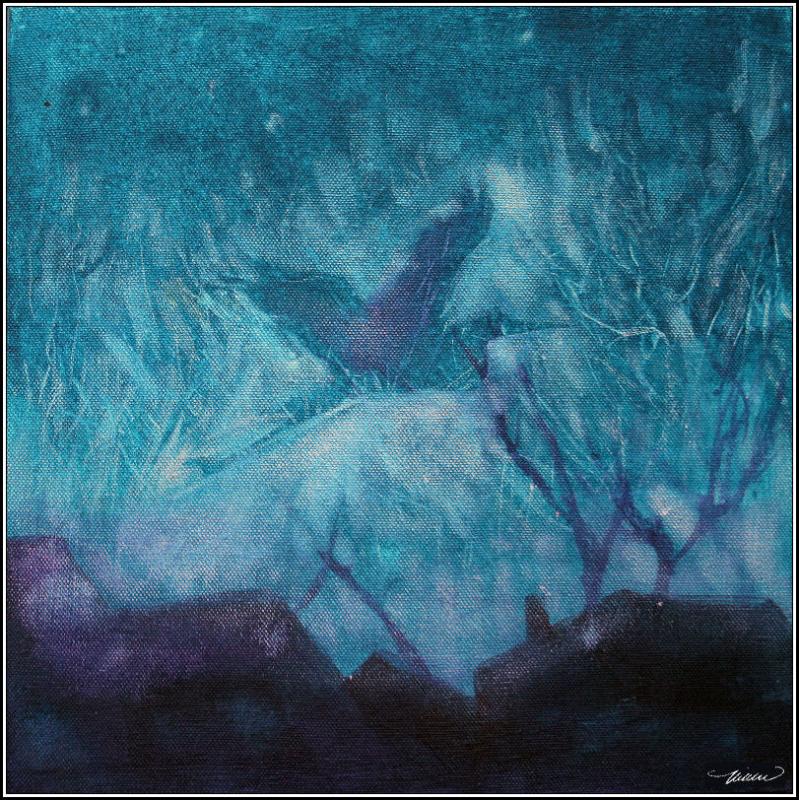 For all artists, the most mysterious question of all might be “is it finished?” , but for the sake of clarity and the examples here I’ll just refer to painters. One popular opinion is that the best painting is one that’s finished quickly; one that retains the artist’s first fresh impressions, otherwise it should be painted over or tossed in the garbage and a new one started immediately. There are solid reasons for not lingering too long on a painting, but in matters of the Art I’m always suspicious when I hear the word should being used in a sentence containing advice. Some art rumors are accepted as absolute when they could stand some explanation. It can be confusing enough for the experienced, but especially for beginners looking for ground rules and a map to follow.
In Art though, for every should there is another option. The same suggestions don’t work for everyone. Have you ever felt guilty or embarrassed – even ashamed – because you took a painting too far? I have, but it’s only when I’ve compared my work and methods to others’ judgment that I should’ve quit while I was ahead…and guilt has no business hanging around in our daily work if it isn’t useful! Frustration can be an excellent motivator if it’s allowed to be.
If it’s going to make sense – not exclusively the sole intention – every painting reaches stages where we need to make the call to leave it alone and say it’s finished, or proceed; stages where placing one more mark means the entire painting has to change and be brought up to par around it. If things that need correcting are not dealt with honestly, the work will not be as successful as it could be. There are phases in each painting that are truly intimidating, when painting is anything but leisurely; when we’re faced with: do we climb that mountain or not?
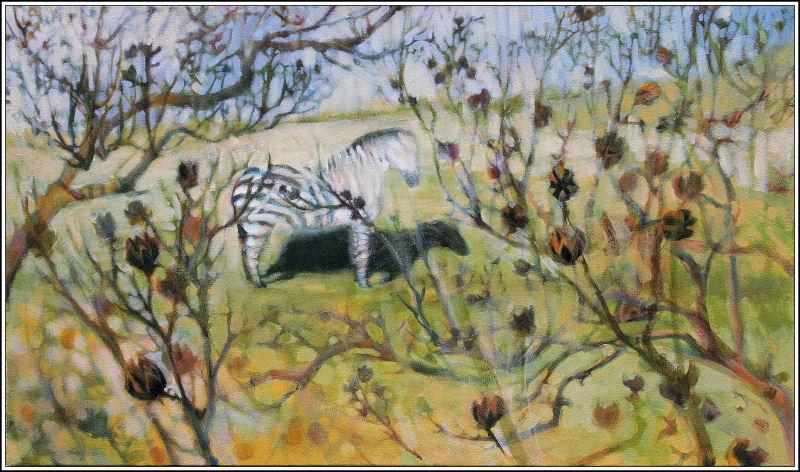
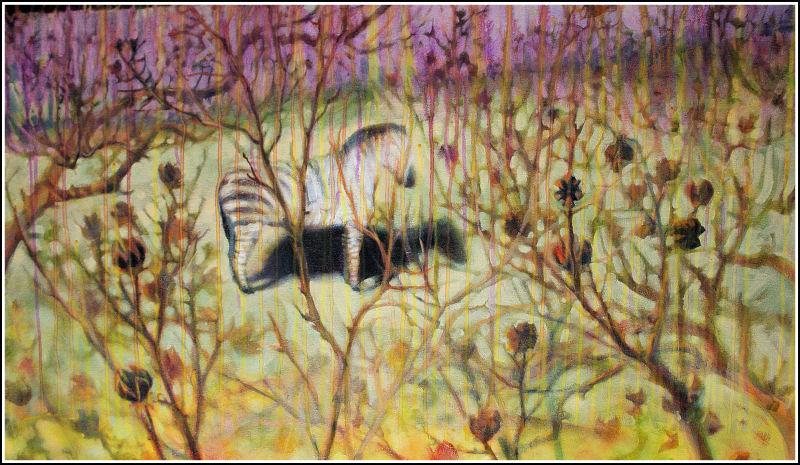
A lot of Plein Aire artists swear that their methods of painting outdoors on-site produce the highest quality work. The limitations of sunlight, location, outdoor temperatures and so on, mean that to finish successfully they need to splash down a lot of information within a short period of time. Doing so, when the thinking brain is disengaged and just responding to the subject, a lot of amazing unintentional surprises show up in the painting. Spontaneity and spurts of enthusiasm for being fully in the present tense can bring great results that need no further efforts at the end of the day. Plein Aire artists are in a field of their own (literally too!).
It’s a curious thing how creativity warps and reforms into amazing things when pressure is applied. Many people who aren’t artists will agree that the greatest ideas can occur when under pressure to produce them. For those who have orders to complete, at its best the challenge is like a beautiful sort of panic, where there’s an understanding of the time restrictions while fully trusting that whatever needs to happen is going to be successful. The abilities are less trustworthy when the pace and demand for finished work increases, time allotted decreases and the quality of the product diminishes. If this imbalance continues over extended periods of time, like years, sloppy and care-less habits take hold too easily. If there is work that must be accomplished though, these things can be controlled to some extent –this is one benefit of pushing personal boundaries: it puts tenacity to practice – but creativity is fickle and that’s a fact.
What has all that got to do with the question about finishing? The best paintings are not necessarily those that are finished in a few hours or a day. There are other purposes for painting besides finishing it to admire, be admired or to sell. Nothing replenishes the quality of our creative energy like being lost in the timeless, pure enjoyment of study and detail for no reason in particular. “The Zone” is like an addiction where the high is fairly elusive but we’re compelled compulsively to track it down again and again, discovering and rediscovering the source of it all. One painting could be someone’s lifetime of work.
I’m saying that if you personally feel you’d like to keep going with a painting for days or years… or never finish, then you ought to follow your own intuition about it. I’m not saying you should. I just recommend considering what other artists say, but also consider each painting as a new experience with new rules, new goals and new circumstances.
Experience, masterpiece to failure, will always apply to future work somehow. That’s the great thing about painting: no time spent searching for answers is ever wasted. It’s all recyclable material! Every decision about finishing – or not – is relative to individuality, and relative to each new painting as it develops your way.
Pushing the boundaries
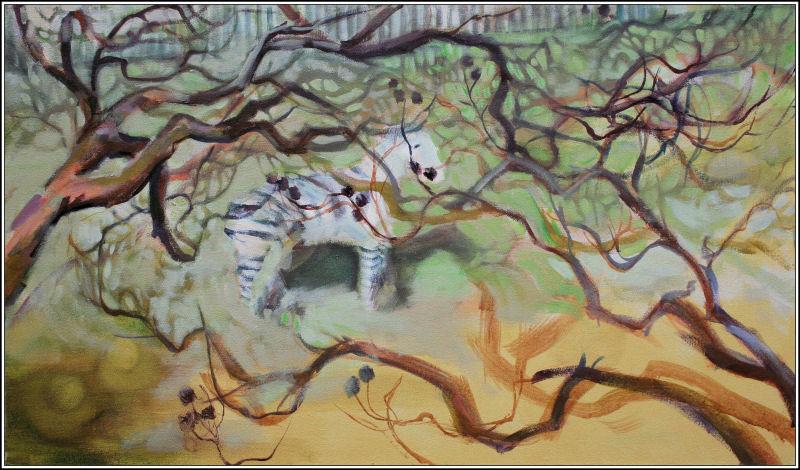
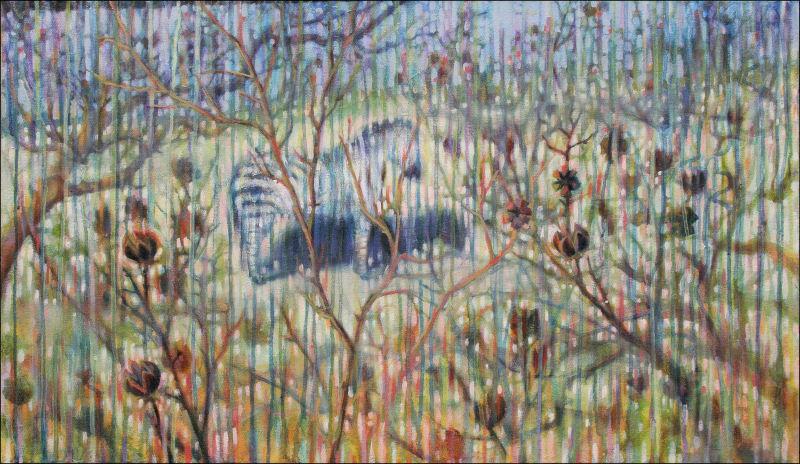 Myrtle At The Zoo, first version, Phase 18, unfinished – Crepe Myrtle branches and seedpods – 20 x 34 x 2 inches acrylics on canvas, gallery wrapped.
Work daily March 10th through April 2nd, 2008:
Finished for now…this one needs a rest, and I may or may not return to it. Regardless, I’ve learned a lot ad enjoyed playing with different ideas. It’s been interesting teetering back and forth between frustration and fun, but sometimes that’s what painting is all about. There’s been such a tension over this one as with no other painting, where the urge to throw it away is pitted against the determination to see what could happen. I still like a lot of things in it, such as the technique of dripping paint down the front that I’ve tried in previous paintings. Dripping re-energized the painting and me, and took the work in unexpected directions.
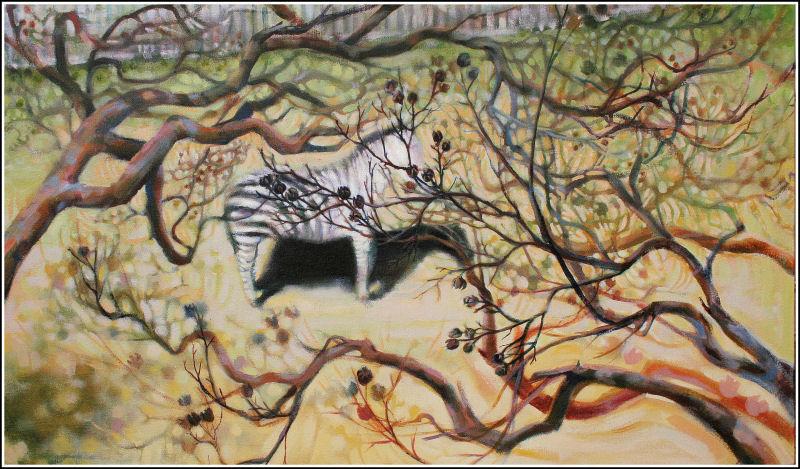
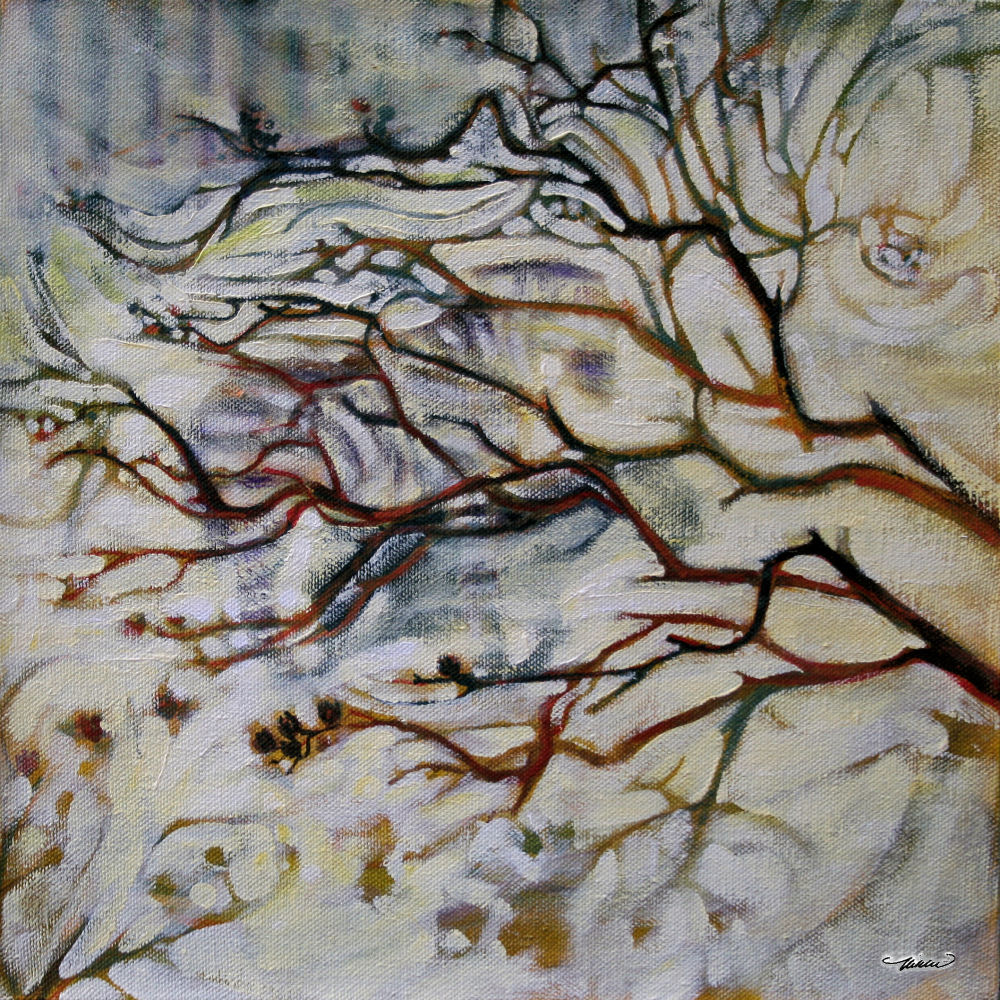 Myrtle At The Zoo, 2nd version – 11 x 11 x 3 inches acrylics on canvas, gallery wrapped sides painted. Many of the issues were worked through on the previous larger version, and I’m pleased with this boxy little painting…still not completely satisfied that I’m finished with this subject because it’s so complex, and it’s like a puzzle that’s nagging at me to figure out, so will probably attempt this same painting at least one more time.
Perpetual painting
Painting animals with distinct and specific characteristics calls for a different approach from start to finish, for example, compared to generic landscapes. The boas are one of my favorite exhibits at the Dallas World Aquarium, downtown Dallas, Texas. The phosphorescent green skin has striking black and white scale patterns along the spine and a turquoise mother-of-pearl overall sheen that’s most visible at certain angles where the body delicately curls and bends, so this painting accumulates finer detail than is typical of my work, except in graphite illustrations.
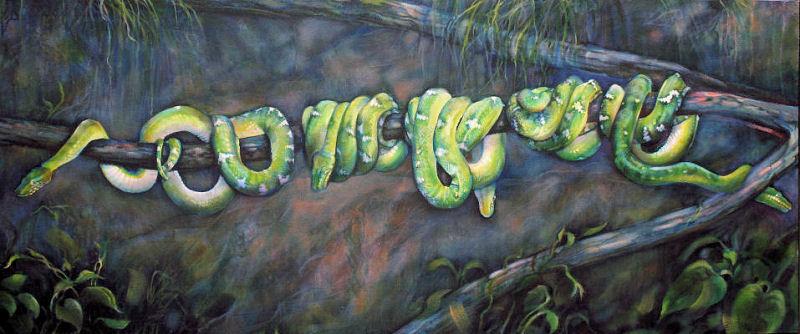
Emerald Tree Boas, 24 x 57 x 2 inches acrylics on canvas, wrapped sides painted (August, 2005 – ? )
As shown in the thumbnail above, there are only a few small things left to do, a little on the skin then some barely visible brushstrokes in the background like ones that were there in earlier phases, thumbnail…so it really is just about finished, but I’m not in any hurry. Of course I’ll stop in my tracks if you want to buy it!
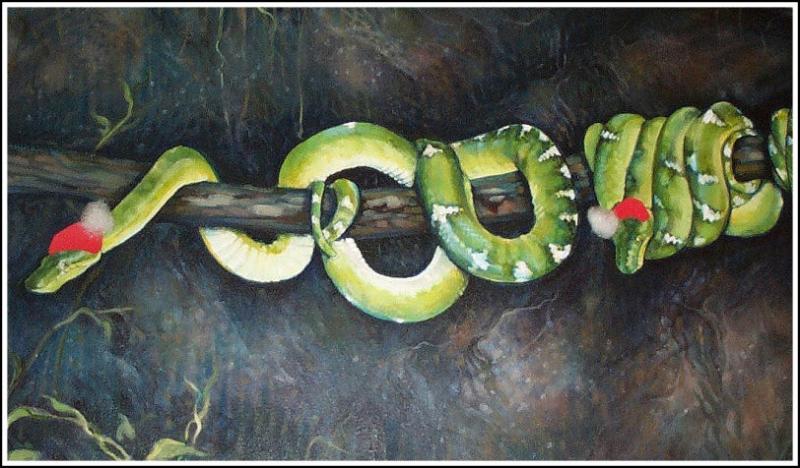
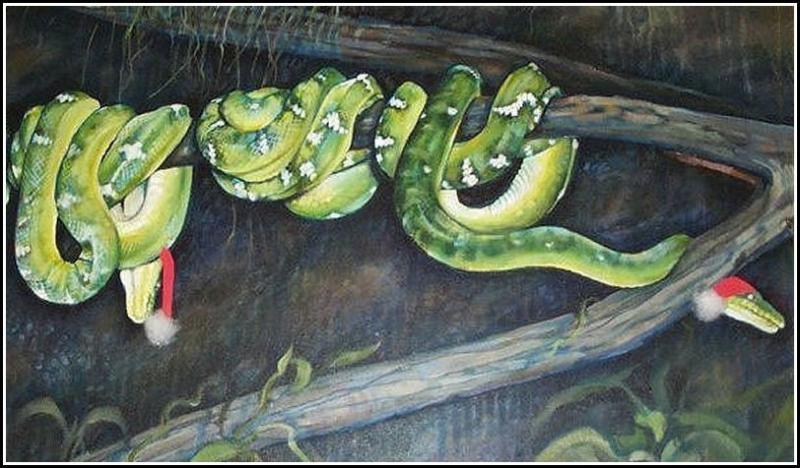
I like having one painting around that’s going to get the full treatment! Emerald Tree Boas has become like an old friend, even hanging out celebrating holidays in the dining room with the rest of us. It would be nice if this painting could carry enough potency to alter the automatic responses of fear and disgust that are associated with snakes. It just occurred to me that it might be fun to offer the buyer an assortment of hats and hearts and ribbons for different occasions. Where I used tape, instead I’d put magnets on the back and magnets on all the little hats and accessories. It’s a little nutty maybe, but it also opens up the target market a little doesn’t it!
Nature is perfectly imperfect. I paint with acrylics, so if the surface is washed back and scrubbed regularly in areas that need change. Scrubbing paint away with a pot scrubber or wet cloth used to remove paint helps texturize, give atmosphere, and also ensure that paint won’t cake up in areas, unless that’s the intention. More debates about spending too long on a painting are that it stiffens the whole look and feel because 1) it tidies things up too much, and 2) due to the plastic properties of acrylics, if they are allowed to pile up they will harden and shine, no longer catching the tooth of the canvas.
These are all things that can also be used to advantage though. In sports you need to know your opponent… well the same is true here. You can use the buildup to create the effects it produces if that’s what you want to achieve. To keep the canvas texture for as long as possible, paint diluted with gels or water is perfect to start, then as confidence builds, so can your applications of paint. My philosophy is that if things need to change they do, until the word “finished” is loud and clear.
…practice and even failure can be applied to future work…
Grackles
Thursday, June 18th, 2009
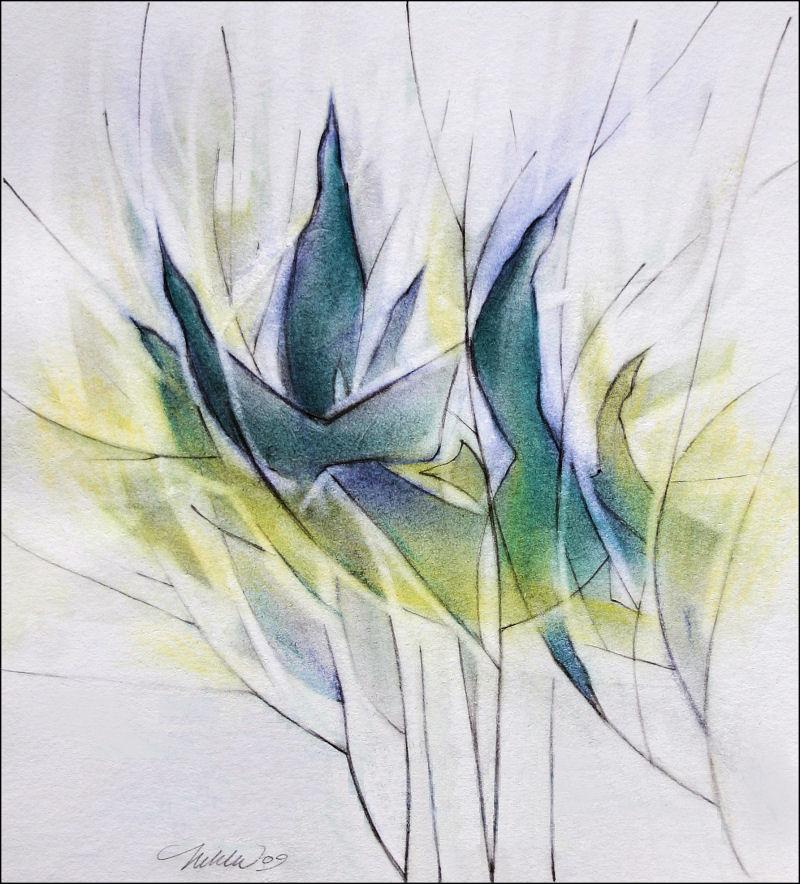
Grackles, 11 x 10 inches soft pastels and graphite on paper. 20H x 16W” framed.
The Dallas area is notorious for its Grackles. In some places they gather in flocks by the thousands. I’m not exaggerating – they are especially notable during evening just before sunset; bird parties I call them, lined along telephone poles and wires, sitting perfect wingspans apart from each other, and packed full in the trees. Photos can’t capture it all, because the experience also includes their loud calls. It’s fantastic! I love it, but they’re a nuisance in public places like near restaurants and malls. Park your black car under a tree if you don’t mind driving away with a fairly white one when you leave.
Kookaburrahs
Saturday, May 23rd, 2009
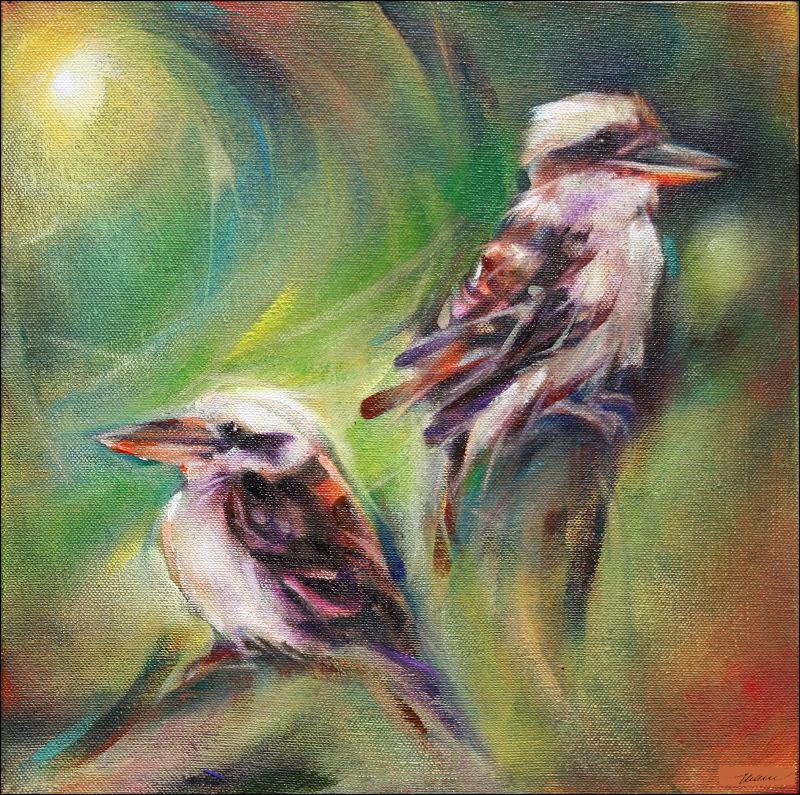
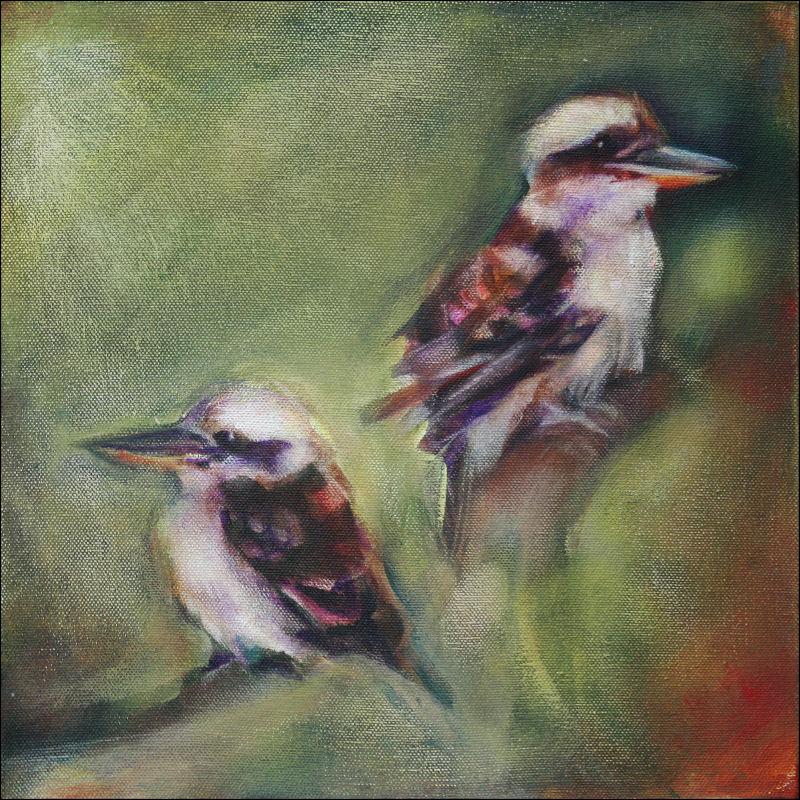
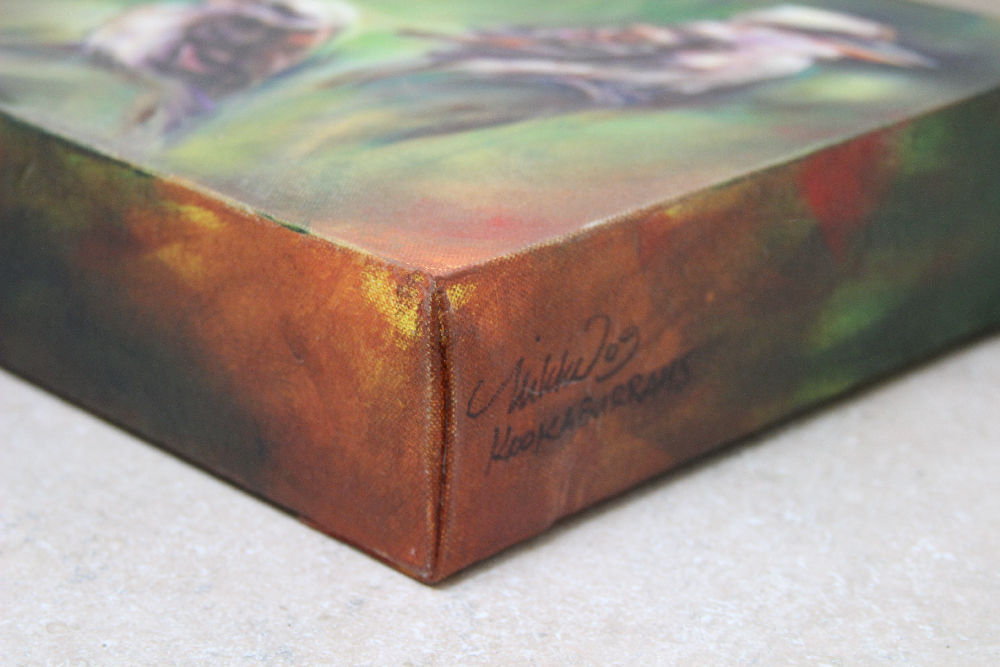
Kookaburras, 11H x 11W x 3D inches acrylics on canvas, wrapped sides painted. Frame unnecessary. Hang on the wall or display on a flat surface. Most of the Magic Square series are signed on the side so as not to impose on the composition. Seen here, the signature is added digitally on the front.
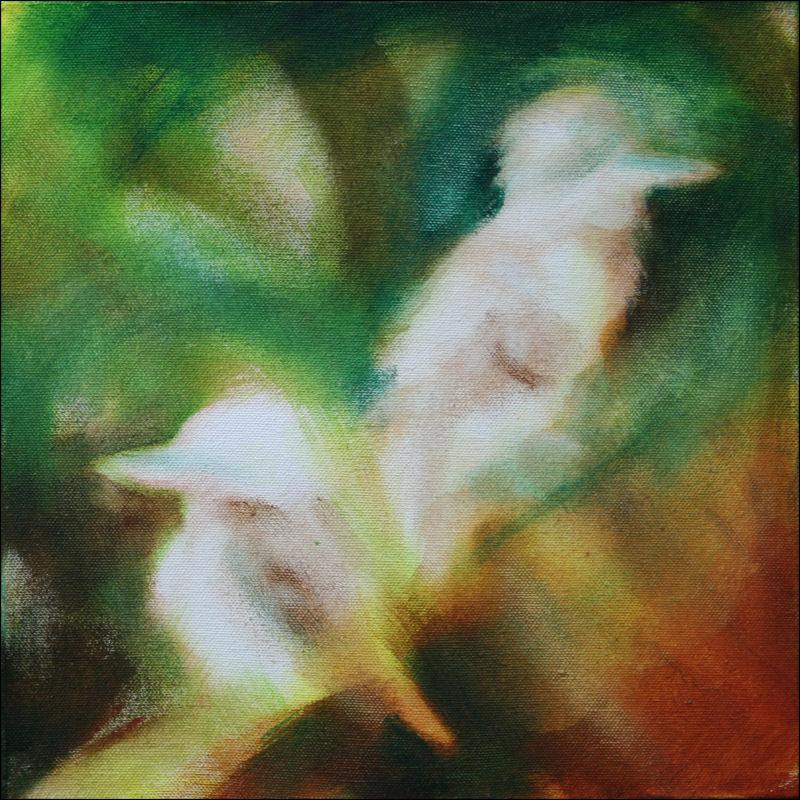
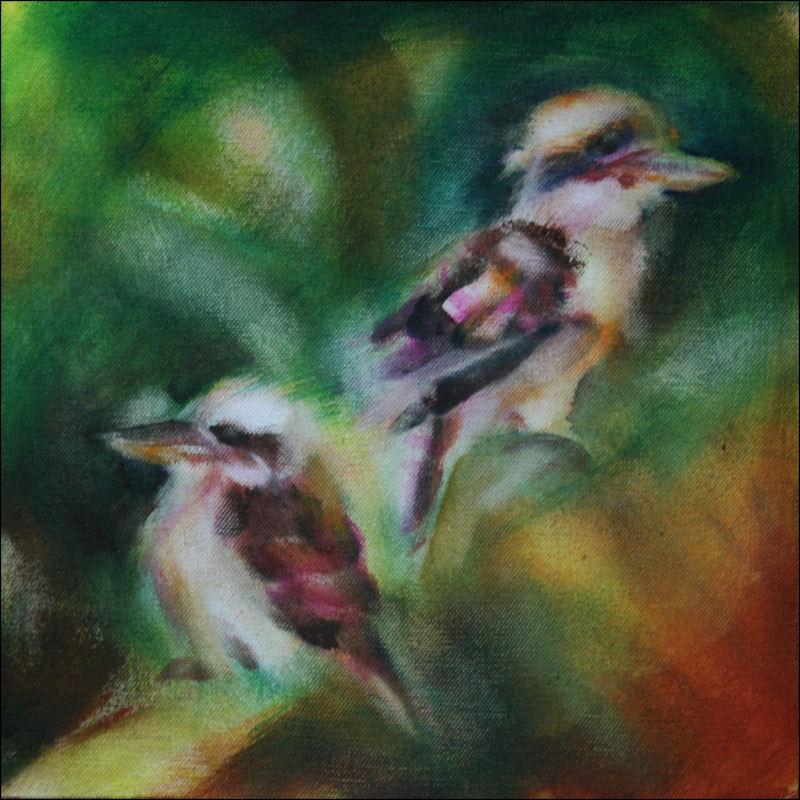
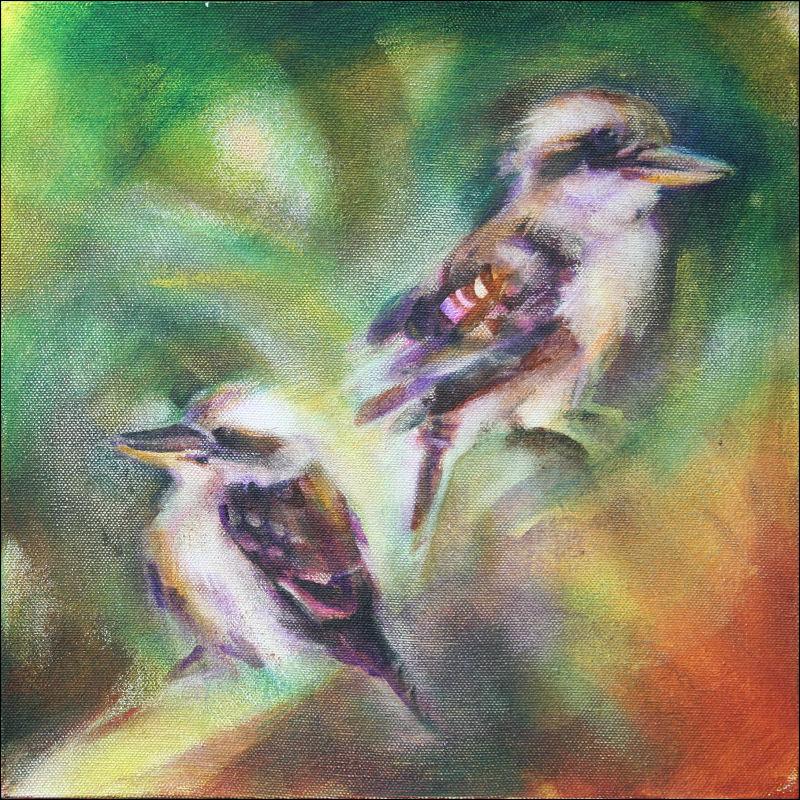
March 13th, 2009 work progress blog post: This painting could have been left at phase 3, but the decision to give the birds more definition and sense of realism created a whole new set of problems. For example, the composition, which was unbalanced from the start, is now exaggerated and more noticeable, so a third element needs to be added in the upper left corner. Not necessarily another object but color or shape that would shift the weight and attention away from the lower left areas.
| Progress details: | |||
 |
 |
||
 |
 |
||
There is a work phase where, once details are added or changes made to one area, every other thing in the picture needs to be brought to the same level of quality: quality meaning style and feeling of the features. I don’t regret proceeding, but it does mean extra effort to solve all the new challenges, and usually while attempting to solve those new ones arise. Other professionals would say this is overworking, but it really depends on what your intentions are as an Artist, and what motivates the work. If risks are not taken sometimes, a painting may never be all that it could be. Phrases we tend to cling to like “less is more” are not written in stone; sometimes more is more…learning is a good thing!
In landscapes details are best left for the imagination, whereas painting animals, birds or other creatures, a purpose needs to be clearer. Is the intention to portray character through shape and silhouette? other traits? specific markings? Is it the main focus or only a part of the whole? Computer tools are also useful in playing with colors and other possibilities.
Neighborhood Heron
Thursday, March 19th, 2009
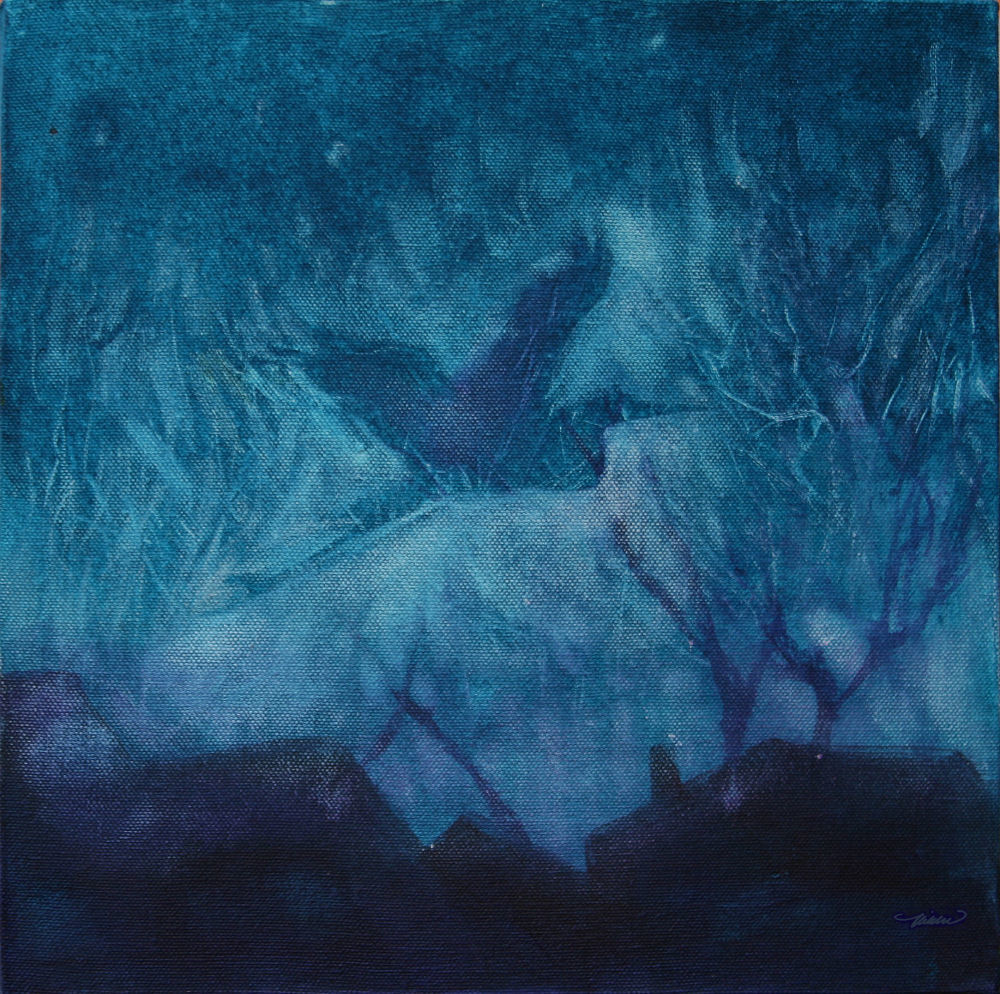
Neighborhood Heron, 11H x 11W x 3D inches acrylics on canvas, wrapped sides painted. Frame unnecessary. Hang on a wall or display on a flat surface. Signed on the side so as not to impose on the composition.
Sold but a similar piece can be recreated upon request. Please allow 7 days to paint before shipping.
Started with a base coat of very watered down translucent pthalos green mixed with cerulean blue. Spraying rubbing alcohol over a damp painted water-based surface then allowing it to dry without moving it will create starry, spotty textures. Salt shaken over wet paint allowed to dry, then wiped off with a dry cloth will produce similar effects.
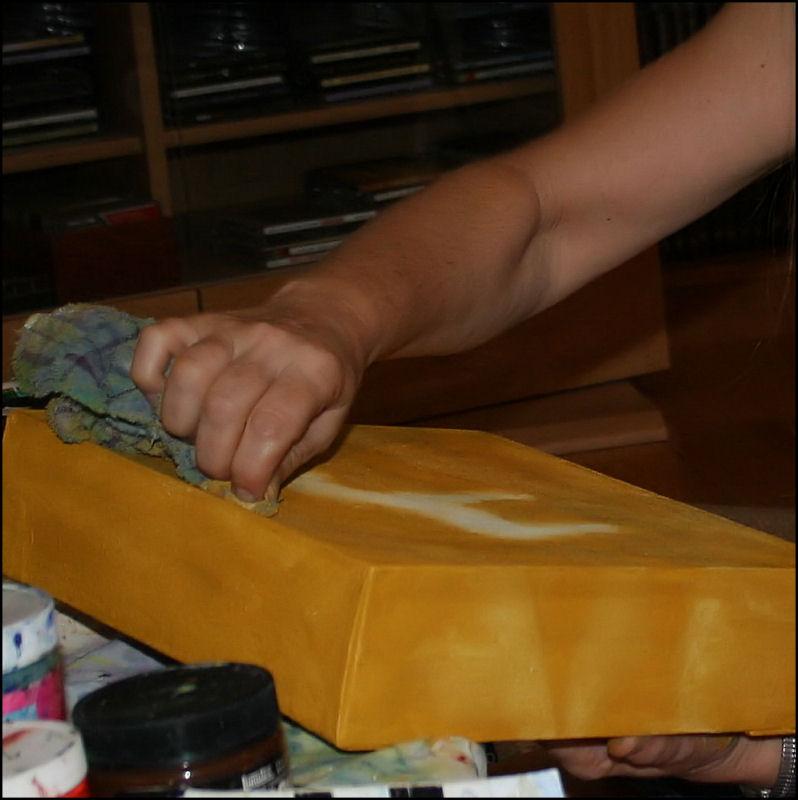
Alcohol loosened up the entire surface of paint, so using fingernails under a damp smooth t-shirt cloth, I rubbed off areas to shape the heron and winter trees. This represents a super argument for the wingin’ it methods!
In college I took a pottery course for one semester, and the thing I remember most is the instructor saying how it’s a good idea to allow some of the raw characters of the materials we work with to remain and “speak” without trying to smooth over and perfect everything. She was of course referring to clay, but over the years I’ve found that it applies to many other mediums also. In Heron, the branches extend into the body of the bird, connecting it to its environment. The effect also does a subtle play on the motion of its flight too.
Showcased in the J. Mane Gallery’s Fins, Feathers and Fur 2020 exhibition.
Iguana and Strangler Fig
Wednesday, March 18th, 2009
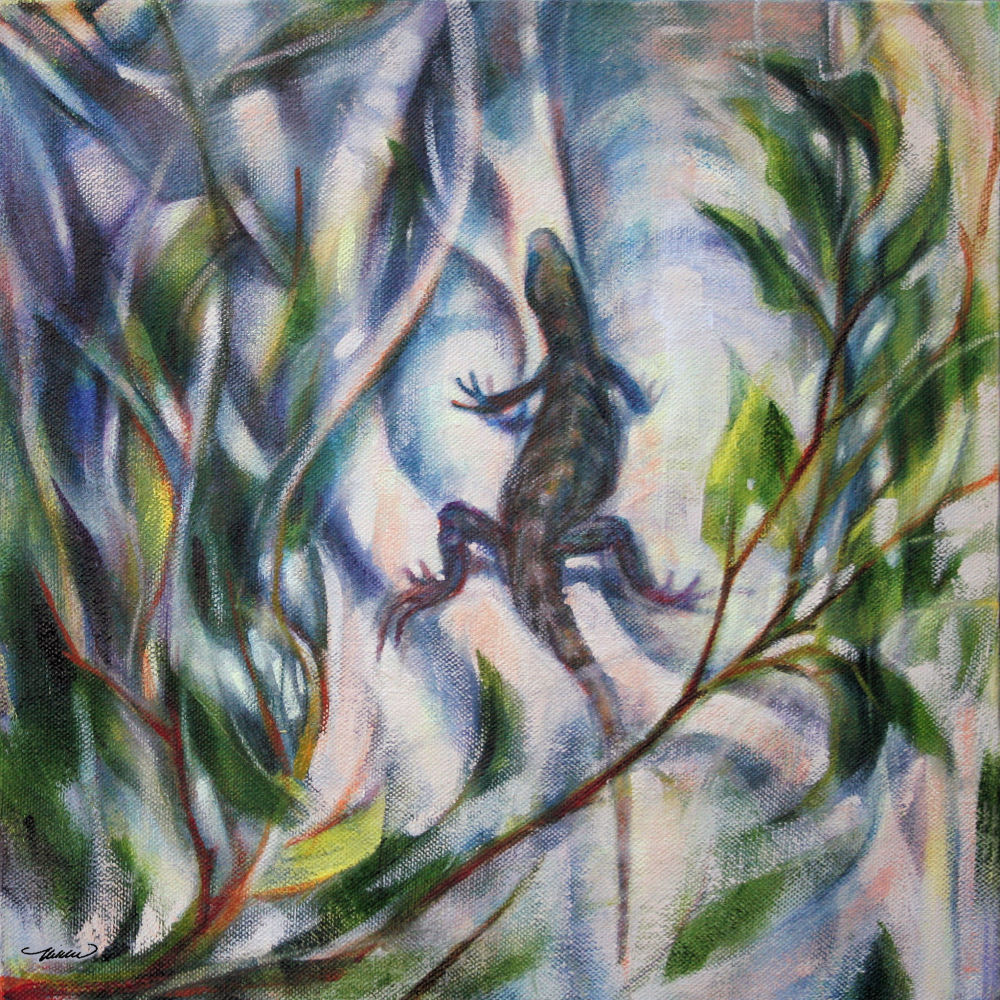
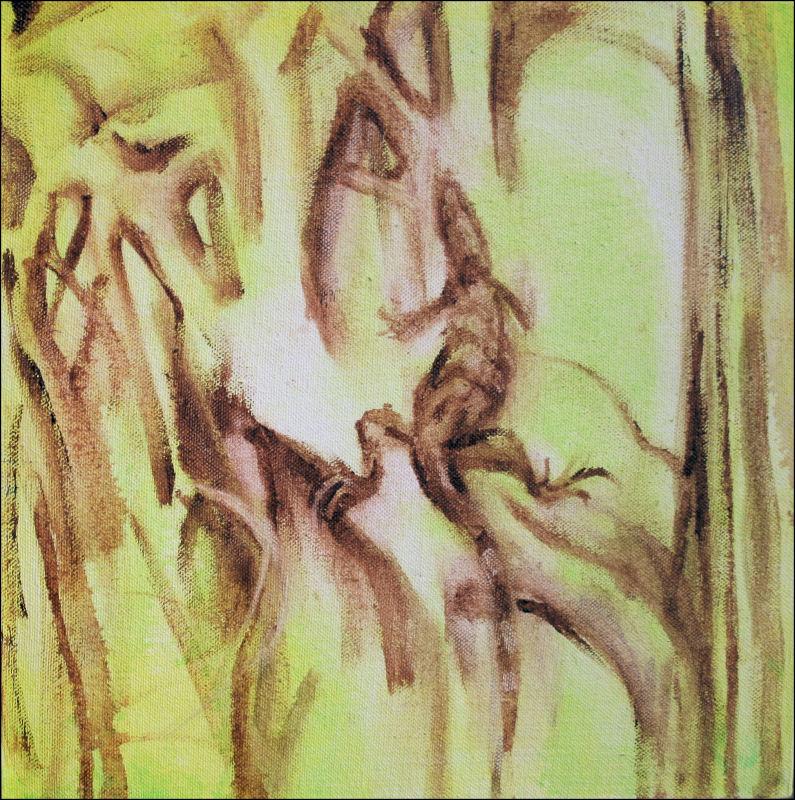
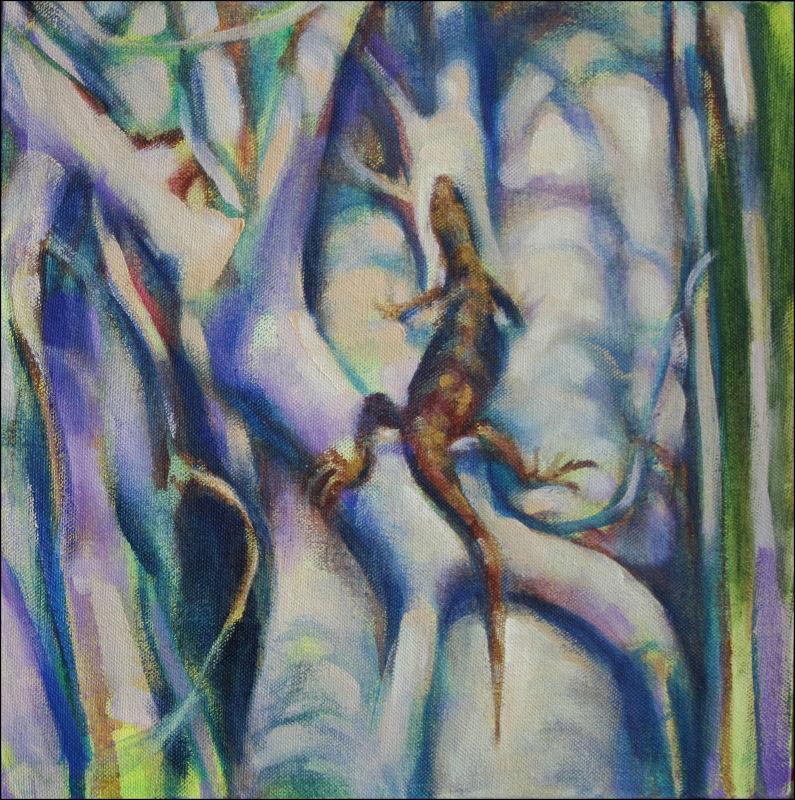
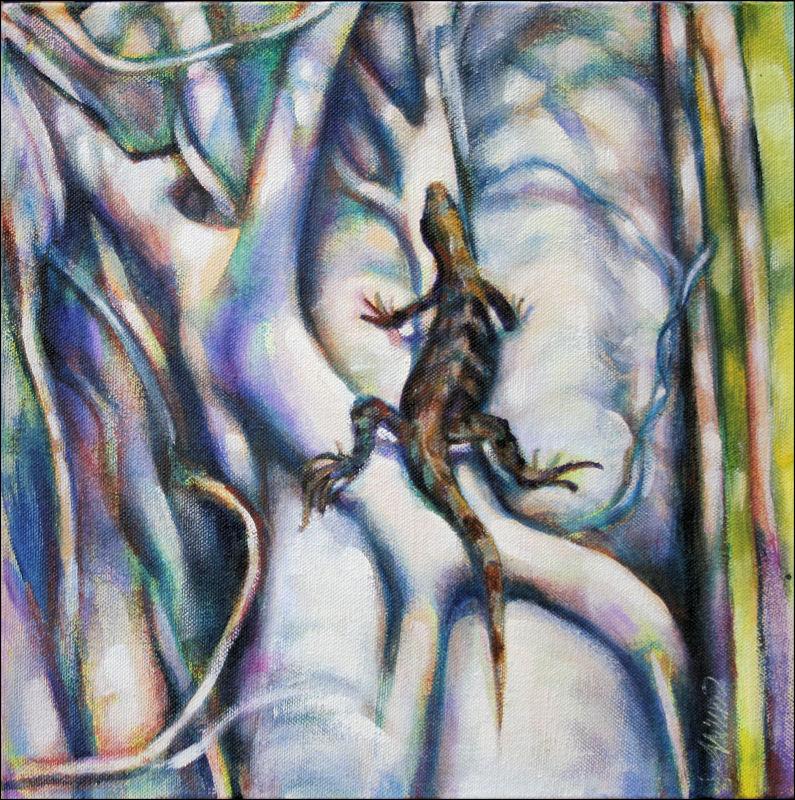
Iguana and Strangler Fig, Costa Rica, 11H x 11W x 3D inches acrylics on canvas, wrapped sides painted. Frame unnecessary. Hang on a wall or display on a flat surface.
The Strangler Fig is a parasite. Seeds sprout in moss or decaying matter among the branches of rain forest canopies. Roots gradually extend downward and over time completely surround the host tree, which dies while nourishing the Strangler Fig growing in its place.
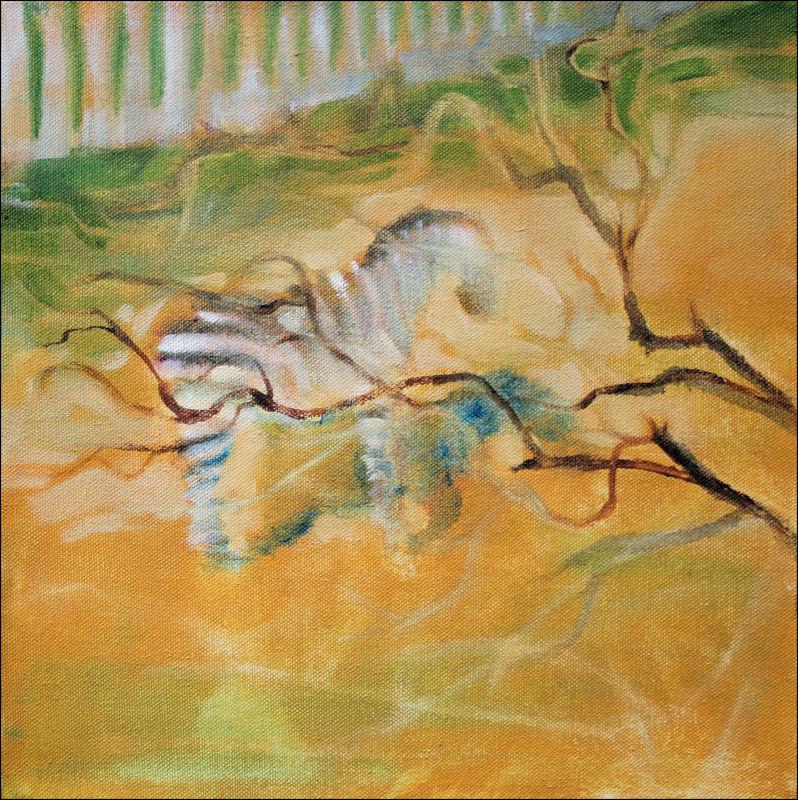
March 14th, March 13: Phases 1, 2 and 3 earlier progress in thumbnails below. Today layering thin washes of pale yellow, placing the iguana more into the background. Some of the details of the Strangler Fig growth that are now covered up might be brought back into focus since this is more about the tree than the iguana. Posting the painting on the blog is helpful because it’s viewed differently than while painting or studying it. It’s somehow easier to see areas that still need change when looking at it on-screen.
Myrtle At The Zoo
Monday, March 9th, 2009
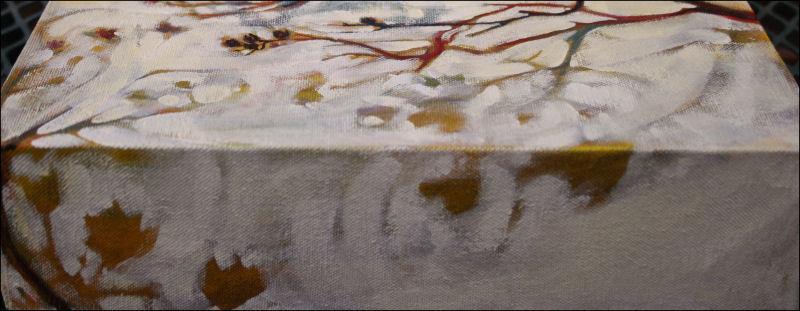
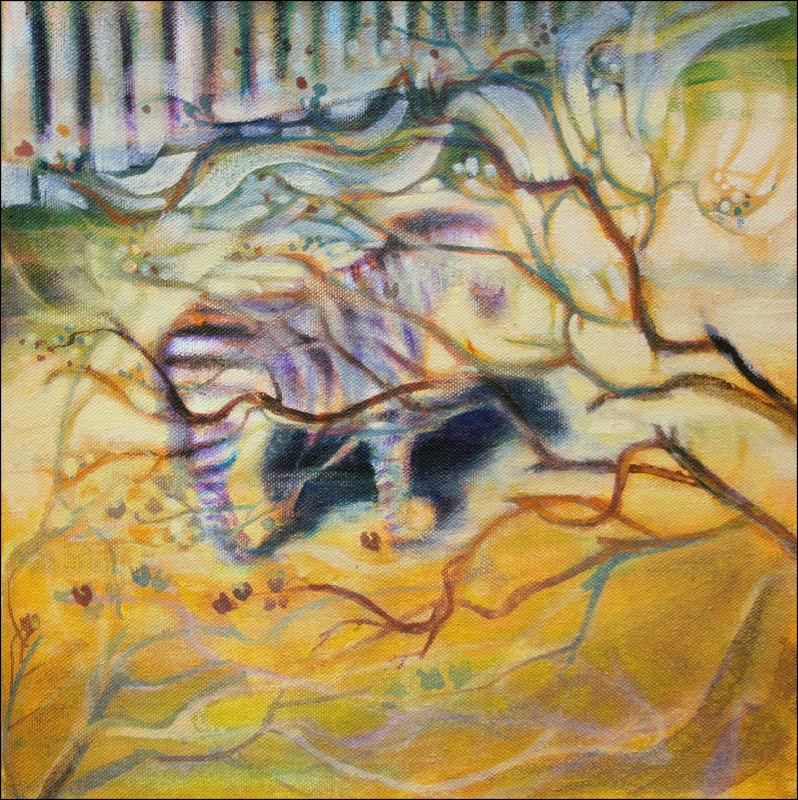
Myrtle At The Zoo – Crepe Myrtle branches and seedpods before pruning, February at the Fort Worth Zoo, Texas. 11H x 11W x 3D inches acrylics on canvas, wrapped sides painted. Signature is on the side, so one is superimposed here on the front. Hang on a wall or display on a flat surface.
Howler Monkey
Friday, March 6th, 2009
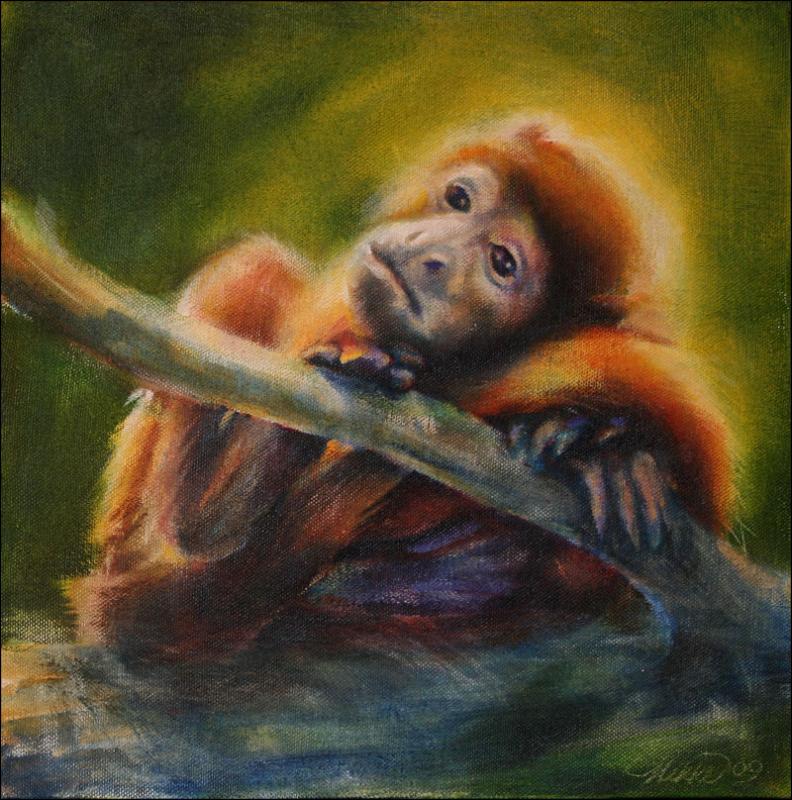
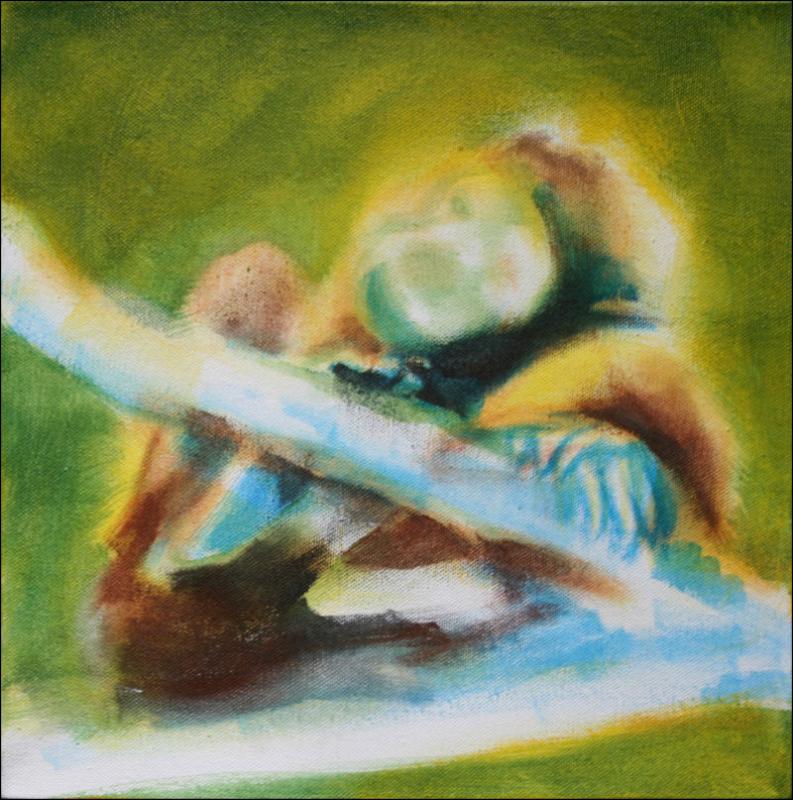
Young Howler Monkey at the Dallas World Aquarium, 11H x 11W x 3D inches acrylics on canvas, wrapped sides painted. Frame unnecessary. Hang on a wall or display on a flat surface. Signed on the side so as not to impose on the composition.
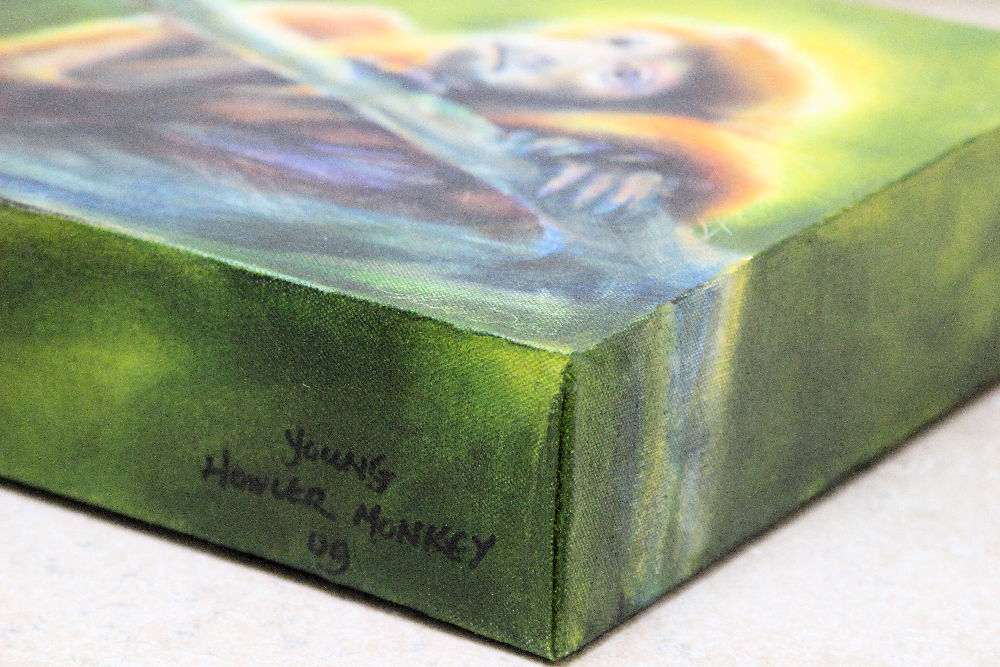
Work progress detail images shown, scrubbing and scratching away more paint than adding it.
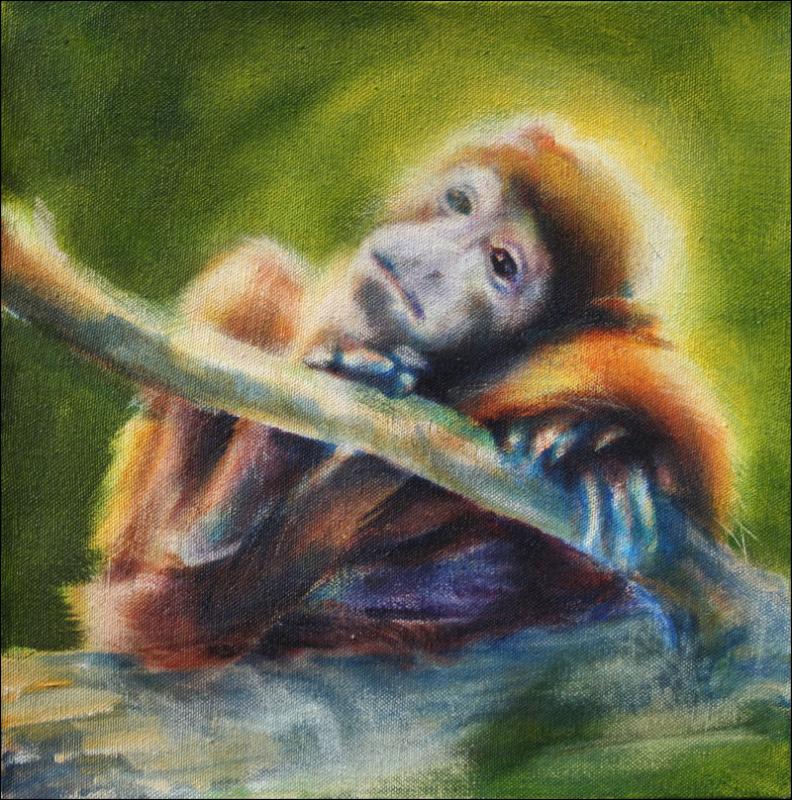
Showcased in the J. Mane Gallery’s Fins, Feathers and Fur 2020 exhibition (post-dated comment).
The Visitor: Raccoon
Thursday, March 5th, 2009
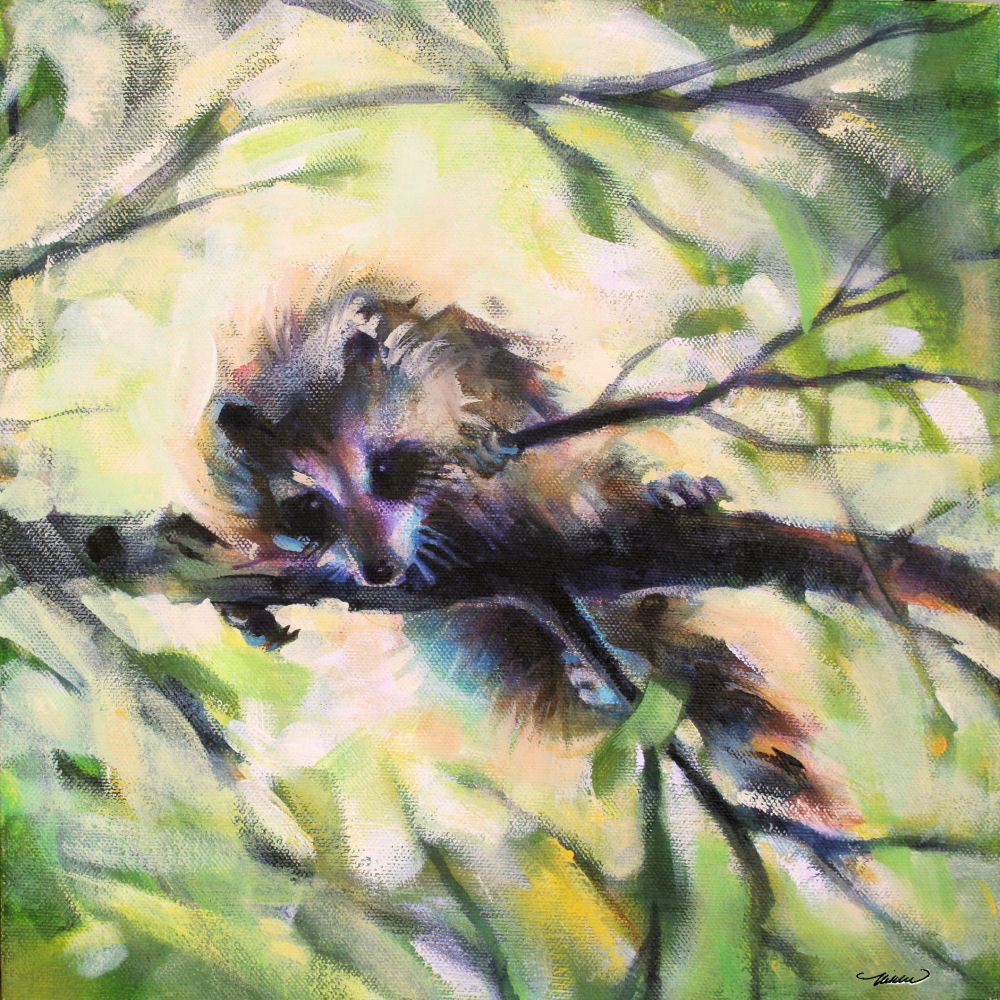
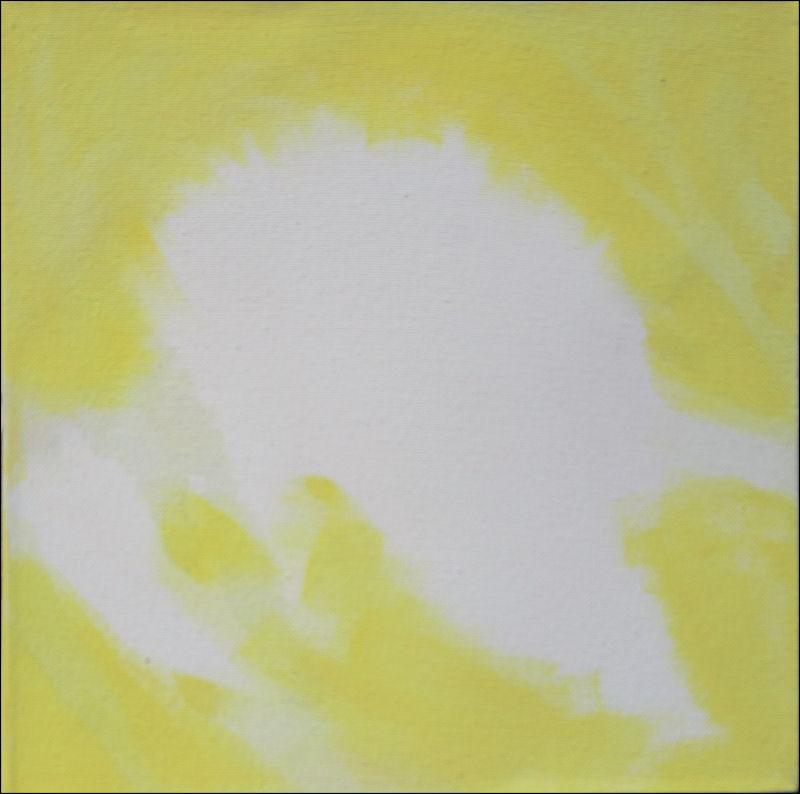
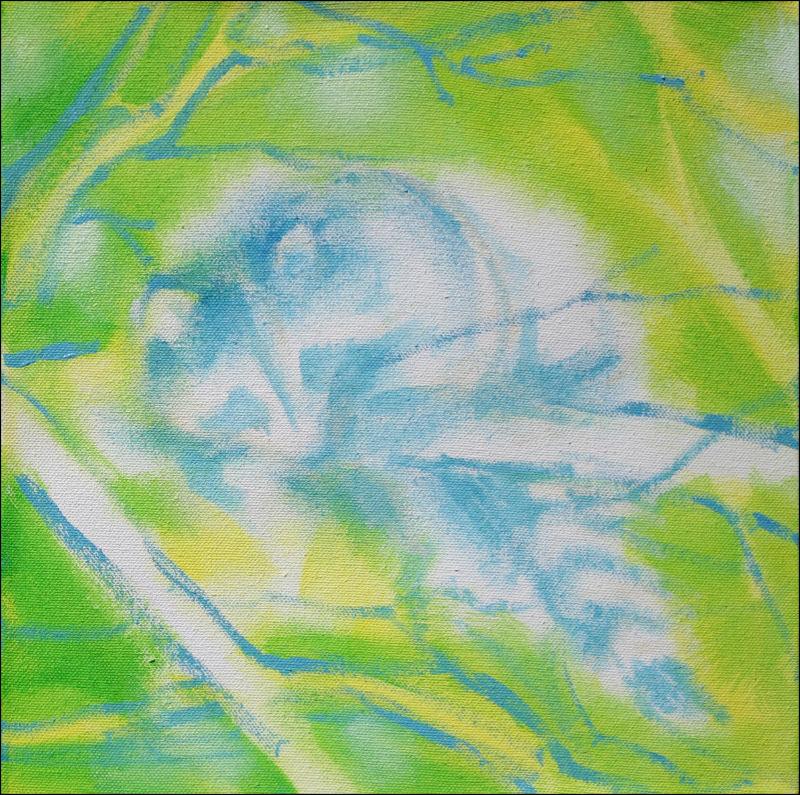
The Visitor: Raccoon, 11H x 11W x 3D inches acrylics on canvas, sides painted. Frame unnecessary. Hang on a wall or display on a flat surface.
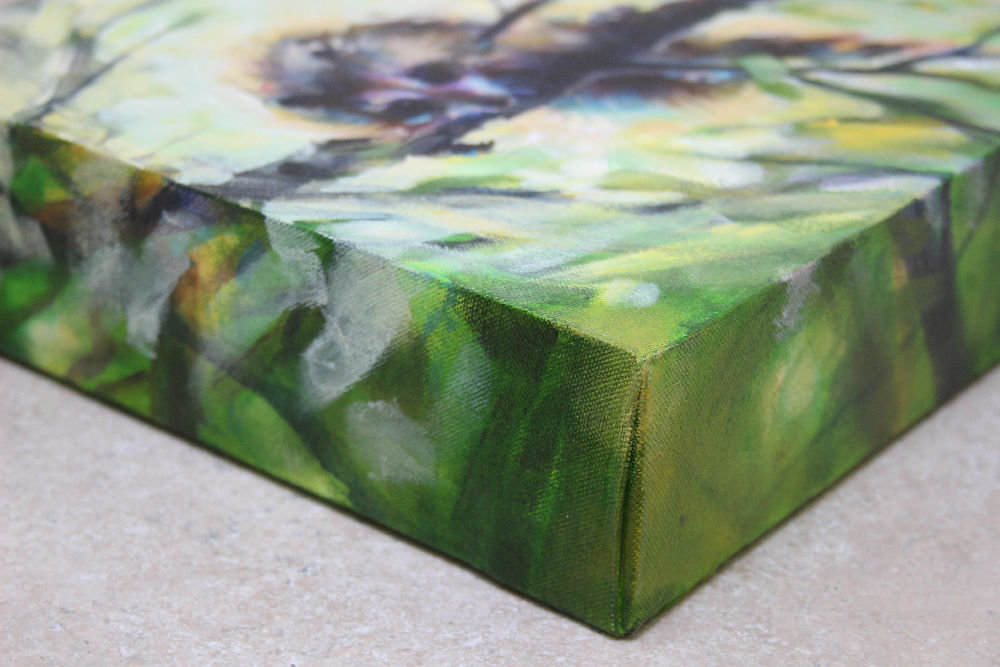
Progress and process details:
Pet portrait
Friday, June 27th, 2008
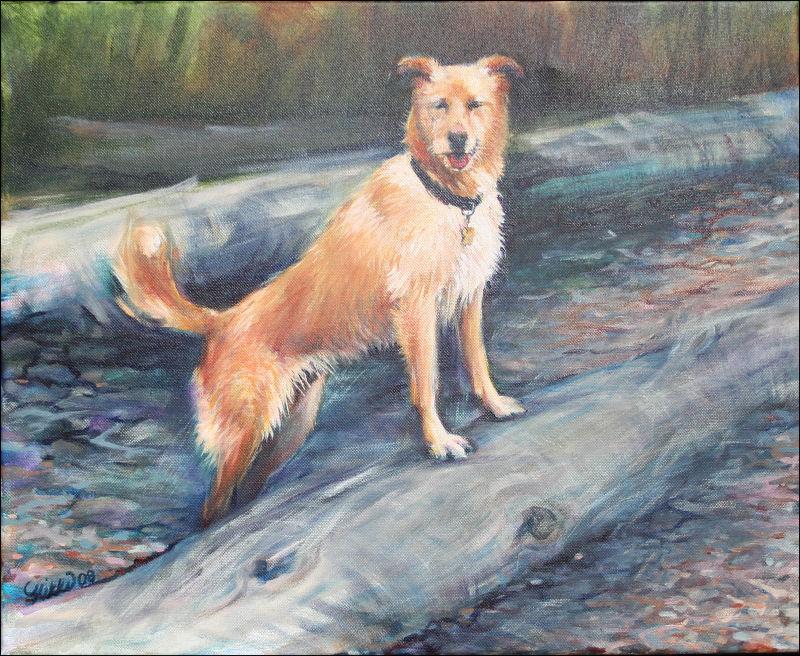
Cloe, 16 x 20 inches acrylics on canvas
I don’t know if I’ll be able to finish ‘The Fourth of July’ as planned in time for the American holiday. Leaving for Canada on Monday, and will be away for two weeks. I’ve been painting and drawing a few gifts for relatives, one of them this pet portrait. The fur is defined by scratches using my fingernail under a wet cloth.
The Art of Caring
Wednesday, June 11th, 2008
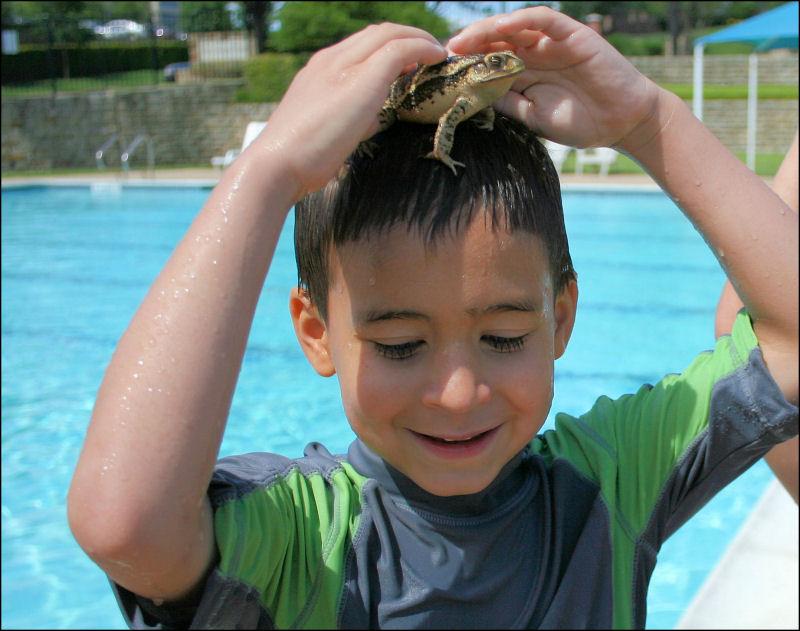
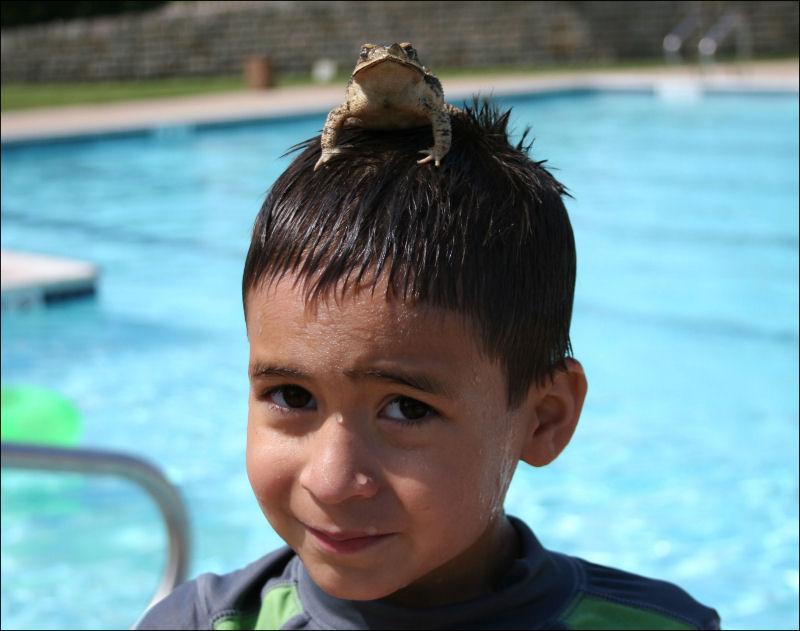
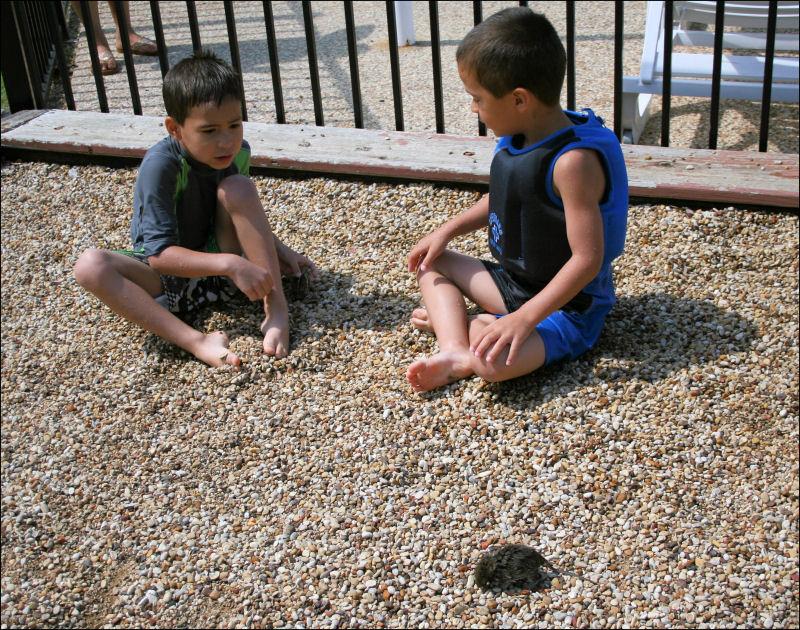
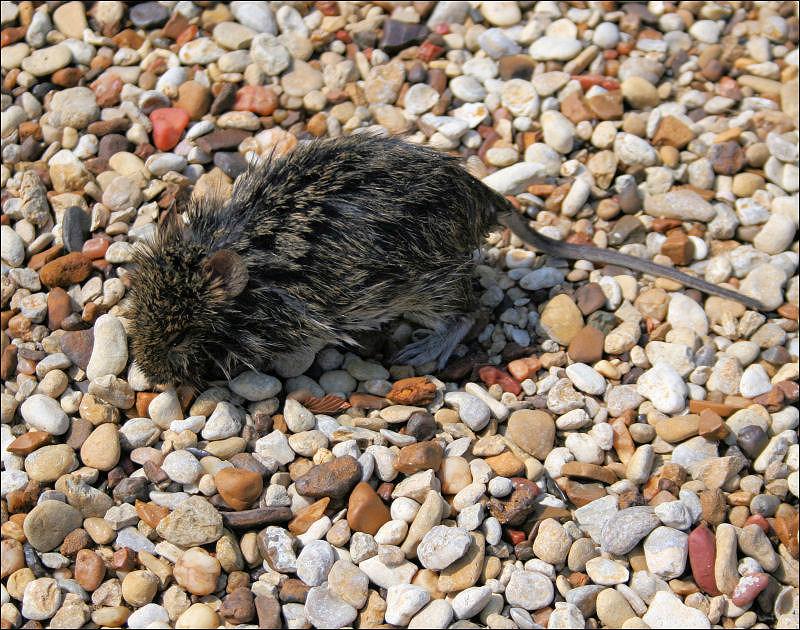
Who would save a drowning rat? These two little boys, Haydon and Noel would.
When I arrived at the neighborhood pool this morning they had just scooped a helpless rat out of the water with a little pail. It was still alive but barely, and the oldest boy who was six years old, explained to me about the circle of life – he used this term, not me. He explained that if rats died then snakes could not live, and so that’s why he saved it. I was impressed, but their other new pool playmate, a toad also discovered in the water… not so much!