
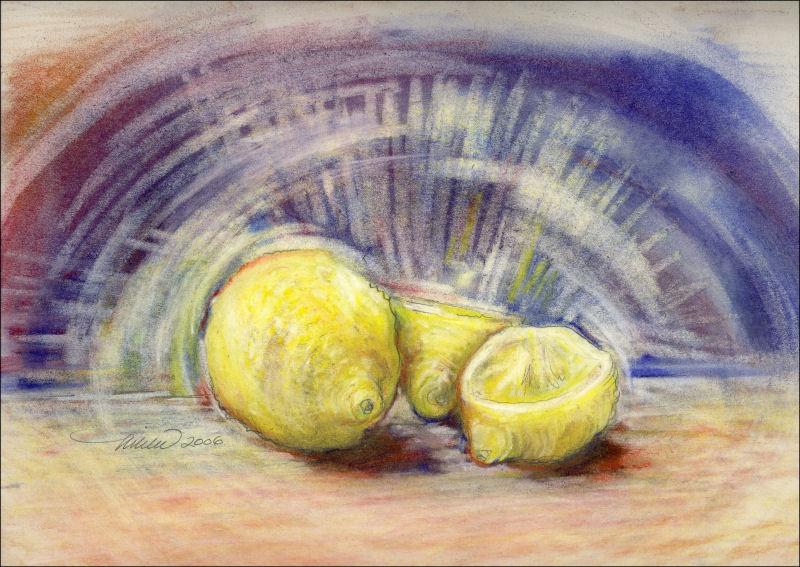
older work
In Full Bloom 2023
Friday, August 11th, 2023
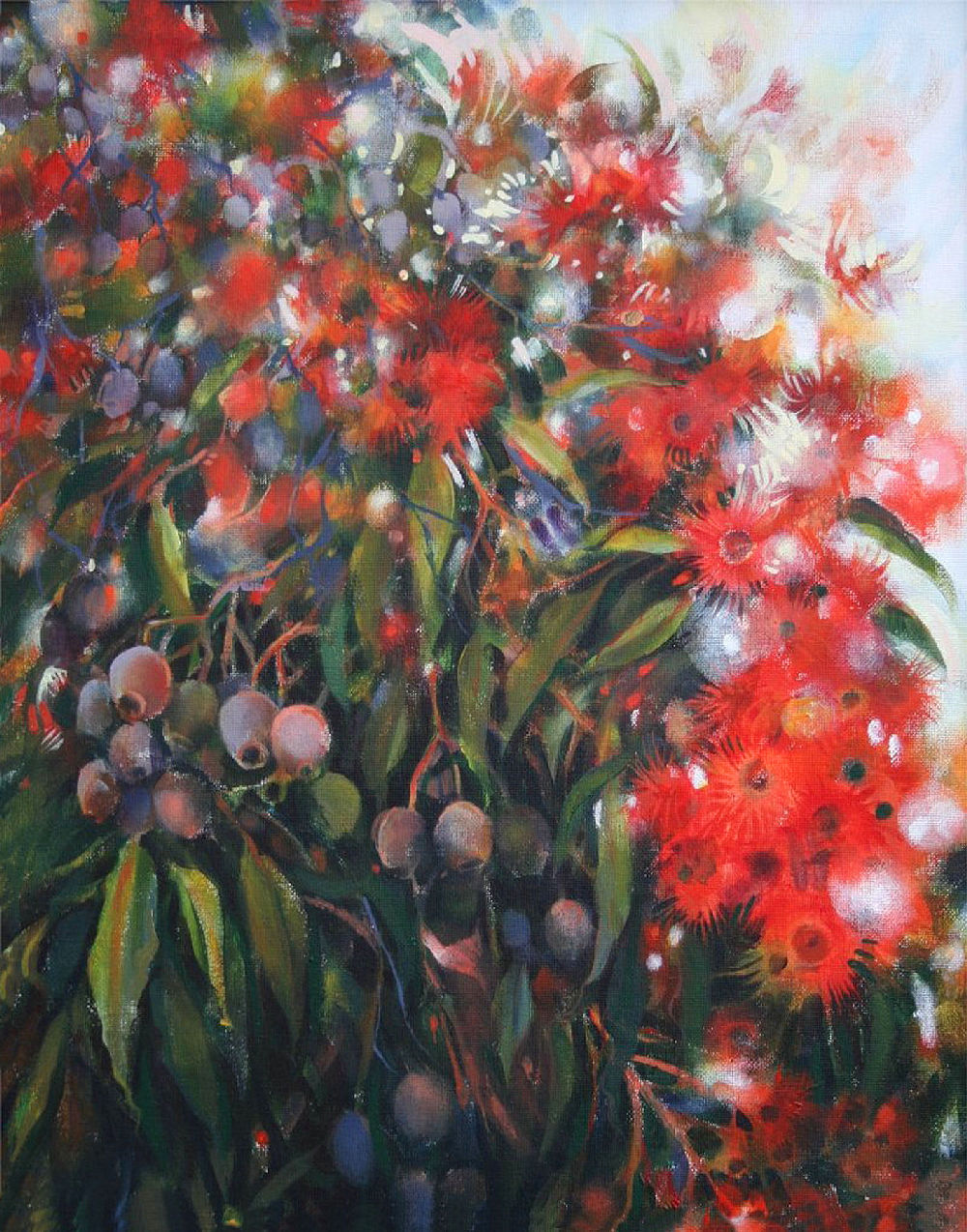
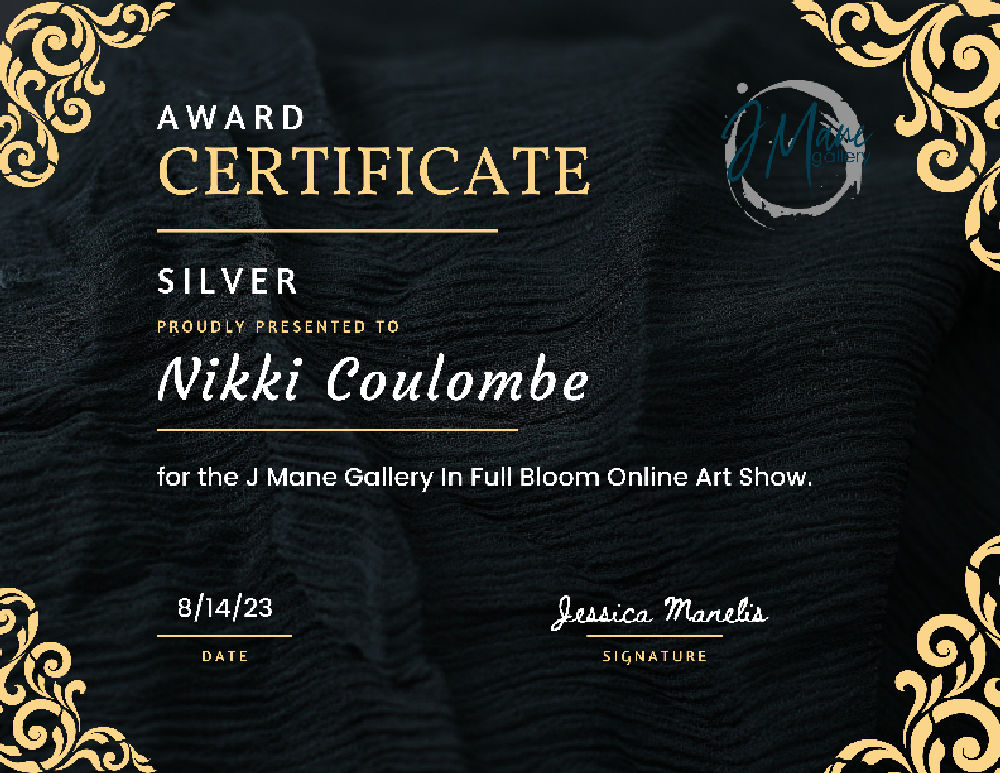 Eucalyptus Flowers and Seed Pods, 20H x 16W inches acrylics on canvas with weathered-look wood frame, has won a Silver Award in the 2023 In Full Bloom Online Art Exhibition at J. Mane Gallery, August 14th through Sept.
Kingdom Animalia
Friday, June 17th, 2022
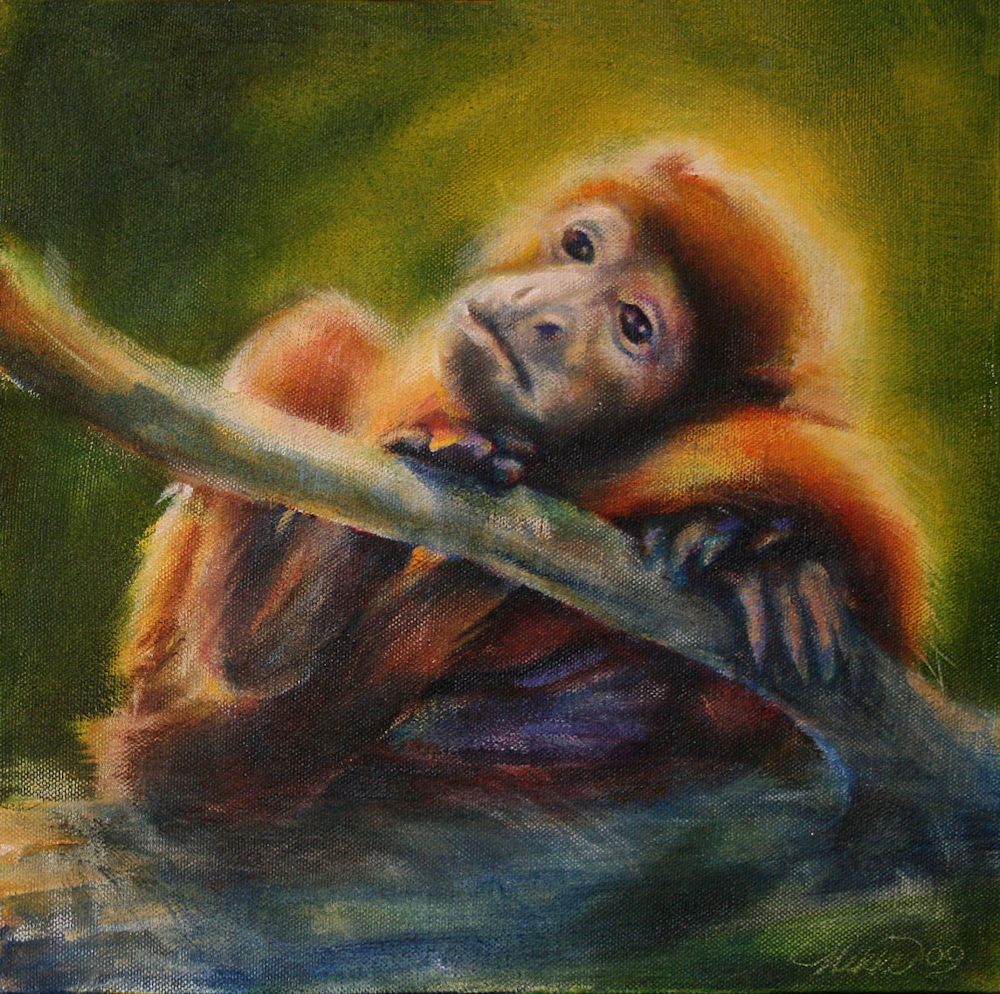
Young Howler Monkey (2006), 11H x 11W x 3D inches acrylics on canvas, $350. Hang on a wall or display on flat surface.
Biafarin / Exhibizone ‘Kingdom Animalia 2022’ showing online from 01-Jul-2022 To 31-Jul-2022.
Abstracts online exhibition
Friday, December 4th, 2020
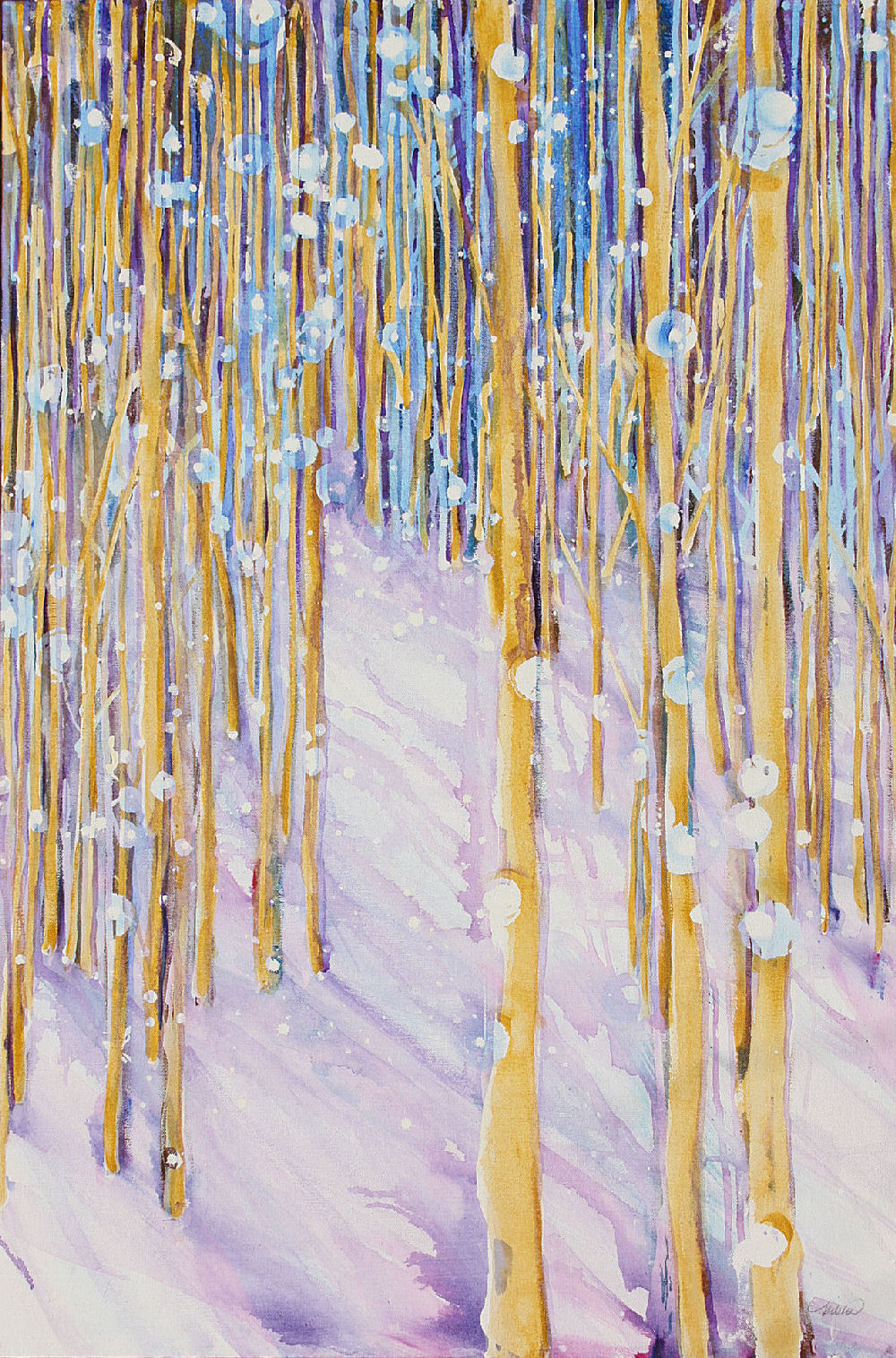
The Sound of Silence – 2009, 36H x 24W x 2D acrylics on canvas, trim frame
Five pieces were accepted into the J. Mane Gallery online exhibition Abstracts 2020 showing through December. All are available for sale, listed on the left sidebar.
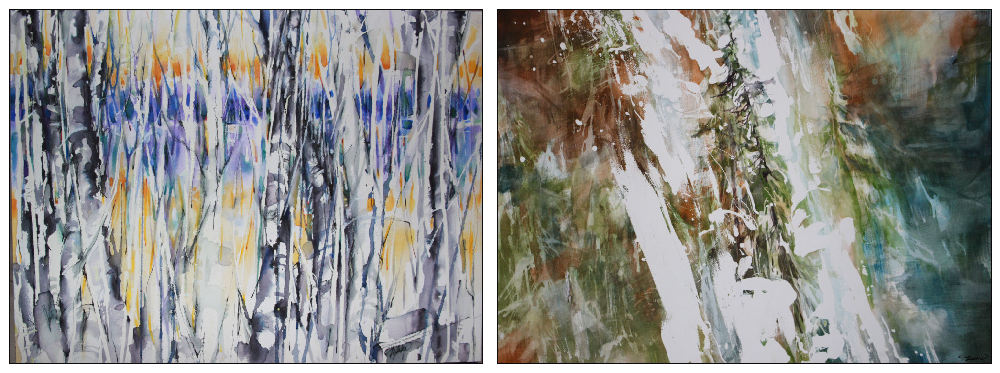
Birch – 2012, 12H x 16W inches watercolors and Multnomah Falls – 2017, 18 x 24 inches watercolors
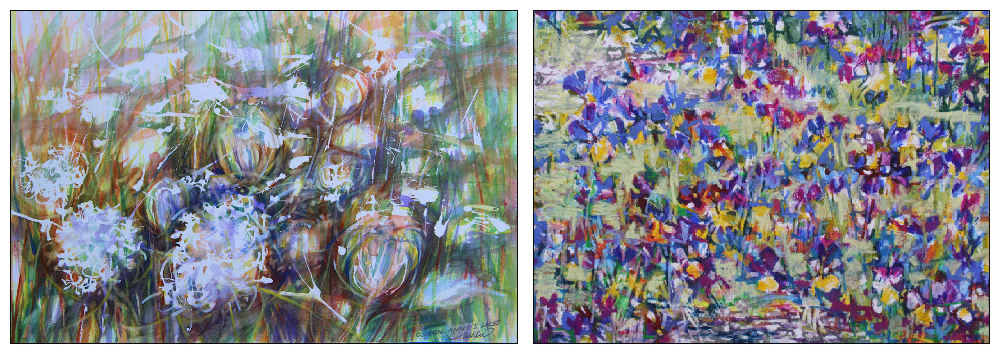
Queen Anne’s Lace – 2018, 14H x 20W watercolors and Spring Garden Mix – 2013, 18H x 24 oil pastels
Missing routine
Thursday, October 11th, 2012
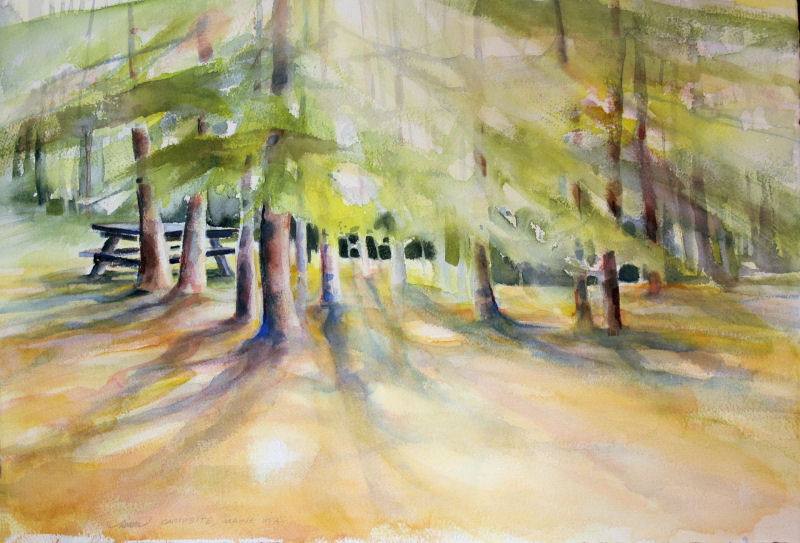 The Campsite, 24 x 30 inches watercolors on 140 lb cold pressed premium
I finally brought my watercolor paints back from my son’s place in Canada, where I left them so they wouldn’t freeze on the 5-day drive back west last November. Driving again, I’ve just returned from this year’s visit, when I gave my grandson a one-of-a-kind fabric book hand-made for his first birthday, Colors for Cameron. I plan to make him something special every year.
So, with a couple of new brushes and 12 x 16″ paper block, and now with the rainy season upon us back in Oregon, I look forward to establishing a routine of painting again. Invigorated by a summer full of gardening and flowers, the stunning scenery across America this time of year, plus reviewing archives of work I haven’t seen for ages, I’m all set to splash out some new watercolors. Our Portland house is a renovator’s dream/nightmare!, and we’re not out of the woods yet. Attempting to focus more on art than house, smaller paintings are more manageable and less of a production than my typically large canvas paintings…however, I’m curious to experiment and see how watercolors behave on primed canvas at some point!
Stepping Stones
Friday, March 25th, 2011
 1.
1. 2.
2.
 3.
3. 4.
4.
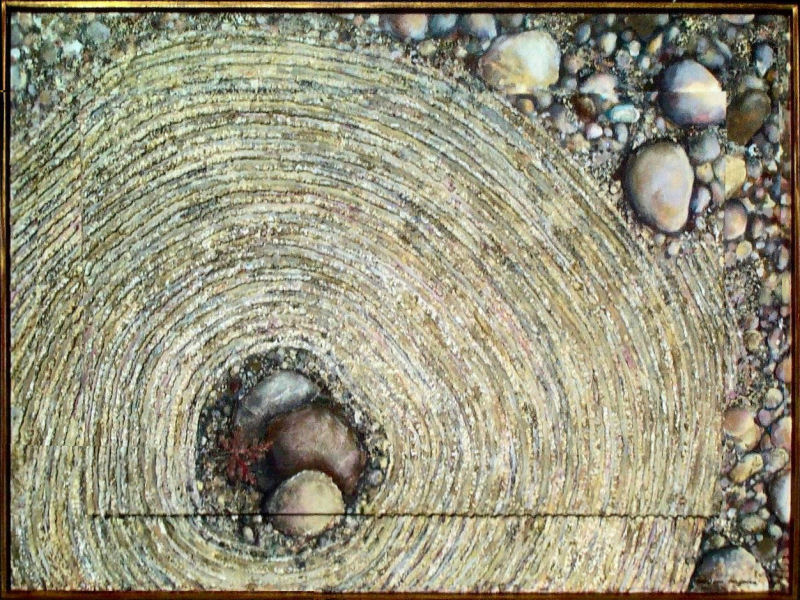
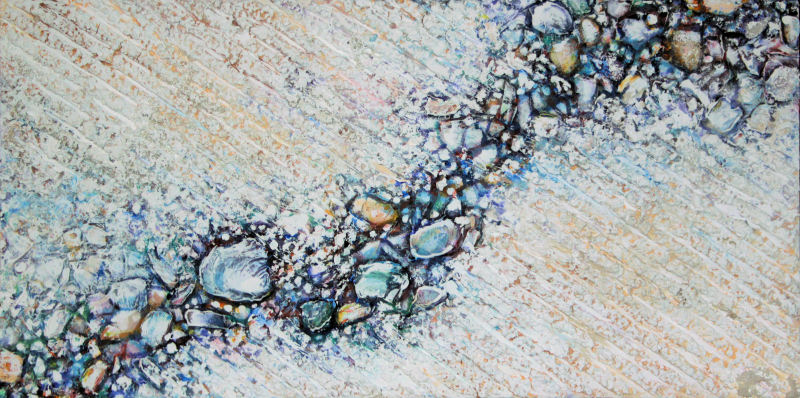
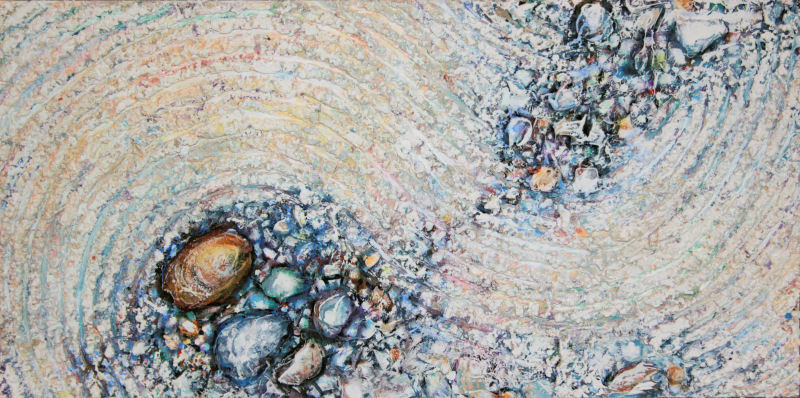
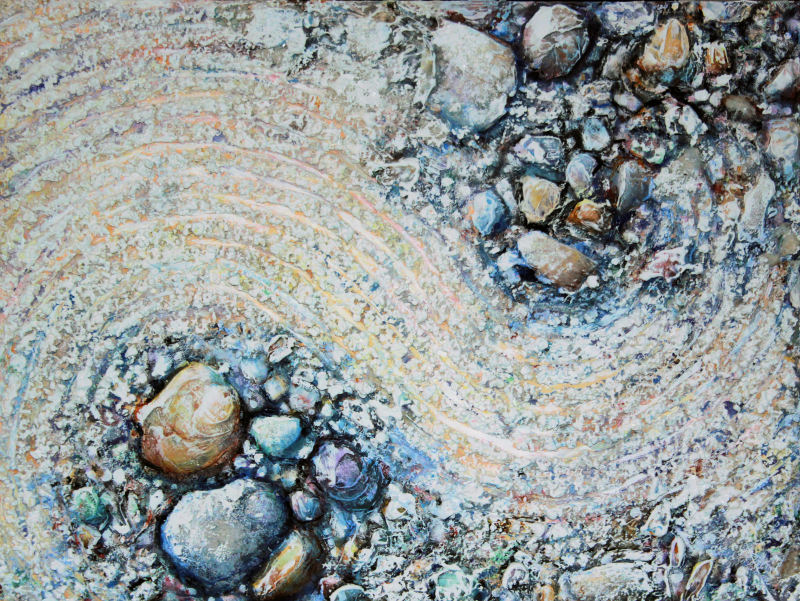
While I was in Portland two weeks ago, starting the Texas-Oregon relocation process, I completed five new Zen Gardens, filling a request for one. All five are smaller, slightly different versions of ones made previously. Four are shown in thumbnail images below.
The very first Zen Garden was created in 2000 as part of a four-painting commission. The ideas established in that set foreshadowed new routes to trying methods I hadn’t before, like enhancing my paintings with 3D elements. That set is also the origins of the “box frame” design that I’ve used on several other paintings since then, where each main canvas is mounted on a wood platform, framing the work with about four inches of extra play-space.
Whereas some frames have the effect of abruptly ending a composition, this type of frame enables space for the subject to continue, softens the edges and adds an interesting twist to the overall impression. When items related to the main subject are placed in that area it adds dimension, not just in the physical sense, but also in the conveying of any abstract or symbolic stories beyond the presentation of the main painting inside.
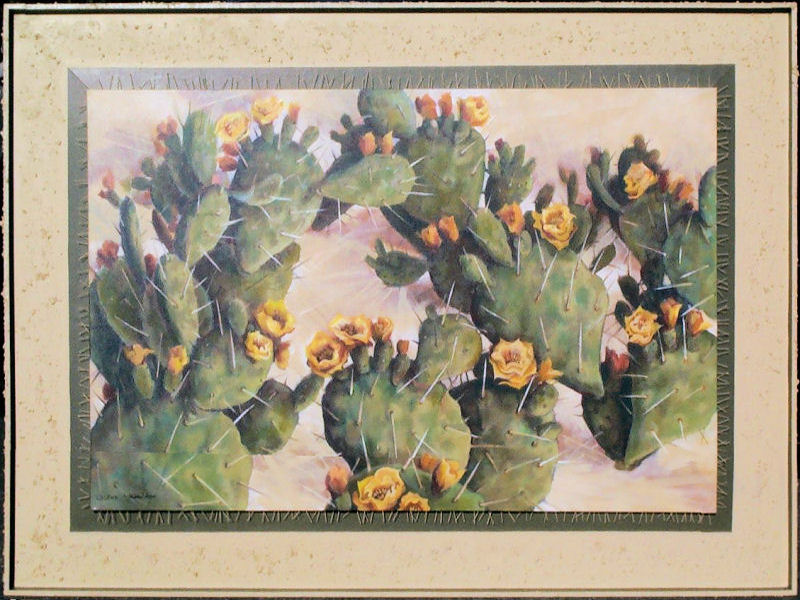
Because of the challenges acheived in those paintings, 1) a series was born that I’ll continue with for the rest of my days. In 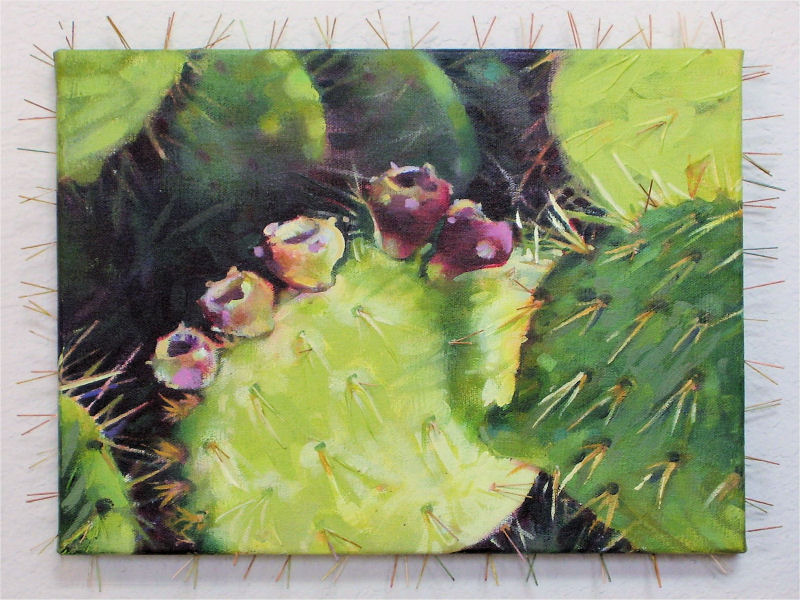 2) Prickly Pear Cactus, pins were applied around the main central frame, then painted. The smaller canvas done during 2005 (left) borrowed this technique, and the same principle of attaching things to the main frame can be used with any number of objects.
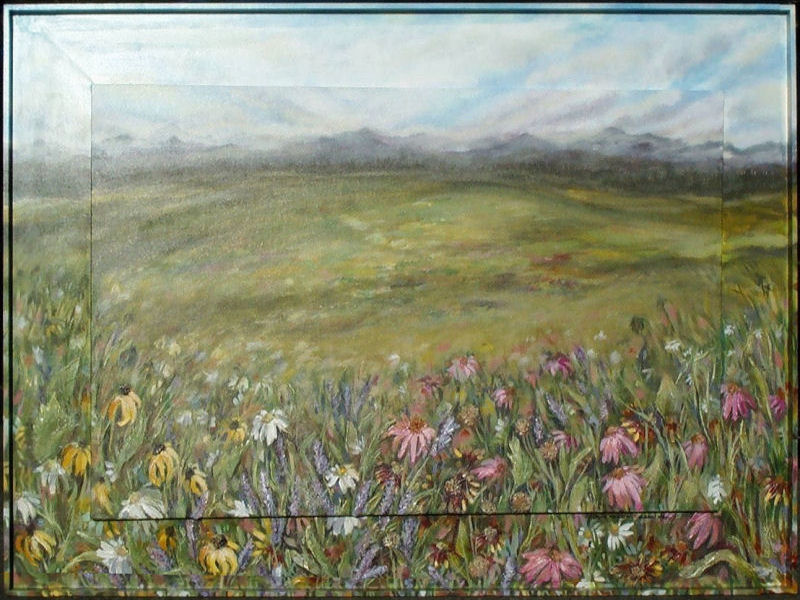
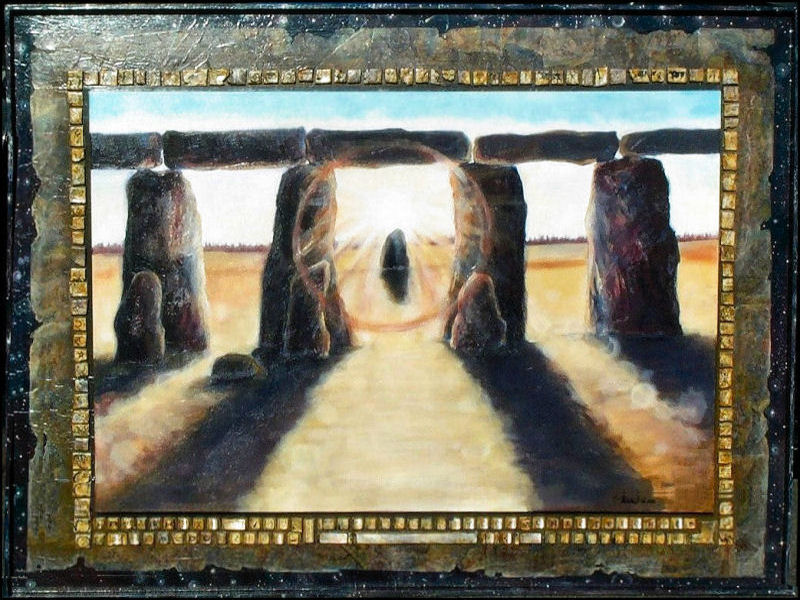
In 3) Alpine Meadows, I learned to use all the qualities acrylic paints offer by watering down the consistency for the distant mountains, then sculpted the flowers and grasses with a palette knife on the lower portion. Finally, the theme of 4), The Evolution of Communication has intrigued me ever since, but I still haven’t fully pursued the possibilities. This is the perfect means to learn about Art History hands-on by attempting to recreate it in some form, then to share that adventure and ideally, inspire interest in the topic at the same time. Two old keyboards have been collecting dust in my studio closet for a number of years, yet to be disassembled and incorporated into a new series of work with similar associations.
~
Some of our peers advocate that if we don’t concentrate our efforts to learn one medium well, we will never excel in any. They are right of course, in many respects, but scores of artists are not content with singing just one note. Some simply cannot. To be fair, what works for one does not work for another. Each of the above paintings are examples where a combination of skills and different media in one piece can be very effective. I’m here to say that integration is possible! It’s a longer, meandering road..but it is possible.
 There are so many different paths artists can take, long and short term; opportunities every day. There are endless kinds of subjects, ready-made and unconventional materials, always something to start or finish, new methods to explore, and an overabundance of ideas to attempt in one lifetime. Self discipline is the order of every day, either to start working or know when to stop.
My philosophy is that doing something, unless naturally in need of rest, is better than doing nothing. However, being overly ambitious in too many areas is also how I, along with millions of other artists end up with a variety of different kinds of art (or just stuff!), and the arguements endorsing one type of study come into play. Should we restrain ourselves when it comes to making “stuff”? Why is consistency given more support than variety when it comes to showing and selling art?
Whatever choices we make; whichever direction we take depends mostly on the intention for the finished products. Who is it for, do you want it to sell it, where, how, and how quickly? Was work done as a personally cathartic process, as a lot of art is? …or is it just a thing with no emotional attachments or brainy messages? Artists who support themselves by offering a range of services, satisfied and busy enough by word-of-mouth sales, do well jumping from medium to medium. If the hope is selling work through galleries and art dealers though, what some call “too many voices” are apt to be a disadvantage. 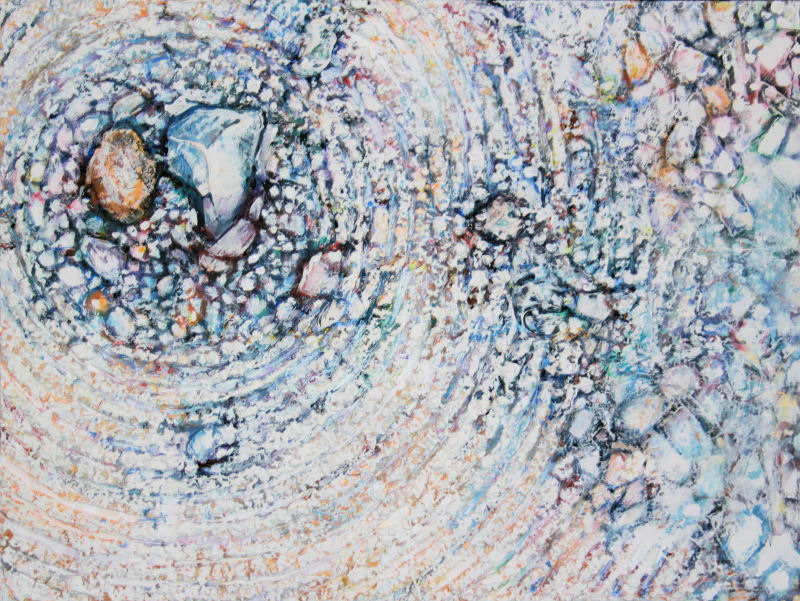
In one of his recent articles, Robert Genn writes sensitively about multi-media artists. While he supports that “for artists, exploration is like oxygen” and that “the nature of our game is to be distracted by our muse”, he also recommends that artists must present consistency in our approach if gallery exhibition/sales is what we pursue.
When a gallery represents an artist, they expect an overall consistent look and a clear statement. Where venues sell a number of artists’ work, the ambiance cannot be one that resembles a yard sale. If potential buyers view too many styles, subjects or media in one place or by one artist, they tend to lose interest, resort to window shopping, and walk away empty-handed.
 I can relate to that: the effect is like standing in the toothpaste isle at the pharmacy, where the senses are bombarded with colorful packaging, alluring titles and fine-print promises. Assuming beforehand that the choice would not be anything but simple, there have been times when I’ve said ‘forget it’ and gone back another day. With art sales though, you don’t want buyers to come back another day, because it may not be your art they choose then.
Gallery owners and dealers do not do us any favor if they display too much variety in typically limited spaces, so Mr. Genn has an excellent suggestion: bring art done in different medias to different galleries.
He also says to keep working no matter what.
Artists have a strong sense of mission. Periodically it needs reevaluation, and with that bigger picture clear, we create the way as it unfolds before us. If we are serious about selling, we first need to become familiar with what we are best at, what we love, what works and what doesn’t. We need experience in order to learn – that takes time – and there’s no getting around it. Experimentation is fundamental to this profession, but if it’s intended to be sold to others and by others, simplifying the look and clarifying the purpose of our art is crucial.
 A viewer at one of my exhibitions commented, “You’re all over the place, arentcha?!” As disturbing as that was, it’s true and I needed to hear it, eventually concluding that I do need to clean up my act, but at the same time this is how I work. This is how my stuff works. Every so often there are paintings or a series of works that encompass all that’s been learned and all that I’m capable of; breakthroughs that define a solid new direction or validate the existing one. The commissioned set of paintings described above were like that, and their significance is still an influence on today’s work and will be on tomorrows’ too. They verified that I’m on the right path even though much of the time is spent off of it, experimenting. I call it serious play and paying attention… “playing attention”! Once in a while the bits and pieces come together in one big rewarding “Eureka!”.
Comforters and Joy
Monday, December 13th, 2010
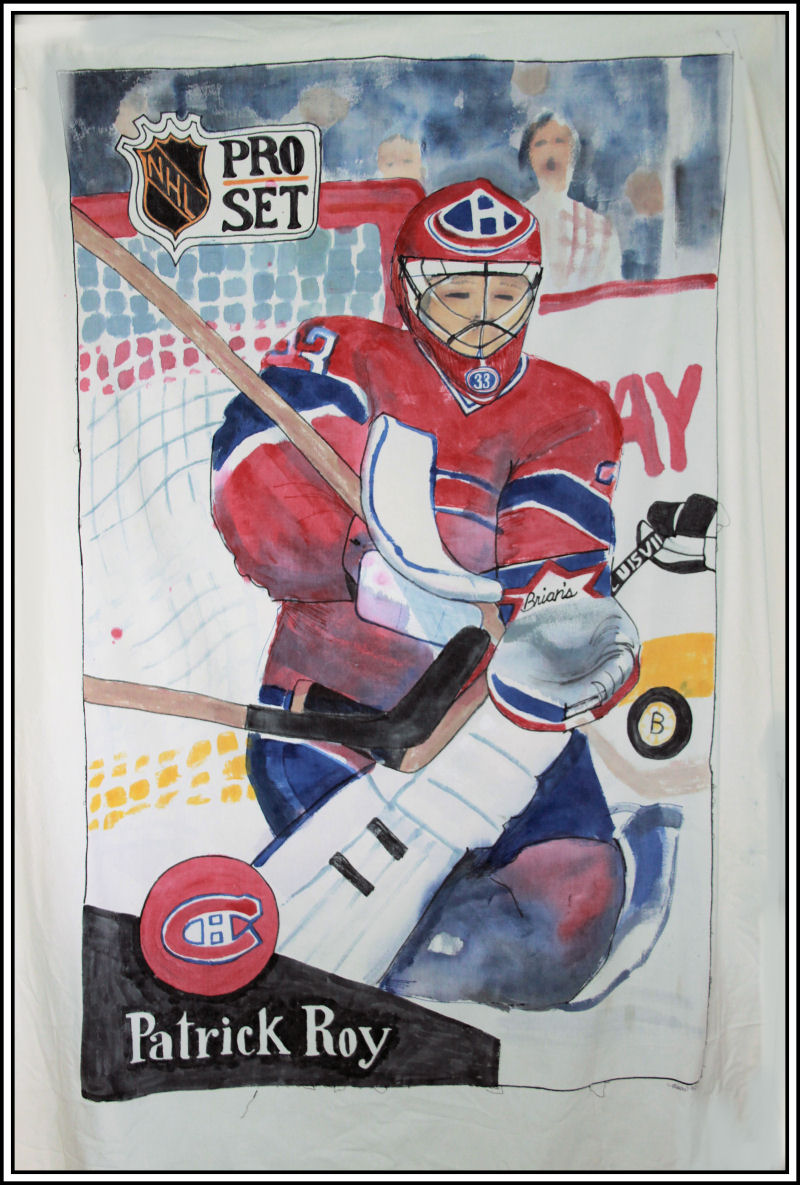 While organizing and packing for the big move to Oregon, I’ve been uncovering (so to speak!) things I haven’t seen for a very long time. In 1992 our boys played hockey and collected hockey cards, so they each chose their favorite to be recreated on a comforter for their beds. My thinking was that if they had stuff they liked in their room, they would keep it tidy. Hey, it did work for a while! Pillowcases, lunch bags and toy bags were made from left-over fabric, and they painted on some too. I’m saving a few of these things to hand down to their children.
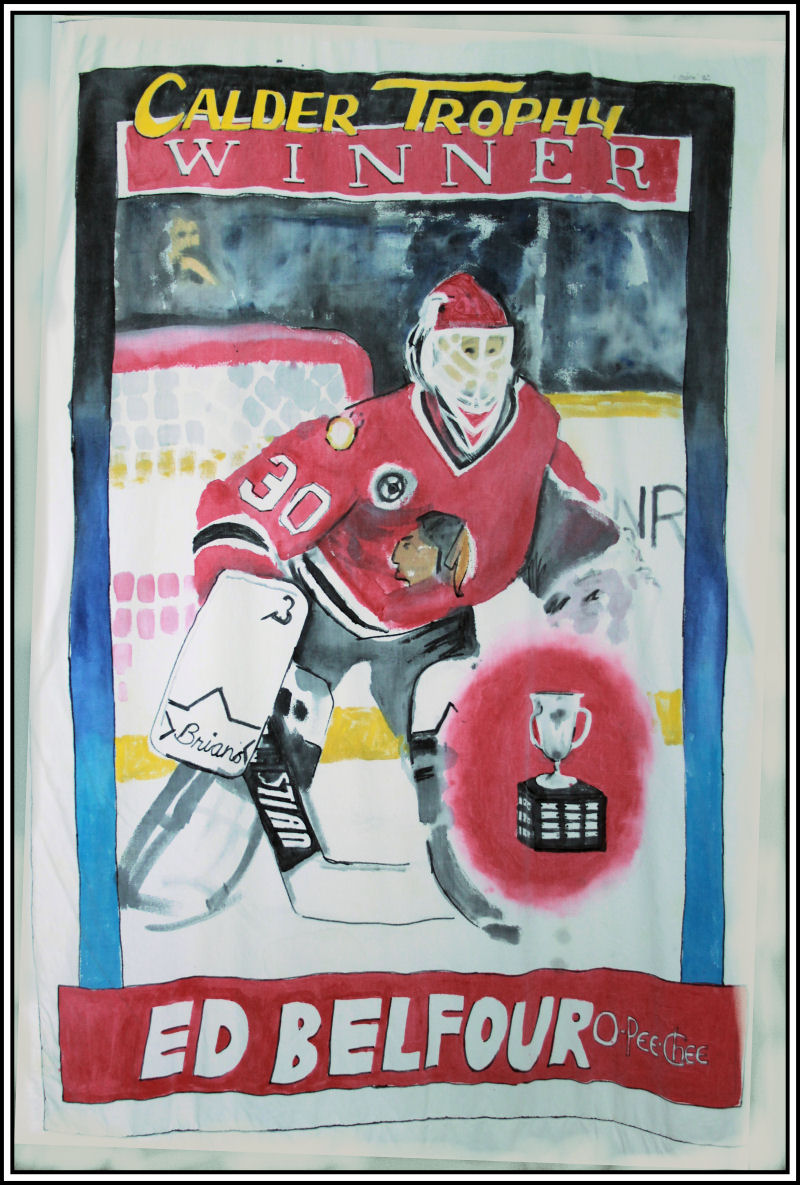 At the time these were made I was working freelance, mostly for interior designers. There were outside on-site jobs, but the work I enjoyed most was designing or matching and painting fabrics at home. I’d be given a fabric sample, a room theme, or sometimes only one word as inspiration, and a limited time to come up with an original idea, then produce it.
The standard business advice to keep professional and personal life separate might work great for companies buying and reselling someone else’s products, but does not really apply to artists. For me at least, work and home life flow as one. Creativity is always there buzzing around, and when professional work is not switched to “on”, it’s looking for something else to do!
Older work available
Sunday, November 21st, 1993
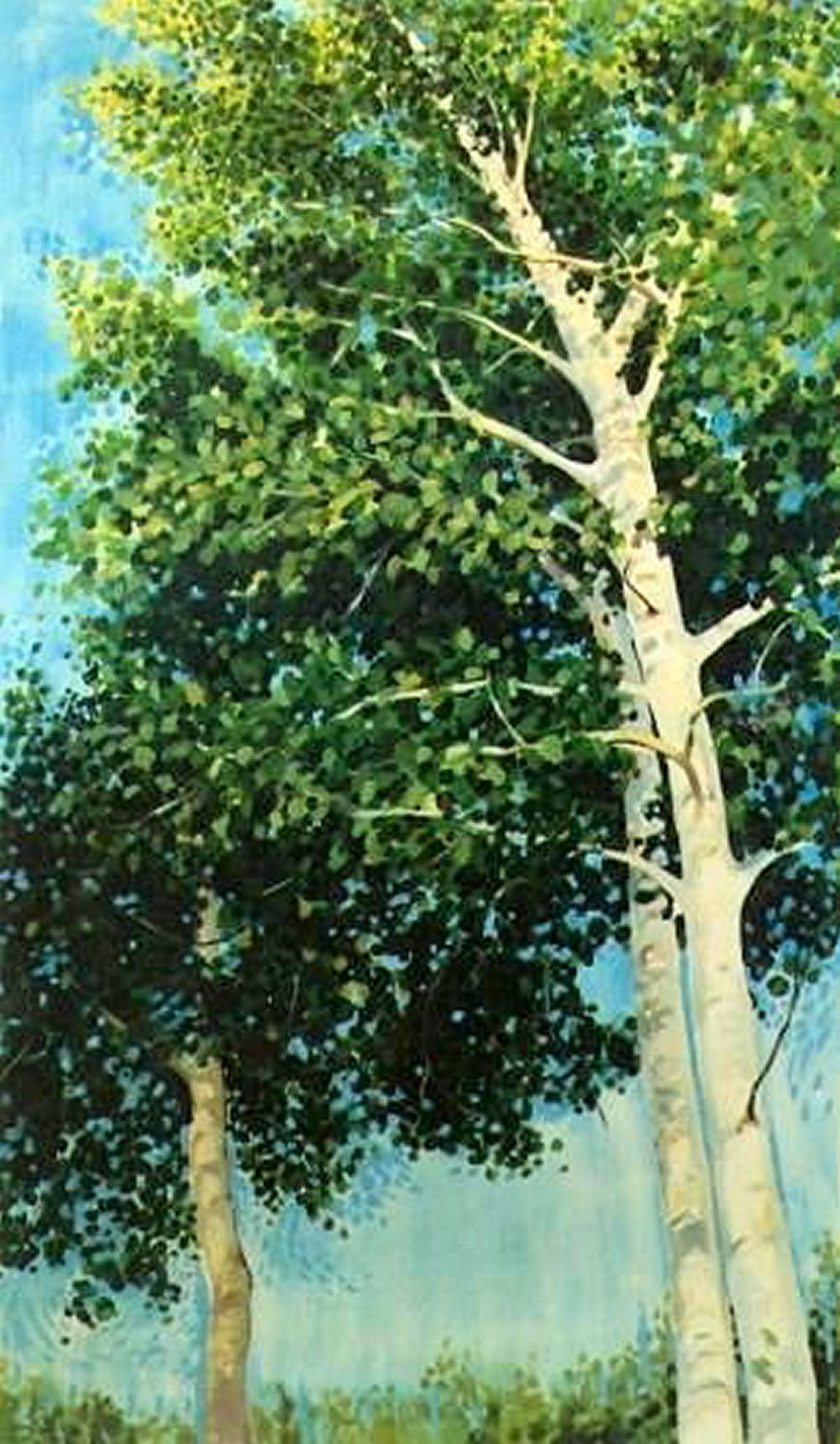
Poplar/Aspen, Maine, USA, 50H x 28W x 1 inches, 1993 acrylics canvas, wrapped sides painted, framed.
Prices lowered in 2016 for all older work.
$300.00 
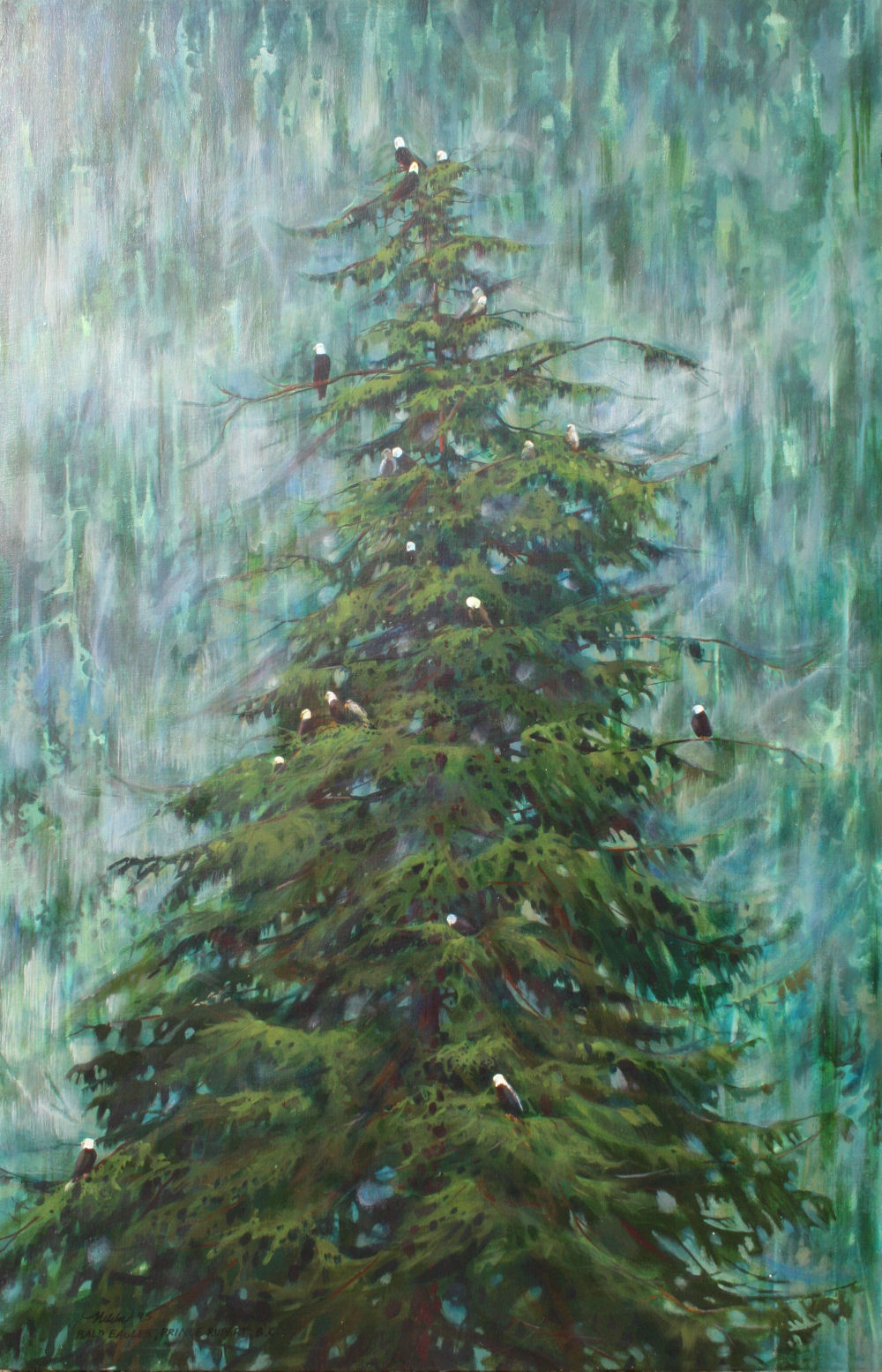
Bald Eagles, Prince Rupert BC, Canada, 44H x 30W inches, acrylics on canvas
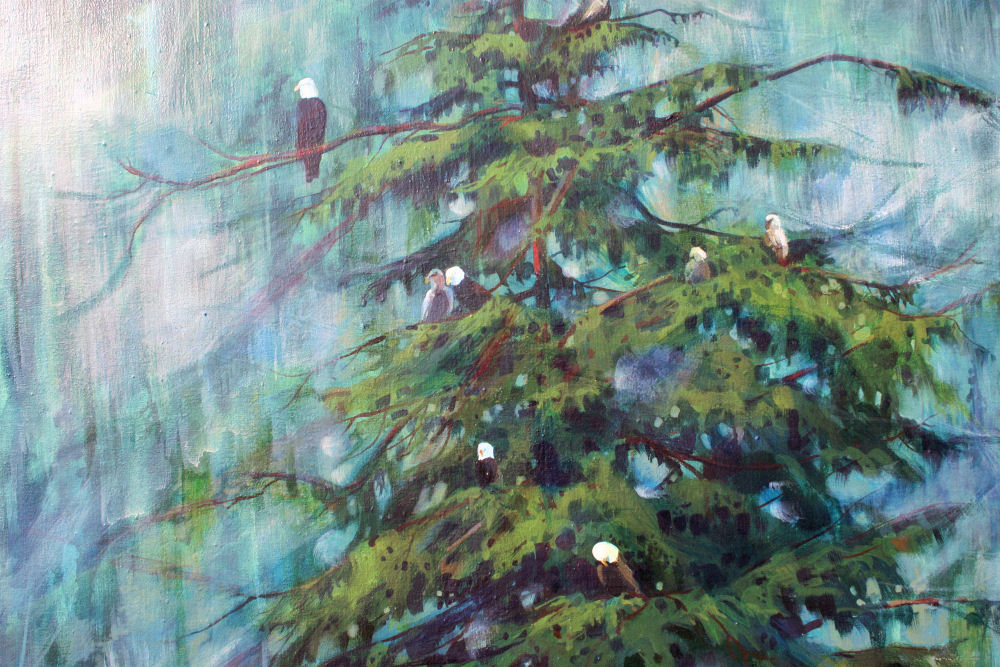
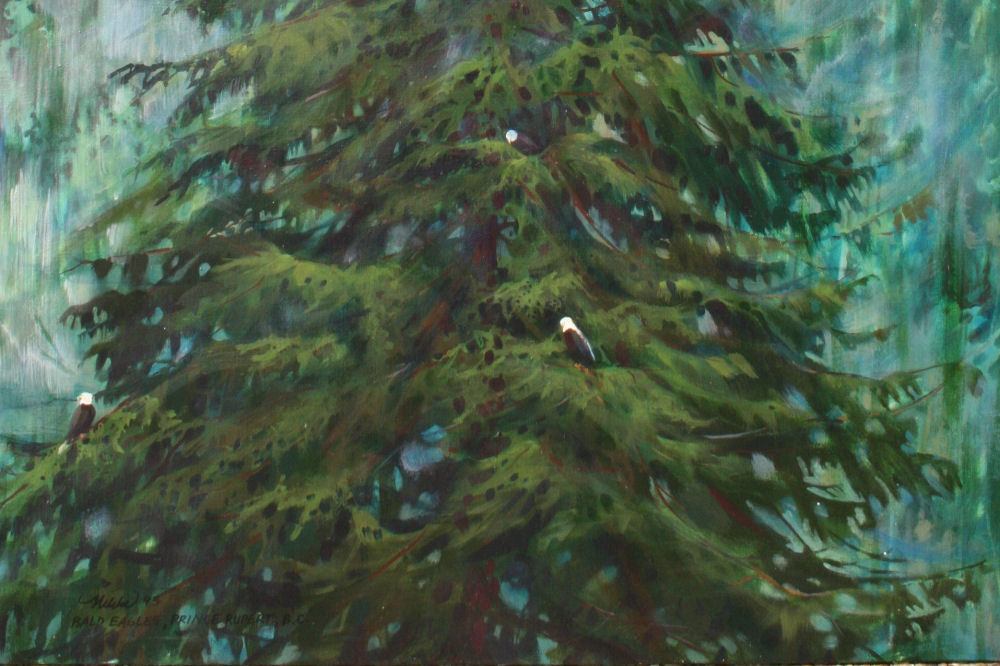
$350.00 narrow trim frame
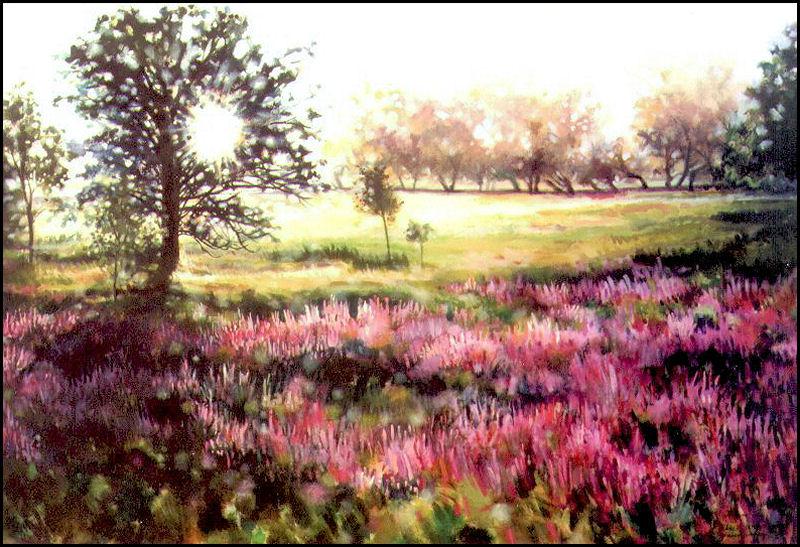
Loosestrife, 41H x 58W 1996 acrylics on canvas, price lowered
$500.00