Abstract/Realism
« Previous EntriesFlamboyant Tree flowers and seed pods
Thursday, December 6th, 2012
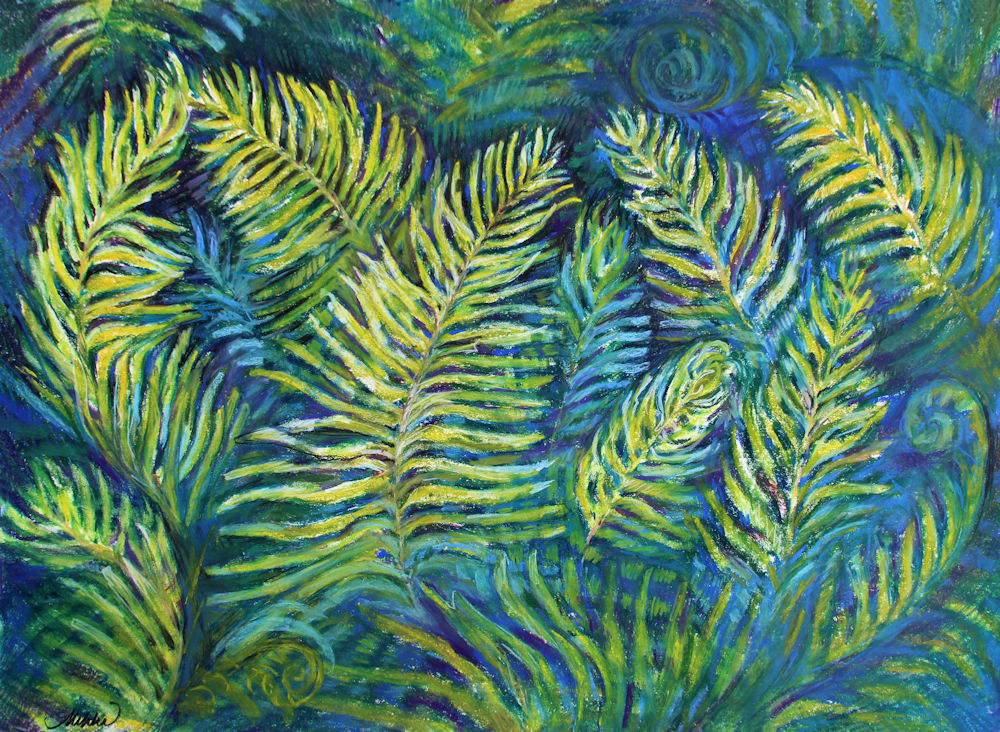
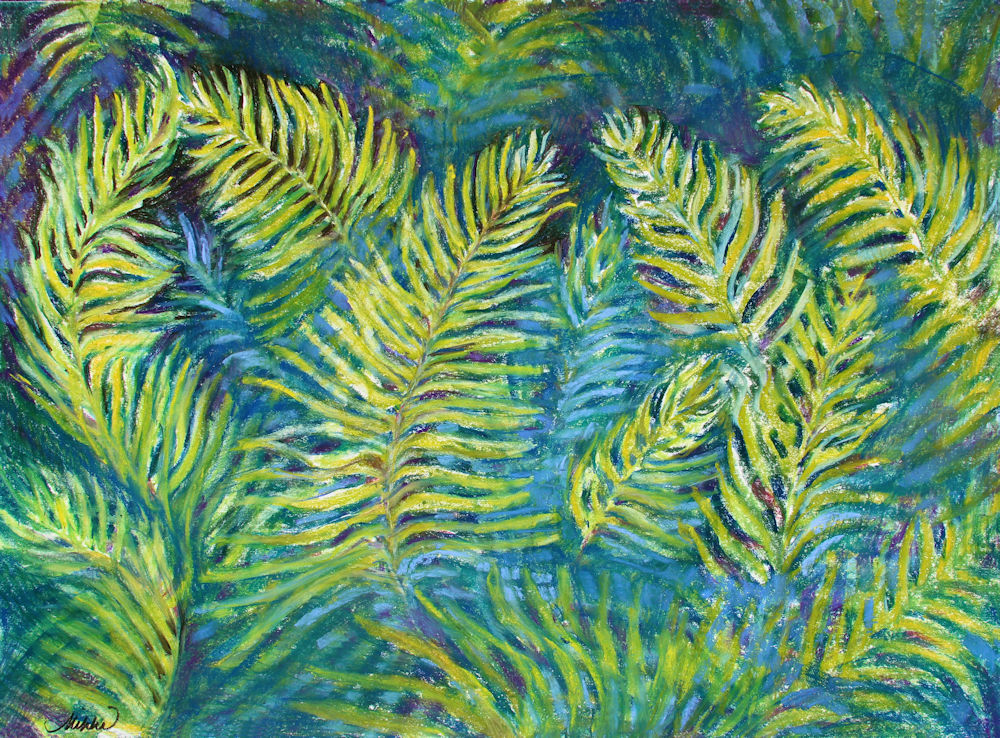
Flamboyant Tree flowers and seed pods (Chapala, Mexico), 9 x 12 inches oil pastels on paper. I started this before ‘Deciduous Forest’, posted previously, so finished it while the resist medium dried.
At the Alamo 02
Monday, November 5th, 2012
Stone walkway on the grounds of the Alamo, San Antonio, Texas 15 x 22 inches watercolors on paper
Missing routine
Thursday, October 11th, 2012
The Campsite, watercolors, 24 x 30 inches watercolors on 140 lb cold pressed paper
I finally brought my watercolor paints back from my son’s place in Canada, where I left them so they wouldn’t freeze on the 5-day drive back west last November. Driving again, I’ve just returned from this year’s visit, when I gave my grandson a one-of-a-kind fabric book hand-made for his first birthday (details posted next). I plan to make him something special every year.
So, a couple of new brushes and 12 x 16″ paper block, and now with the rainy season upon us back in Oregon, I look forward to establishing a routine of painting again. Invigorated by a summer full of gardening and flowers, the stunning scenery across America this time of year, plus reviewing archives of work I haven’t seen for ages, I’m all set to splash out some new watercolors. Our Portland house is a renovator’s dream (nightmare?), and we’re not out of the woods yet, so to speak. Attempting to gain back the focus more on art than house, smaller paintings are more manageable, and less of a production than my typically large canvas paintings…however, I’m curious to see how watercolors dis-behave on primed canvas at some point!
Stars in the Sweetgum
Thursday, June 28th, 2012
Stars in the Sweetgum,9 x 12 inches charcoal and colored pencils on paper, preliminary sketch of the extremely large Sweetgum tree in our side yard.
Portraying darkness offers an excellent color study. Inspired by travels on clear nights when speeding by tree silhouettes, there’s an illusion that horizon is absent, and stars are in the sky as well as the trees. I often marvel how dark skies can still be so intensely colorful and vibrant…ranging across the spectrum from rich teals, purples, to shades of red and orange.
Adding Color: the point of no return
Wednesday, May 30th, 2012
Chrysanthemums, work in progress; see previous post. Above: color details of 85W x 45L inches graphite, colored charcoal / dry pastels on white 100% cotton
When working with a large format, it’s easy to overwork the smaller areas. They’re like little compositions on their own. The trouble is, they may seem successful close up, but may not contribute to the overall balance and flow of the larger piece. Above are some examples, where I’m now reluctant to change what needs to be changed…but I will. Back to Art 101: It’s absolutely necessary to stand back often and study the entire composition from afar.
When you throw in a factor like color, there’s no turning back. I had a specific purpose for this drawing though; to fill a wall space in an otherwise fairly monotone, contemporary room. After much deliberation I kept with the original plan, which was to create a look similar to a black and white photo where one color highlights the main subject only. It was time to dive into the unknown.
It’s obvious that introducing color has compromised some of the original spontaneity, so to recapture some of that energy, I carefully try not to disturb what’s left of those livelier marks, and enhance some with little sparks of color. Isolating red, and only red to the central main flower sapped all the attention, so I’ve added more colors to it and the surrounding elements than initially planned. To continue risks ruining what is working, but there is no satisfaction in quitting, especially when the leaves on each side of the main flower look like wings! Back to the drawing board…(but not for much longer).
June 26th update: Hopefully those leaf-wings are no longer dominant! Now, after a period of study, just a few more strokes of primer in the right places may bring out more depth around the main flower.
Zen Garden #10 almost finished
Wednesday, November 10th, 2010
Zen Garden 10, 40 x 60 x 3 inches mixed media on canvas.
The final stages of paintings are often finished as they hang on a wall. As seen in a realistic room setting, it will be easier to spot a clearer path for the eyes to follow and make the composition more interesting. Some colors need to be re-enhanced to add more depth and definition. The texture continues around all 3″D edges. All paintings in the Zen garden series are wired to hang in any of 4 orientations; vertically or horizontally. Below: details of left central portion as seen in the above .
Zen Garden #09 and #10
Tuesday, November 2nd, 2010
Zen Garden 09 work in progress, 48 x 21 x 2 inches Mixed Media on canvas
The perfect painting in a room can elevate the atmosphere of the whole floor, and sets the tone for showing off the entire house. With selling the house in mind, I’m trying to choose a decent painting for our living room, but the only one that really looked good there was Zen Garden #2. It sold, so I decided it’s worthwhile to make two more for the series - even though painting walls is the order of the day.
Zen Garden 10 outline, 40 x 60 x 3 inches Mixed Media on canvas
Painting is always meditative, but I find it especially so when creating pieces in the Zen Garden series. This kind of work does not present the same kind of emotional concentration or intellectual challenges that other paintings do. There are few struggles and hardly any decisions to make, except to find cooperative materials. Once the outline is accomplished it’s pretty straightforward compared to other forms of painting. The outstanding difference is that each stage in these 3D paintings requires time and patience to allow areas to dry before proceeding. The Zen Gardens can be drying in stages while other work gets done too, and the multi-tasker in me is quite happy to be accomplishing many things at once!
Art supplies are expensive. Most will last long enough to justify purchases, and much of the time you get what you pay for, but some items are ridiculously overpriced. Keeping material costs down is essential so they aren’t reflected in the final price, but quality should never be compromised. Still, there are ways to get around any dilemma, and there are alternatives for everything.
When I started the Zen Garden series ten years ago using modeling paste and textured gels, jars were about $15 for 250 ml. Since then I’ve experimented with various unusual materials, and shopped everywhere to compare prices. It’s still more economical to purchase brand-name products in larger quantities – if you can find them. There are some fun mediums available now too, like gel with tiny glass beads in it. Prices for art supplies do not seem to waver over time in either Canada or the U.S., so I reserve the brand-name mediums to sculpt the rocks and highest quality paints do the finishing touches. Here I’ll share a few of the trade secrets I’ve discovered over the years, and you can create your own Zen garden painting.
As a base for the raked sand mixture, it’s worth purchasing a large 2 gallon (7.58 L) pail of textured paint. I purchased Behrs at Home Depot in Canada, and it looks like Ralph Loren has the market cornered in the States. Watered-down drywall plaster can be used also, but I recommend attention to how heavy the piece may be when it’s finished. Mix in copious quantities of white glue, large containers of white or light-colored acrylic craft paints, and anything water-based that will extend the liquid mixture and bind well with the dry ingredients. Sand, even popcorn kernals and/or rice can be added for texture. Other objects can be incorporated too…just use your imagination. For example, and this is my most valuable secret, unscented kitty litter from the dollar store, the non-absorbant kind, looks exactly like tiny stones and is light in weight.
Zen Garden 09 details: applying mixture with a knife, sculpting rows
The mixture can be put in a ziplock bag with one corner cut out, but I discovered that it’s more efficient – however messy – to spread small portions out onto the surface with a knife and hand-mold it. Keep a wet cloth handy to wipe your hands and the utensil often.
Drywall plaster makes nice-looking rocks, plus it cracks well for a parched-earth look, use sparingly because of added weight. Wood filler is a lighter alternative, much less expensive than professional brand gels and mediums. Modeling pastes do not lend well to sanding or carving when dry, but wood filler can be sanded and re-shaped.
Also, if it dries out completely, chop it up, add water then seal the container for a day or so. This is where you can experiment with whatever helps acheive 3D effects. Art, craft, hardware, department stores and dollar stores carry generic brand basics, so it’s worth researching and shopping around.
When it’s all dry, rocks and other details are outlined and painted with pure colors, then all covered with a coat of primer. The colors are all reapplied to further enhance rocks, then brushed white, skimming across the entire surface. This process is repeated until you are pleased with the results by a final coat of white with remnants of the layers of colors poking through underneath. As far as acrylic paints, you do get what you pay for, but price differences are mostly due to pigment quality and viscosity, which, until final stages is not really an issue. Inexpensive acrylic craft paints are perfect as a filler (only).
Zen Garden #10 (above and left) is already quite heavy, so about 1/4 of it will be painted rocks, keeping the sand patterns to a minimum. There is enough mixture that could dry out if it’s not used right away, plus it’s great to make multiples while all the mess, materials and utensils and are out, so I’m doing two simultaneously. There may even be enough for 3!
The neccessity of work, especially if it’s at home, seems less like a chore if you dangle some kind of carrot for yourself every day. Sometimes having too much to do is more exhillerating than exhausting. Each day, though work as an artist can be considered by others as play, the energy, motivation and circumstances are unpredictable.. It takes self-discipline to find a way to go with the flow and still get work done. The good thing about this occupation is that it is flexible in every way. The creative compulsion seeps into every other activity, and there is almost no way to not add a little something extra.
2D Pine Cone
Monday, April 12th, 2010
2D Pine Cone, diagonal 28 x 28 x 1 inches, acrylics on woven canvas, gallery wrapped sides painted, signed on the back so as not to intrude on the design. This is the 2nd attempt with larger woven canvas strips, hanging diagonally on a superimposed blue background.
More often than not, allowing some imperfections to show through says “a human made this”. Still, quality ought to be the result, and it wasn’t working (see version #1 below). The crooked pattern on the first woven canvas was impossible to correct, which I tried over and over many times. Then I made pine bristles from threads pulled from the sides of the canvas, painted various shades of green: time consuming and experimental, and also not successful, so I started all over with a new rewoven frame, above.
Left, April 8th: 2D Pine Cone, first version
There were second thoughts about opting to go the imperfect route in the weaving process right from the start. The canvas strips are not all the same size, a deliberate choice, and I assumed it wouldn’t matter, but the pattern of scales relied on the woven accuracy. The color combos are interesting, but things should be a bit straighter.
March 6th and 7th: 2D Pinecone, 28 x 28 inches, woven canvas strips, acrylics. Work in progress shows 1) weaving and 2) a very rough paint-sketch on the primed canvas.
Norway Maple: finished, combined posts
Friday, April 9th, 2010
Norway Maple in Madison, Wisconsin, 36 x 48 x 2 inches acrylics and modeling gel on canvas, gallery wrapped sides painted, narrow frame, finished April 9th
March 9th: Subtle changes since last post…have been working more on tones in the background, which weren’t planned initially; I had hoped to use only pure colors without the usual layering, but it’s otherwise too hard to look at. Also am connecting a few shapes horizontally, and it’s almost “there”, but 2D Pinecone was started in the meantime to avoid overworking this.
Merging Visions Exhibition
Tuesday, April 6th, 2010
Milkweed Melody, 27H x 33W inches framed Oil Pastels on 140 lb cold pressed premium watercolor paper
Partnering with poet Christina Smith and her poem, Earth’s Love Song Milkweed Melody is showing April 1st – 30th at the VAST (Visual Arts Society of Texas) and Denton Poets Assembly collaborative event, Merging Visions Exhibition, with art and poetry at both the Emily Fowler and North Branch Libraries, Denton, Texas. Opening Receptions Saturday, April 17th 10 a.m. – 12 p.m. at Emily Fowler and 1 – 3 p.m. at North Branch
« Previous Entries