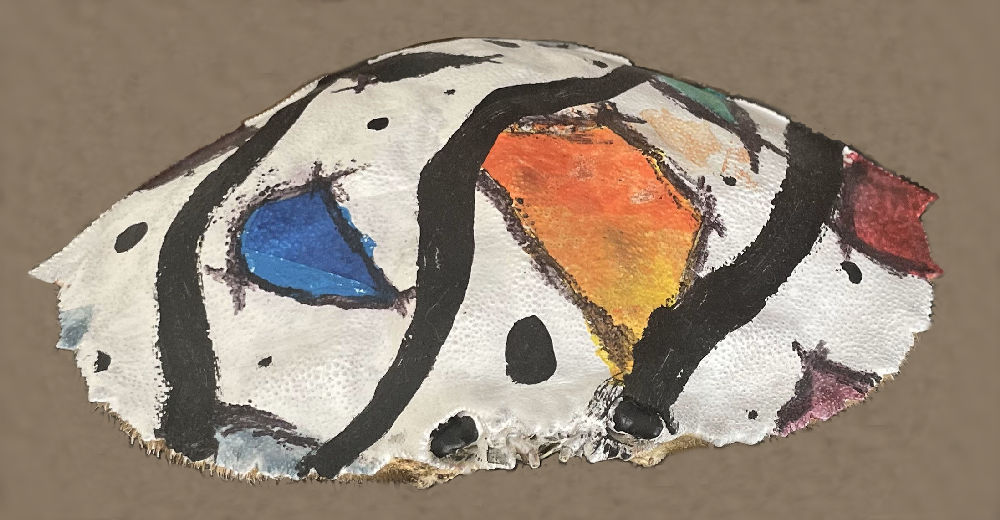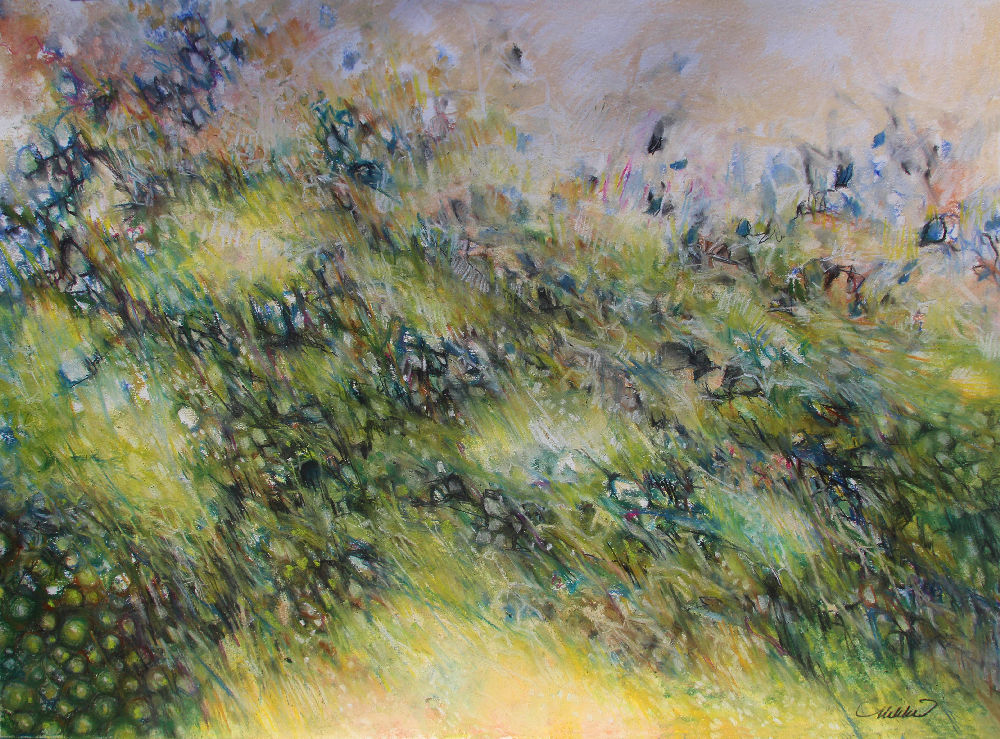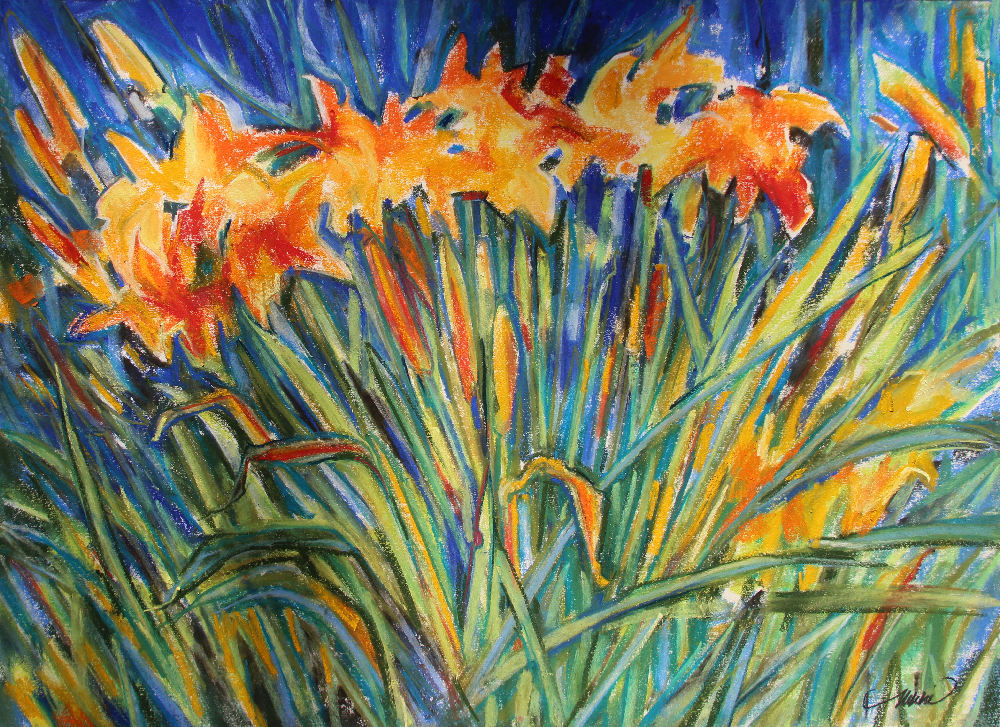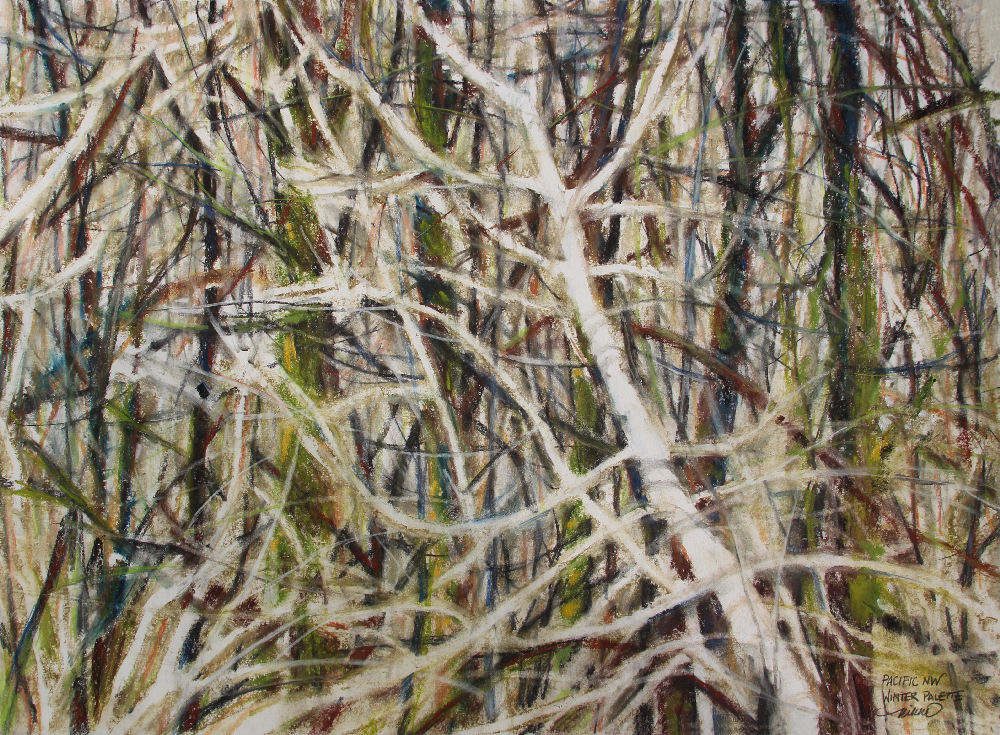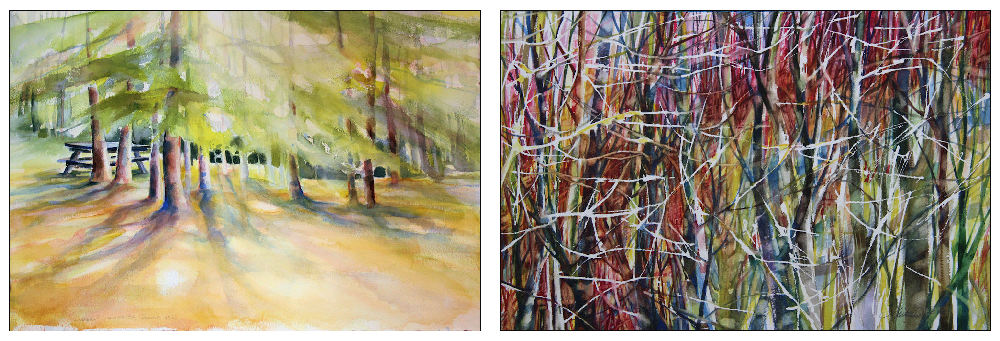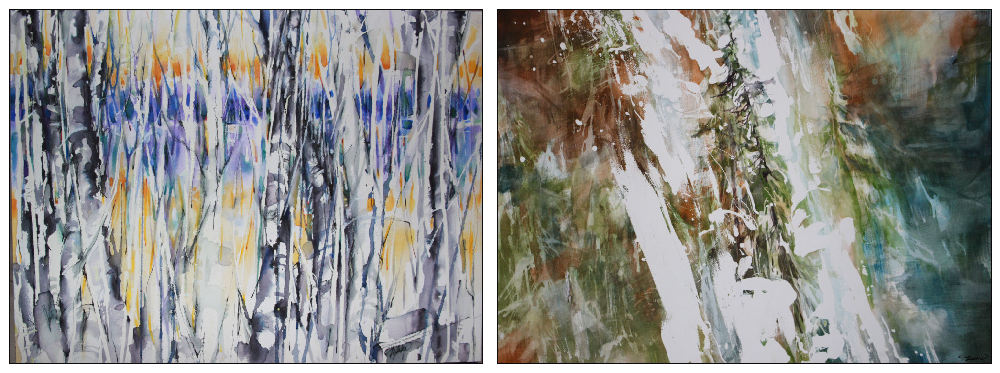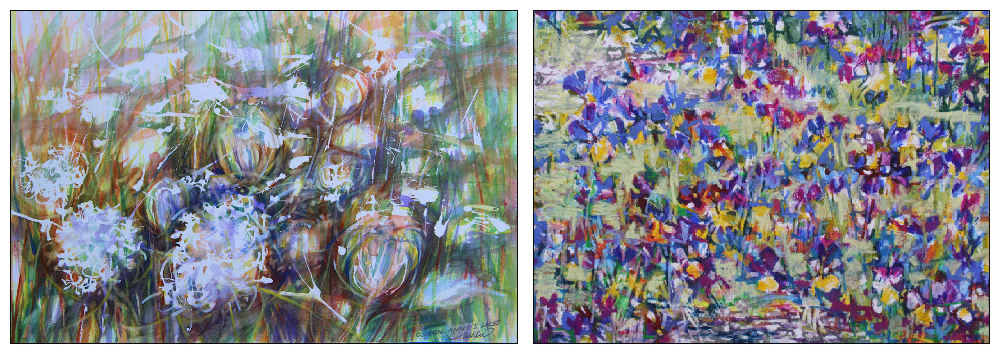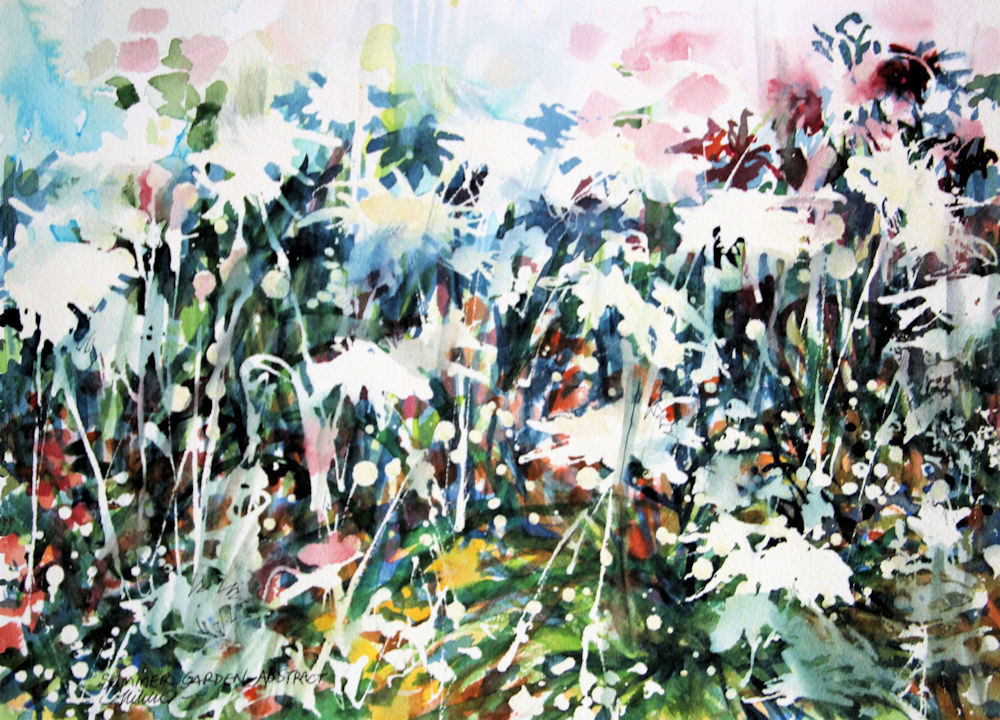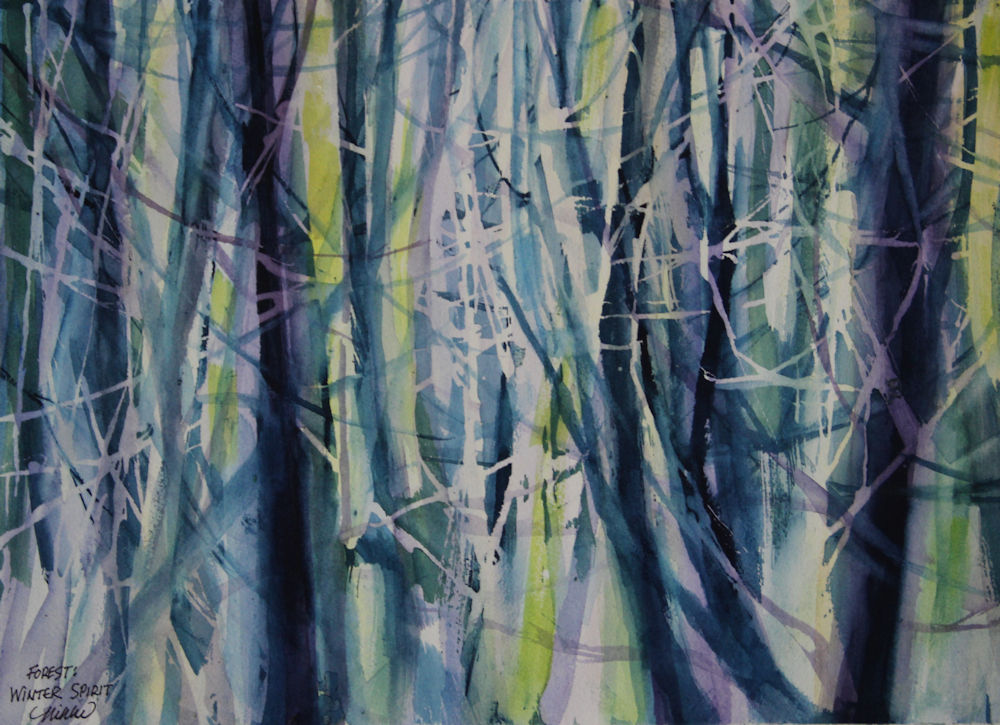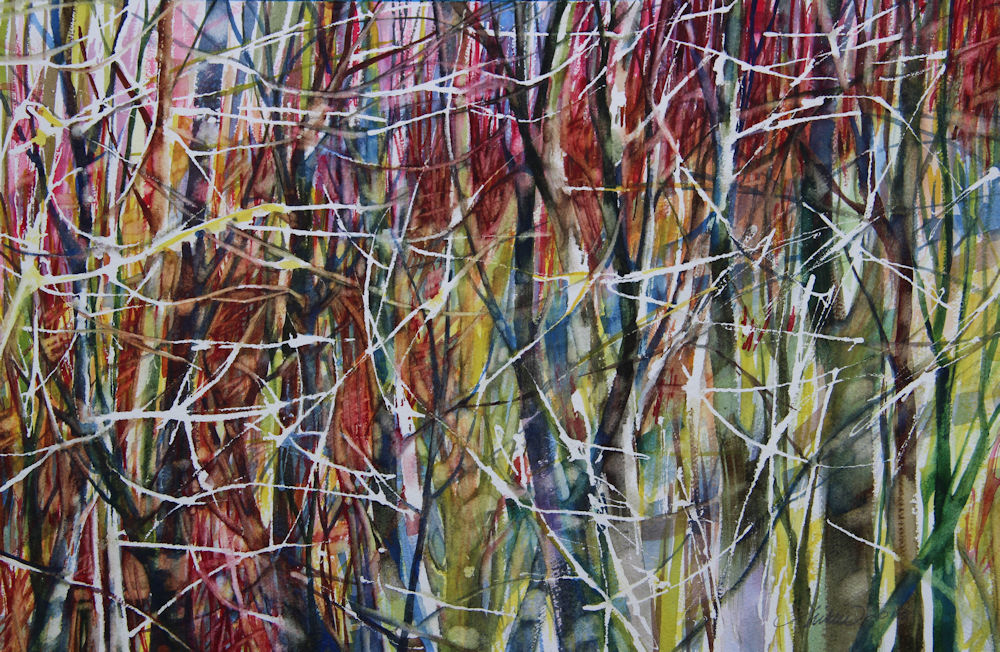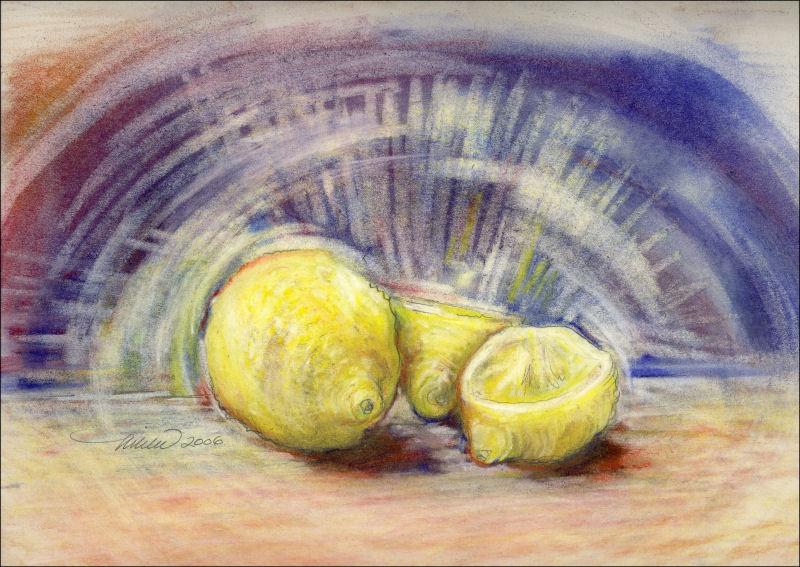
When life gives you lemons, draw them, 11 x 14 inches dry pastels, graphite on paper

"When life gives you lemons, draw them". (Nikki)

"...the painting has a life of its own. My mission is to bring forth this life". (Jackson Pollock)

"Trust your intuition, it's just like goin' fishin'; you cast your line 'til you get a bite." (Paul Simon)

abstract

« Previous Entries

Stepping Stones

Friday, March 25th, 2011

Zen Garden #01, 48 x 36 x 2, Nov. 2000, mixed media on canvas, 3 in. box frame, sold1.Prickly Pear Cactus, acrylics pins around 48 x 36 x 2 in. canvas, 3 in. box frame, Nov. 2000 - sold2.

Alpine Meadows, Acrylics using palette knife on foreground flowers, 48 x 36 x 2 in. canvas, 3 in. box frame, sold3.The Evolution of Communication, 48 x 36 x 2 in. acrylics on canvas, computer keys and handmade tiles in frame, 2000 - sold4.

While I was in Portland two weeks ago I completed five new Zen Gardens, filling a request for one. All five are smaller, slightly different versions of ones made previously. Four are shown in thumbnail images below.

The very first Zen Garden was created in 2000 as part of a four-painting commission. The ideas established in that set foreshadowed new routes to trying methods I hadn’t before, like enhancing my paintings with 3D elements. That set is also the origins of the “box frame” design that I’ve used on several other paintings since then, where each main canvas is mounted on a wood platform, framing the work with about four inches of extra play-space.

Whereas some frames have the effect of abruptly ending a composition, this type of frame enables space for the subject to continue, softens the edges and adds an interesting twist to the overall impression. When items related to the main subject are placed in that area it adds dimension, not just in the physical sense, but also in the conveying of any abstract or symbolic stories beyond the presentation of the main painting inside.

Because of the challenges acheived in those paintings, 1) a series was born that I’ll continue with for the rest of my days. In Prickly Pear Cactus, 2005 acrylics and pins on 8 x 10 in. canvas, sold but will take commissions for other versions2) Prickly Pear Cactus, pins were applied around the main central frame, then painted. The smaller canvas done during 2005 (left) borrowed this technique, and the same principle of attaching things to the main frame can be used with any number of objects.

In 3) Alpine Meadows, I learned to use all the qualities acrylic paints offer by watering down the consistency for the distant mountains, then sculpted the flowers and grasses with a palette knife on the lower portion. Finally, the theme of 4), The Evolution of Communication has intrigued me ever since, but I still haven’t fully pursued the possibilities. This is the perfect means to learn about Art History hands-on by attempting to recreate it in some form, then to share that adventure and ideally, inspire interest in the topic at the same time. Two old keyboards have been collecting dust in my studio closet for a number of years, yet to be disassembled and incorporated into a new series of work with similar associations.

~

Some of our peers advocate that if we don’t concentrate our efforts to learn one medium well, we will never excel in any. They are right of course, in many respects, but scores of artists are not content with singing just one note. Some simply cannot. To be fair, what works for one does not work for another. Each of the above paintings are examples where a combination of skills and different media in one piece can be very effective. I’m here to say that integration is possible! It’s a longer, meandering road..but it is possible.

Zen Garden 09-02, 30L x 15W inches, mixed media on canvasThere are so many different paths artists can take, long and short term; opportunities every day. There are endless kinds of subjects, ready-made and unconventional materials, always something to start or finish, new methods to explore, and an overabundance of ideas to attempt in one lifetime. Self discipline is the order of every day, either to start working or know when to stop.

My philosophy is that doing something, unless naturally in need of rest, is better than doing nothing. However, being overly ambitious in too many areas is also how I, along with millions of other artists end up with a variety of different kinds of art (or just stuff!), and the arguements endorsing one type of study come into play. Should we restrain ourselves when it comes to making “stuff”? Why is consistency given more support than variety when it comes to showing and selling art?

Whatever choices we make; whichever direction we take depends mostly on the intention for the finished products. Who is it for, do you want it to sell it, where, how, and how quickly? Was work done as a personally cathartic process, as a lot of art is? …or is it just a thing with no emotional attachments or brainy messages? Artists who support themselves by offering a range of services, satisfied and busy enough by word-of-mouth sales, do well jumping from medium to medium. If the hope is selling work through galleries and art dealers though, what some call “too many voices” are apt to be a disadvantage.   Zen Garden 10-02, 18L x 24W inches mixed media on canvas 

In one of his recent articles, Robert Genn writes sensitively about multi-media artists. While he supports that “for artists, exploration is like oxygen” and that ”the nature of our game is to be distracted by our muse”, he also recommends that artists must present consistency in our approach if gallery exhibition/sales is what we pursue. 

When a gallery represents an artist, they expect an overall consistent look and a clear statement. Where venues sell a number of artists’ work, the ambiance cannot be one that resembles a yard sale. If potential buyers view too many styles, subjects or media in one place or by one artist, they tend to lose interest, resort to window shopping, and walk away empty-handed.

Zen Garden 02-02, 30L x 15W inches, mixed media on canvasI can relate to that: the effect is like standing in the toothpaste isle at the pharmacy, where the senses are bombarded with colorful packaging, alluring titles and fine-print promises. Assuming beforehand that the choice would not be anything but simple, there have been times when I’ve said ‘forget it’ and gone back another day. With art sales though, you don’t want buyers to come back another day, because it may not be your art they choose then.

Gallery owners and dealers do not do us any favor if they display too much variety in typically limited spaces, so Mr. Genn has an excellent suggestion: bring art done in different medias to different galleries.

He also says to keep working no matter what.

Artists have a strong sense of mission. Periodically it needs reevaluation, and with that bigger picture clear, we create the way as it unfolds before us. If we are serious about selling, we first need to become familiar with what we are best at, what we love, what works and what doesn’t. We need experience in order to learn – that takes time – and there’s no getting around it. Experimentation is fundamental to this profession, but if it’s intended to be sold to others and by others, simplifying the look and clarifying the purpose of our art is crucial.

Zen Garden 02-03, a squished version of 02, 18L x 24W inches mixed media on canvasA viewer at one of my exhibitions commented, “You’re all over the place, arentcha?!” As disturbing as that was, it’s true and I needed to hear it, eventually concluding that I do need to clean up my act, but at the same time this is how I work. This is how my stuff works. Every so often there are paintings or a series of works that encompass all that’s been learned and all that I’m capable of; breakthroughs that define a solid new direction or validate the existing one. The commissioned set of paintings described above were like that, and their significance is still an influence on today’s work and will be on tomorrows’ too. They verified that I’m on the right path even though much of the time is spent off of it, experimenting. I call it serious play and paying attention… “playing attention”! Once in a while the bits and pieces come together in one big rewarding “Eureka!”.

Summer travels

Friday, August 13th, 2010

  Archean rocks, Lake Superior just east of Wawa, OntarioArchean rocks, Lake Superior just east of Wawa, OntarioLichen, Lake Superior just east of Wawa, OntarioLichen and distant shoreline, Lake Superior, Ontario, CanadaLichen, Lake Superior just east of Wawa, Ontario

When I’m back in Dallas blogging regularly again, these photos will be posted on the photography website. An unplanned extra trip from Alberta to Ottawa; in Ontario a second time, means I won’t be back until the first week of Sept. Here are a few photos I took on the shores of Lake Superior just east of Wawa, ON.

Stars and Fireflies

Sunday, June 27th, 2010

   Stars and Fireflies, photoshop

Home from Singapore for a few days, and having to go north to pack up the Dancing With Trees exhibition, I drove up to Ontario first so I could see my sons in Canada before Christmas. At night in the fields and trees from Tennessee to Michegan there are stars and fireflies in the trees – so magical! Until I can express it in paint (and I must!), here is a quick photoshop impression.

One in a million

Thursday, May 6th, 2010

Artwork: Waiting For The Sun by Virginia Wieringa, 24 x 36 inches acrylics on canvas

Waiting For The Sun by Virginia Wieringa, 24 x 36 in. acrylics on canvasFortune? sure, of course. Fame? mmeh! I could manage happily without. The pop group Pearl Jam has a recent song with a beautiful title, ”Just Breathe” with a couple of lines that state, “I’m a lucky man to count on both hands the ones I love”. While I’m not a man, I feel likewise as fortunate.

However, an extra hand is now required because I just met an artist-pen-pal whom I never expected to meet, and she’s as intelligent and enthusiastic in person as she has been online for the past four years. Virginia is adventurous and open-minded, yet soundly rooted in her spiritual faith – and therefore so is her art . I especially enjoyed the little 4 x 6″ sketchbook that she shared with me, where a number of ideas for paintings originate as she draws in it during church sermons. I think it’s really funny that she doesn’t listen in church….but she does hear, and she doesn’t preach, she works… and her work speaks volumes. I’ve mentioned Virginia in previous posts – she’s been so supportive, even promoting my work on her own website. Thanks “VA”!

Sounds of Silence

Thursday, October 15th, 2009

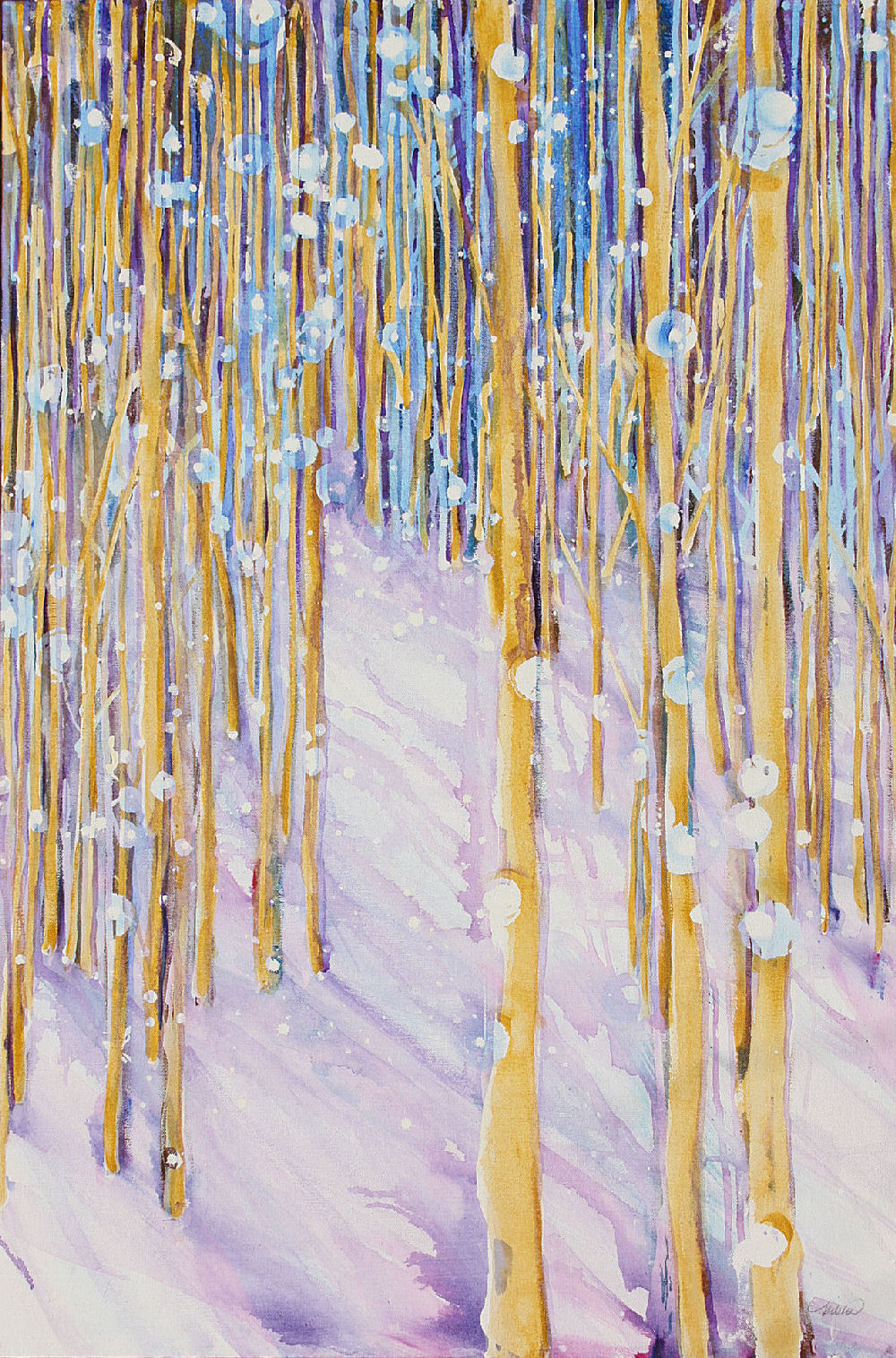
  Sounds of Silence, 36 x 24 x 2 inches acrylics on canvas, gallery wrapped sides painted

Sounds of Silence, 36 x 24 x 2 inches acrylics on canvas, gallery wrapped sides painted – finished today. After  a second application of mask medium only on the snowflakes this time, some unbleached titanium and yellow ochre brought color back to the trunks. Snowflake mask was then removed. Still deciding on a price for this, and Dawn at Bell Rock also.

  Sounds of Silence, Phase 01, 36 x 24 x 2 inches acrylics, masking fluid on canvasSounds of Silence, Phase 02, 36 x 24 x 2 inches acrylics, masking fluid on canvas

 Oct 13th, above: Phase 01 and 02

 Sounds of Silence, pulling off rubberized masking medium and a few layers of paint Sounds of Silence, highlighting a few snowflakes

Oct 14th, Phase 03 and 04: Mask medium removal, then highlighting snowflakes.

P.S. View Virginia Wieringa’s coincidental blog entry: a relevant poem by Thomas Merton, and an icon painting entitled  Holy Silence.

Grackles

Thursday, June 18th, 2009

 Grackles, 11 x 10 inches dry pastel and graphite on paper

Grackles 11 x 10 inches dry pastel and graphite on paper, tidied up with some digital work

The Dallas area is notorious for its Grackles. In some areas they gather in flocks by the thousands – I’m not exaggerating – especially notable during evening just before sunset; bird parties I call them, lined along telephone poles and wires, sitting perfect wingspans apart from each other, and packed full in the trees. Photos can’t capture it all, because the experience also includes their loud calls. They are fantastic to see and hear.. I love it, but they’re a nusance in public places like near restaurants and malls. Park your black car under a tree if you don’t mind driving away with a fairly white one when you leave.

Paint Arson

Thursday, March 26th, 2009

 Paint Arson , 11 x 11 x 3 inches acrylics on canvas, gallery wrapped sides painted

  Arson, 11 x 11 x 3 inches acrylics on canvas, phase 1 work in progressArson, 11 x 11 x 3 inches acrylics on canvas, phase 2 work in progress

Paint Arson, 11 x 11 x 3 inches acrylics on canvas, gallery wrapped sides painted: finished, and phases 1 and 2.  Most of the Magic Square series are signed on the side, so the signature is superimposed.

Buying a new jar of Cadmium Red medium hue was just the thing to reboot, then re-route some old habits I was falling back into, like over-working paintings. Here I began with a lush Redwood forest in mind, thinking I could safely stir up some inspiration with the hot scarlet under my usual cool green palette… I did not intend to start a fire!
A new color invigorates the work process like nothing else can, and adds renewed life to your results as well. Incorporated as a base, straight out of the tube or mixed with your usual palette, a new color changes everything. Here now, as the painting is seen in the second thumbnail, there’s nothing I can do except follow it and see where it leads. The strength and intensity of this color as a base is dictating a whole other unintended but interesting direction, and it’s in charge for a while. I hope I can manage it.

Painting, whatever the subject may be, is a journey through all kinds of unanticipated thoughts and associations; some are short and sweet, ending within 1 - 6 hours and not much more than a visual, but some are packed full of adventure that isn’t even realized until surfacing from a few hours of work.

The forest fires were still-smoldering when we walked through the Californian Redwood and Sequoia forests last November, and my memory lapses into romanticized imagery of smoky rays of light in the sunset. It’s perplexing that the effects of forest devastation could be so pretty when the fact is that just the week before, a raging fire was the cause of all that beauty, and not just the smoky sunset, but fire enables the entire forest to flourish. As I’m painting this I’m thinking about all kinds of  how fire is a naturally occurring event like rain and snow, and is an essential part of forest cycles…and of how fire is destructive but supports renewal and re-creation as well.
Fire opens pine cones to disperse their seeds, controls pests and disease. By burning weeds and weaker trees that rob sunlight and nutrients from healthier trees and plants, it also clears the way for new seeds to sprout. Ash aerates, and contains properties that determine the quality of soil and what is able to grow there. Realizing that certain trees only regenerate with the aid of fire, like the giant Sequoia cones only release seeds through fire, today’s standard fire management practice is to allow naturally occurring forest fires to burn, still with a mind to sensibly control it.
So what element does it take to open a painter’s eyes to new possibilities? A jar of Cadmium Red medium hue!

Myrtle At The Zoo

Monday, March 9th, 2009

Myrtle at the Zoo, finished 11 x 11 x 3 acrylics on canvas, gallery wrap sides painted 

 Myrtle at the Zoo, 11 x 11 x 3 acrylics on canvas, phase 4 bottom side detail

Myrtle At The Zoo - Crepe Myrtle branches and seedpods before pruning, February at the Fort Worth Zoo, Texas. 11 x 11 x 3 inches acrylics on canvas, gallery wrapped sides painted.  Top: finished, center: bottom side detail, two thumbnails below: phases 1 and 2 in progress. The signature on most of these ‘magic squares’  is on the side so it is digitally added here – see how much a signature can intrude on the front of the work?

 Myrtle at the Zoo, 11 x 11 x 3acrylics on canvas, phase 1Myrtle at the Zoo, 11 x 11 x 3acrylics on canvas, phase 2Myrtle at the Zoo, 11 x 11 x 3acrylics on canvas, phase 3

Many of the issues were worked through on the previous larger version, and I’m pleased with this boxy little painting…still not completely satisfied that I’m finished with this subject because it’s so complex, it’s like a puzzle that’s nagging at me to figure out, so will probably attempt this same painting at least one more time.

Ceiba Leaves

Sunday, March 8th, 2009

Decaying Ceiba Leaves, 11 x 11 x 3 inches acrylics on canvas, gallery wrapped sides painted

Ceiba Leaves, Lake Cote Cloud Forest floor, Costa Rica, 11 x 11 x 3 inches acrylics on canvas, work in progressCeiba Leaves, Phase 2, 11 x 11 x 3 inches acrylics on canvas, work in progress

Decaying Ceiba Leaves, Lake Cote Cloud Forest Reserve, Costa Rica, 11 x 11 x 3 inches acrylics on canvas.

Jone’s Falls

Tuesday, March 3rd, 2009

 Jone's Falls, 11 x 11 x 3 inches acrylics on canvas, finished

Jone’s Falls,  near Thousand Islands, Southern Ontario 11 x 11 x 3 inches acrylics on canvas, finished. April 11, finished: I scratched some barely noticable lines here and there, and they break up the space  into sections now, if you compare the 3rd thumbnail and the finished piece. This is exactly why paintings need to sit off to the side for a while. With new eyes a few weeks or months later the finishing touches will suddenly be obvious, or there will at least be renewed confidence about what else to try that might work..

 Jone's Falls, mapping out composition, removing paint with clothJone's Falls, phase 2 work in progress, 11 x 11 x 3 inches acrylics on canvasJone's Falls, phase 3 work in progress, 11 x 11 x 3 inches acrylics on canvas

Left, February 28: mapping out composition by washing off damp paint with a wet cloth. Central and right, March 1: experimenting with limited palette, work in progress.

« Previous Entries