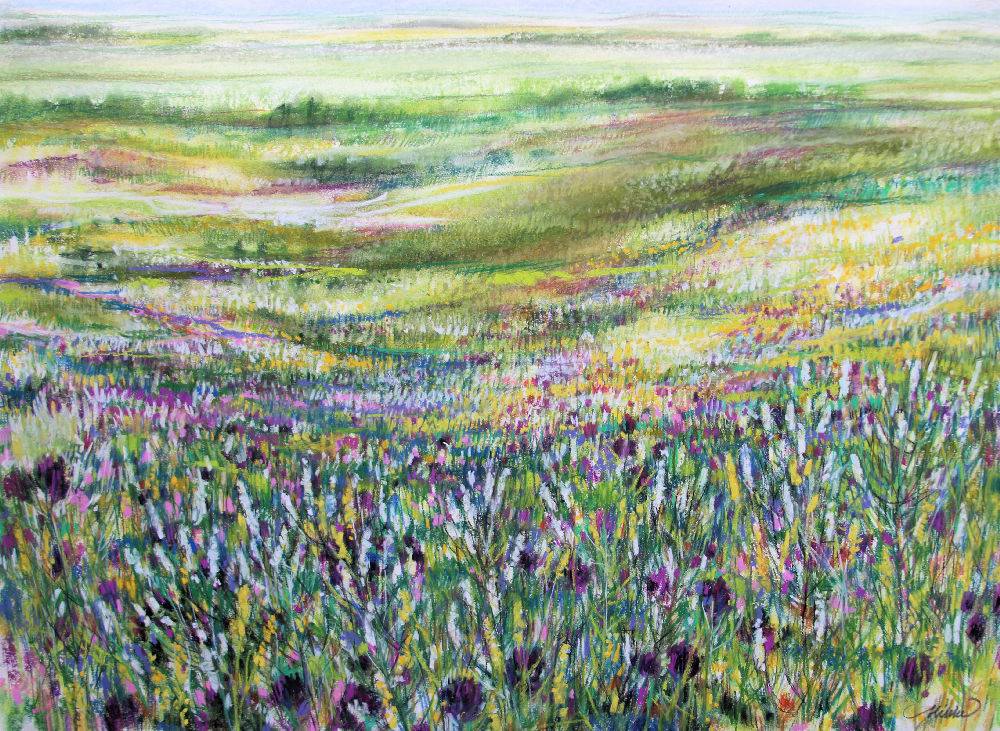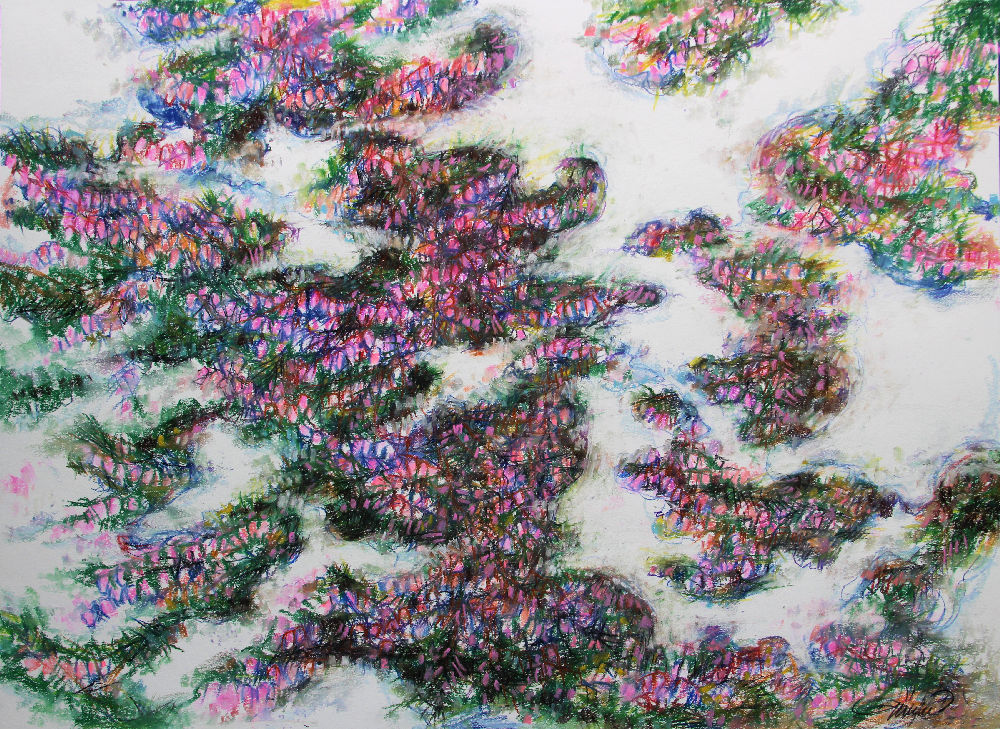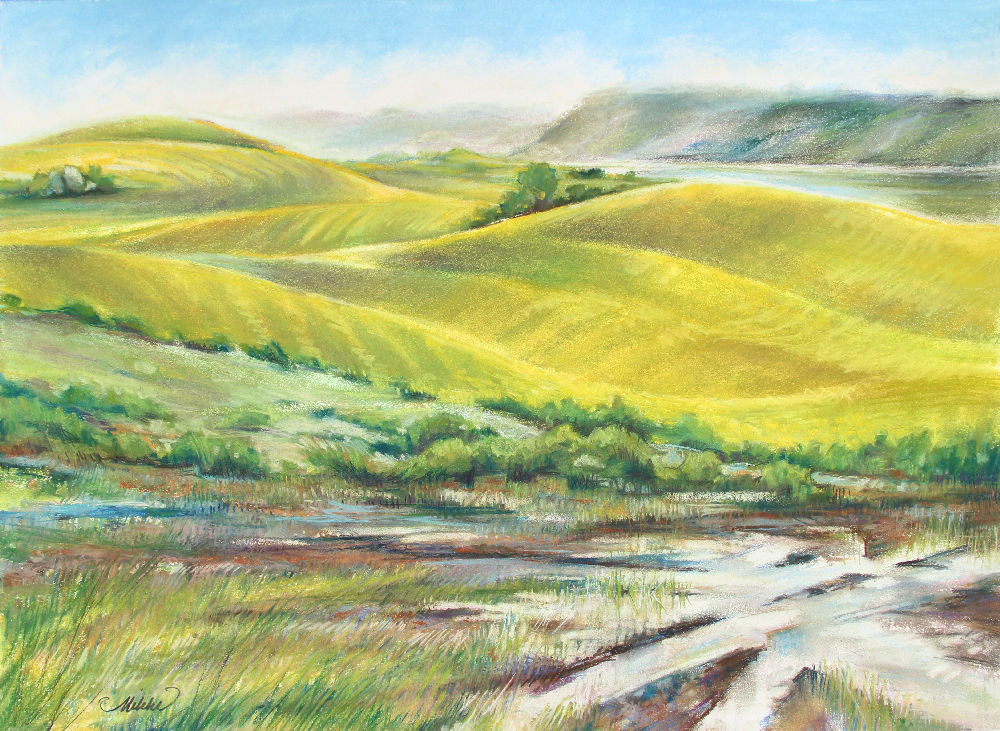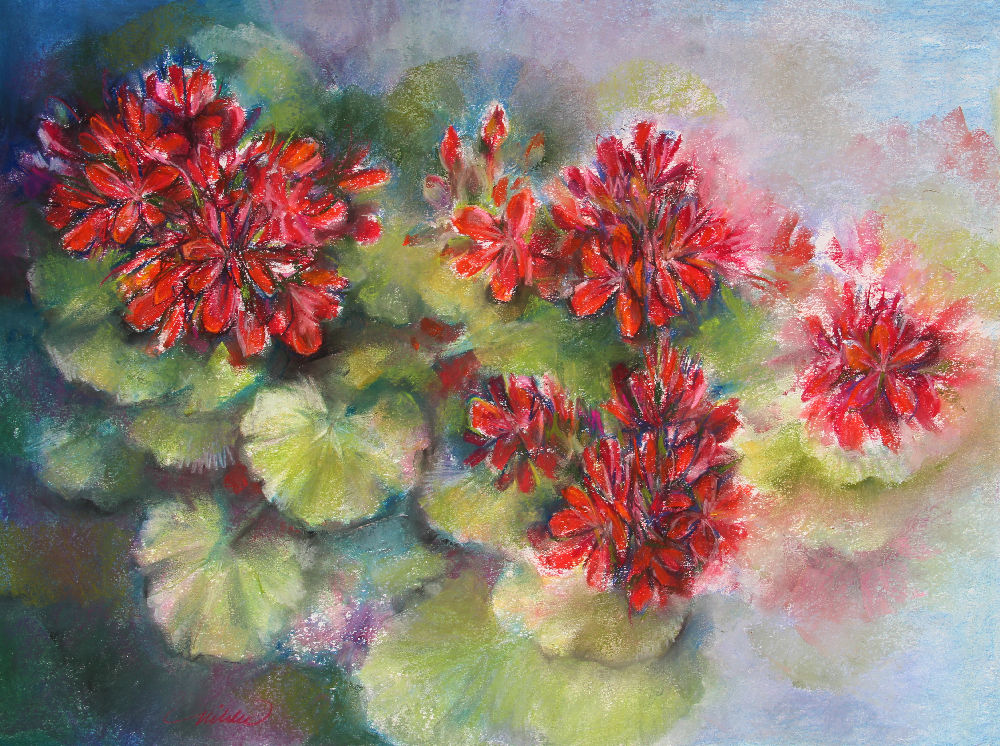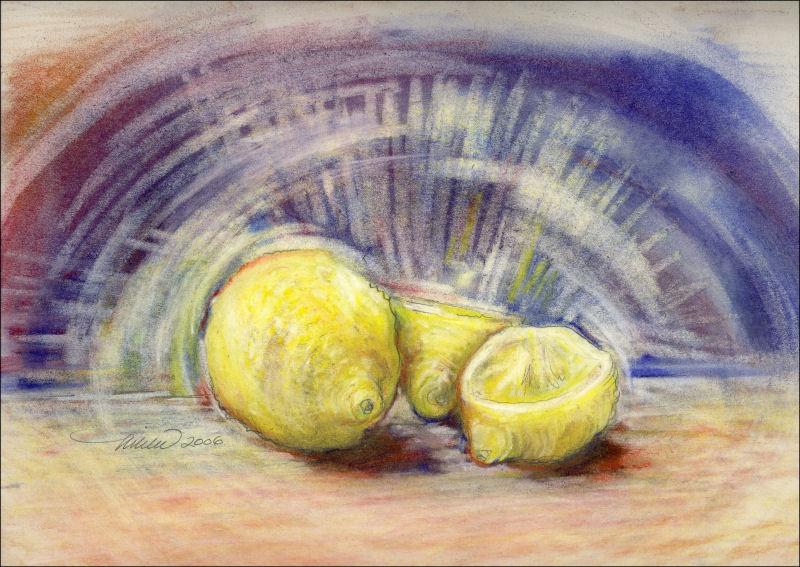
semi-impressionist
« Previous EntriesFraming on Northern Delights 02 update
Tuesday, December 14th, 2010
Northern Delights 02, 24H x 36W inches acrylics on canvas, adhered to a 36H x 48W x 1D inches canvas. Mask/resist medium was used to maintain white spaces and pure colors in both sections.
The central painting was started in 2008, and the framing dilemma resolved today – a perfect example where some paintings just need to hang around for a while before they are well and truly finished.
I began extending the scene of the central painting onto the back “frame”, a 36H x 48W x 1D inch canvas, in the same style, but stopping for a coffee break, then coming back with fresh eyes, decided to quit in the early stages. I’m pleased with the clash of styles – a rather impressionistic style framed inside an abstract. Art is the best place to exhibit any rebellious tendencies! Besides, formal frames can sometimes cut off the energy of a composition too abruptly. Every painting does not need a frame, but finishing the edges should always be considered.
Here is the finished painting as it was previously. I used masking medium to block out areas that are intended to stay white, and am continuing the same technique on the back frame.
On exhibit
Friday, July 9th, 2010
On exhibit at Oxide Gallery, Denton, TX
Dandelions, 16 x 20 acrylics on canvas, dark brown wood frame with red trim design. Total size 22 x 28 inches, Bonsai Garden, Chinese Gardens, Singapore 9 x 12 inches graphite on paper Milkweed Melody, 27H x 33W inches framed Oil Pastels on 140 lb cold pressed premium watercolor paper, Seasonal, 36 x 24 x 2 inches acrylics on canvas, gallery wrapped sides painted, narrow frame
Seasonal: finished, and process
Tuesday, May 18th, 2010
May 18th added a little more permanent green and raw sienna to deepen tones and finish Seasonal, 36 x 24 x 2 inches acrylics on canvas, gallery wrapped sides painted
Process May 12th – 17th images below: 1) May 12th: in progress after 90 minutes. 2) Worked a few hours more. The lower quarter of the painting will be a fairly detailed Lilac, and am leaving the blurry, semi-impressionistic background. 3) May 13th: blocked out shapes and lighting. Now jots of pure color will be added to the main flower to make it stand out from the rest. Tones need some correcting also. 4) May 17th: After 4 days more, the work needs studying before painting anything else. Past the point of no return, meaning: I had hoped to keep this one simple with few brushstrokes and limited palette, but it didn’t work out that way. One stroke over the line! Almost finished…working on the more contrast because the painting is overall flat now.
Detail, left: a damp cloth is used to remove areas of wet paint to soften and create texture, also dripping water over damp paint and scratching with fingernail under a cloth. The painting can hang horizontally or vertically.
Norway Maple, work in progress
Thursday, December 10th, 2009
No title yet, work in progress: 36 x 48 x 2 inches acrylics, will sculpt edges of leaves with modeling paste medium on canvas. Gallery wrapped sides painted. The watercolor classes really helped with awareness of color choices, keeping those colors pure and marks fresh, and also a desire to leave more abstract elements alone; less realism and more expressionism. All of those things will be magnified in this painting.
After today, blogging and Artwork will be infrequent until mid-January. Driving up to western Canada, there will be plenty of snow-covered trees and winter photo opportunities along the way to Alberta, B.C. and back. Working up until the last possible moment, I started this painting of purple Maple leaves that were seen in Madison, WI during late August. Modeling/Molding paste will be applied, then painted with acrylics when dry, this will be a 3 dimensional (ish!) painting, similar to Polypore Fungi (also see this earlier posting of that painting).
Happy Holidays everyone!
Ceiba Leaves
Sunday, March 8th, 2009
Decaying Ceiba Leaves, Lake Cote Cloud Forest Reserve, Costa Rica, 11 x 11 x 3 inches acrylics on canvas.
Bird’s Eye
Saturday, February 28th, 2009
Above: Bird’s Eye, 12 x 12 x 3 inches acrylics on canvas, gallery wrapped sides painted, finished Oct.13th, 2009
Bird’s Eye, 11 x 11 x 3 inches acrylics on canvas. Signed on the side, so a signature iss superimposed on the front. March 3rd: above, February 28: thumbnails below
Logic is one-dimensional, creativity is not
Monday, January 19th, 2009
There are at least four active projects on the go here, and that’s the case with most artists. Because creativity is all-encompassing, and when the unpredictable nature of it is revealed on a daily blog, a defining statement or mission and re-evaluating it every once in a while is all-important for artists.
* Career Artists do not generate production like a factory or have the same business formulas and game plans as retailers; for us everything from conception to sale is self-prompted. Motivation to work every day on something often means doing something different every day. I give myself the guilt-free permission to do what I feel best at on any given day. However…
* One main piece of work needs to be on the plate always, and the others are like a sort of coffee break; the mind needs to think of other things for a bit then returns to the main work with new perspective.
* About faith and fortitude: eventually things are finished one after the other, some in one day, some not…but every day no matter what, if one puts forth effort even with no results, then something is still accomplished.
* Self-discipline: if a client is expecting an original concept and a complete product within 48 hours, then absolutely: results can be forced. Within that limited time frame, the usual way of working and thinking becomes temporarily chaotic; a difficult process for some, because pre-supposed thoughts have to scatter and previously-done ideas need to be let go. At some point, maybe with only one hour left - crunchtime - trust that chaos regroups into something totally new and unexpected..the best, most rewarding work can occur during these times. In other words, here’s how anything is created: you’ve gotta be willing to go a little kooky if you have to, but always be alert to reason and bring a thing into reality!
* We have long-term goals and short-term goals, and mini-goals within the short-term ones, but the process is one and the same: shifting the usual and expected way of thinking – or working - is the best way to regenerate creativity on a consistant basis.
Started a new large painting today: 85 x 45 x 3 inches Acrylics, wrapped canvas.
Sumac Bushes director’s chair
Tuesday, January 6th, 2009
Back and seat of 47H x 22W x 16D inches refurbished tall wood director’s chair, work in progress. Acrylics on canvas, will be varathaned.. functional Art. The wood will be painted a dark faux cherry wood finish; reddish burnt sienna.
Sun Shower out again (#4)
Saturday, November 15th, 2008
Nov. 15th Above the largest thumbnail of the painting as a whole are 6 details of Sun Shower #4, 49 x 84 x 3 inches - masking medium, Acrylics, and matte glaze on wrapped canvas. Last few days worth of layering glazes, work in progress. Started May 3rd (see ‘more’)
November 10th - Left and right details, continuing to define leaves, not too much though and layering colors of rain and light. Low-light situation today, so the colors shown here are not as vibrant as they actually are.![]()
November 7th - Mask medium has all been peeled off and now layers of matte glazing medium/acrylics color washes gradually bring things to life and into focus.
Rules, and Bridges to Your Own
Friday, October 31st, 2008
I think that a painting is more than the sum of its parts, but often it’s the parts that have more to teach.
Some of the details in this painting are kind of groundbreaking for me, and new things I tried will be applied to future paintings, but with an honest and unbiased eye toward it, from a distance it looks like just another landscape. That seems to be the general opinion about most landscapes; being the most popular genre of painting, they are so common they need a second glance and closer study in order to be fully appreciated. Anyway, with this one I’m now pleased with the efforts, but when I started painting this one I had no intentions of posting it .![]()
One of our neighbors thoughtfully collects our mail and waters the garden whenever we’re away, even when not asked, so when he requested a painting to be copied from a postcard of his home town in France I cringed (you know, about the copying thing), then agreed, but to barter. With no deadline demanded there was plenty of time to wrap my head around this project, and I took it. I still wanted to do a good job despite my strong convictions about copying, and waited for a time when I felt ready to do my best – because the first few strokes are as important as the last.
There are decent arguments for and against a “right time” for things, and if a job needs doing immediately I have no problem doing it immediately, but I was thankful to have a little more time without the pressure to visualize this one.
I came to terms with the thing by finally just starting it, and the rest of this blog entry explains how that taught me more than my last five paintings all together.![]()
Once I let go of all the over-thinking about ethics and integrity, while resolving to make it my own I got lost in the most important part of anything you create: the work; that zone (we all want to get lost in The Zone!). It turned into a really interesting, fun learning opportunity.
There are a lot of slogans, terms, traditions, quotes and Art-myths passed along through generations of Artists. We absorb them over the years and they gradually play a part in forming our opinions and our work habits to some extent. Impulsively we set up walls that can get in the way of seeing and discovery.
We need assignments like this that challenge us to break free from rules, if only temporarily…rules that may be fine for others but may prevent us from exploring the avenues that lead to our own personal best.
There’s a lot of competition in the Art Biz, a surplus of advice, group lessons, suggestions, and strong opinions about what Art is and isn’t, what you should and shouldn’t do, and even a kind of unspoken “underground” rating system that some people have, pinpointing what style or motivational source is better than another.
The point here is: whatever the initial source is that gets you painting or creating something, then use it. If it feels right for you then it is right for you. There are things in each painting, successful or not, that bridge all our efforts into the next. The act of painting is valuable above all, whatever it is or however it’s done. The value you hold for yourself translates into your work that, if successful, may also become valuable to someone else ($!).